
Escapism Severity Scale Test
How the Scales are Structured
Who Usually Takes This Test?
See How You Compare
Below is a preview of how scores are typically distributed across each scale.
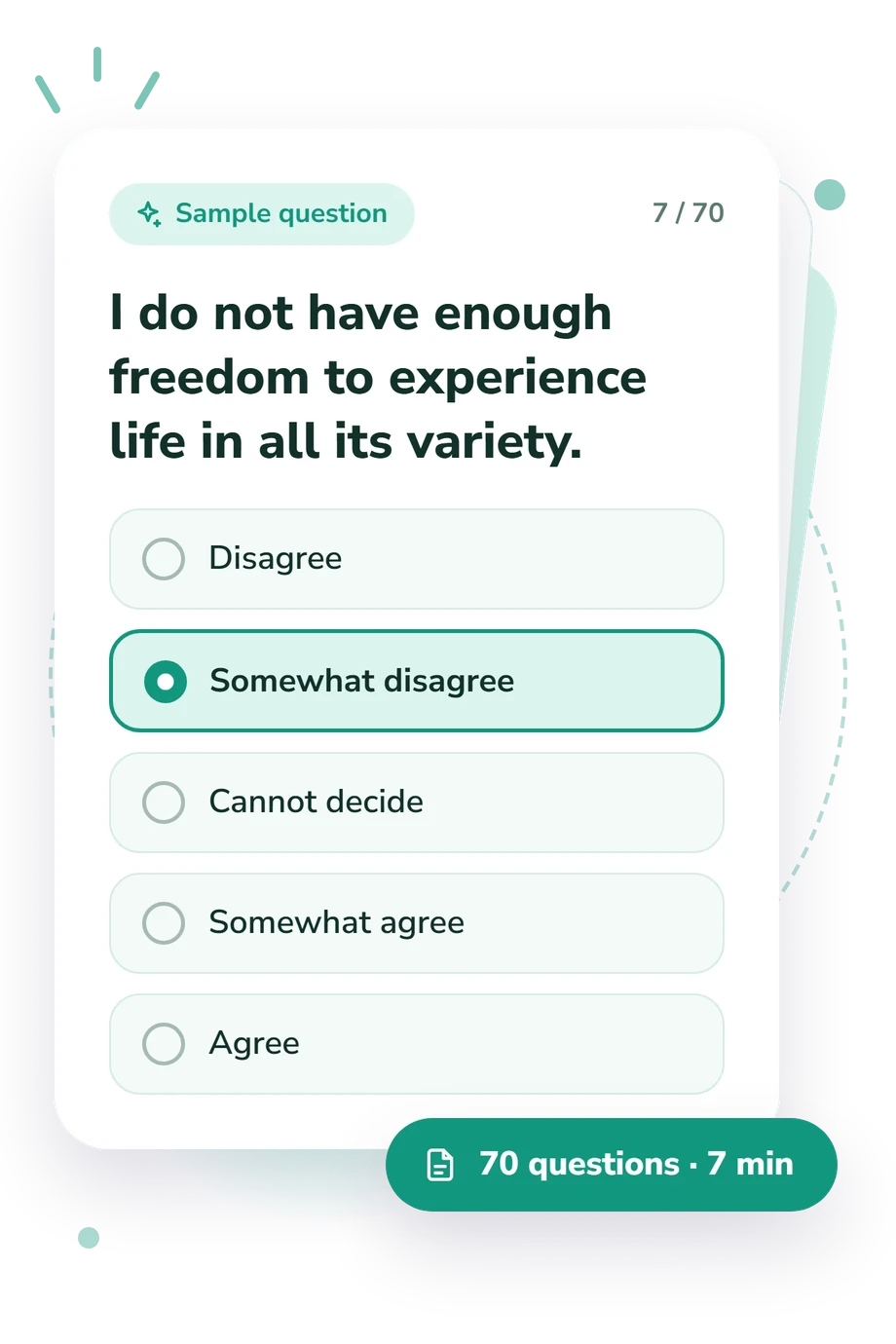
Example Questions From the Test
- Disagree
- Somewhat disagree
- Not sure
- Somewhat agree
- Agree
- Disagree
- Somewhat disagree
- Neither agree nor disagree
- Somewhat agree
- Agree
- Disagree
- Somewhat disagree
- Neither agree nor disagree
- Somewhat agree
- Agree
Escapism Severity Scale Test - Description and methodology of the test
People who notice retreat into fantasy, absorbing activities, or imagined alternatives may use this questionnaire to examine how those patterns relate to coping and everyday adaptation. The Escapism Severity Scale Test offers a structured profile instead of a single label, making it suitable for self-reflection when immersion, divided views of social reality, dissatisfaction, or avoidance feels relevant. Completing an escapism assessment helps you understand which tendencies matter most.
What This Assessment Measures
Withdrawal from immediate reality is treated as multidimensional. Someone taking an escapism test can use the profile to understand whether retreat is linked mainly with pleasurable absorption, alternative social outlooks, dissatisfaction, or avoidance and passivity. The four displayed dimensions are:
- Flow State (9-45) measures immersion and pleasure during enjoyable activity; high scores may signal excessive preoccupation. Low immersion 9-21; Moderate immersion 22-33; High immersion 34-45.
- Alternative Social Reality (12-60) measures retreatist, negativistic, and utopian attitudes with divided actual and imagined domains. Low 12-27; Moderate 28-43; High 44-60.
- Dissatisfaction and Avoidance (14-70) measures inner conflict, dissatisfaction, problem avoidance, and passivity. Low 14-32; Moderate 33-51; High 52-70.
- Escapism Severity (35-175) measures withdrawal from reality. Low 35-89; Moderate (normative) 90-114; High (excessive) 115-175.
Methodology and Evidence Base
In this self-report, each statement uses a five-point agreement scale from Disagree to Agree, with a middle option for uncertainty. The items address absorption in enjoyable activity, imagined or divided realities, negative reactions to ordinary life, and turning away from problems. Responses produce totals, but their ranges do not reveal whether items are weighted or reverse-scored; a formula should not be inferred.
Methodologically, the escapism questionnaire is consistent with Escapism Methodology (Savchenko et al., 2016), not the published method itself. The framework provides construct-level context, not validation or standardisation of this version. Teslavskaia and Savchenko (2019) examined links between escapism, life quality, and psychological adjustment; Teslavskaia et al. (2017) situated the construct within psychological research.
Interpret the profile across dimensions rather than treating an elevated total as a verdict. The interpretation treats moderate escapism as normative, associated with balance between self-expression and avoiding difficulties; excessive levels may accompany conflict and reduced adaptation. This version states no item-level scoring formula or published norms; stress, mood, self-awareness, and response style can shift answers. The result describes tendencies, not a fixed trait or diagnosis.
- Savchenko, T. N., Olkina, O. I., Belovol, E. V., Kardapoltseva, A. A., & Golovina, G. M. (2016). Development of a method for diagnosing tendencies towards escapism. In V. A. Barabanshchikov (Ed.), Procedures and Methods of Experimental Psychological Research (pp. 100-107). Moscow: Institute of Psychology of the Russian Academy of Sciences.
- Teslavskaia, O. I., & Savchenko, T. N. (2019). Subjective quality of life and psychological adaptation of individuals with low, normal and high level of escapism. Experimental Psychology (Russia), 12(2), 162-176. 10.17759/exppsy.2019120212
- Teslavskaia, O. I., Kardapoltseva, A. A., Belovol, E. V., & Savchenko, T. N. (2017). Escapism as a research subject in contemporary scientific psychology. Psychological Journal, 38(6), 52-64. 10.7868/S0205959217060058
Updated: