
Brief Self-Control Scale (BSCS) Test
How the Scales are Structured
Who Usually Takes This Test?
See How You Compare
Below is a preview of how scores are typically distributed across each scale.
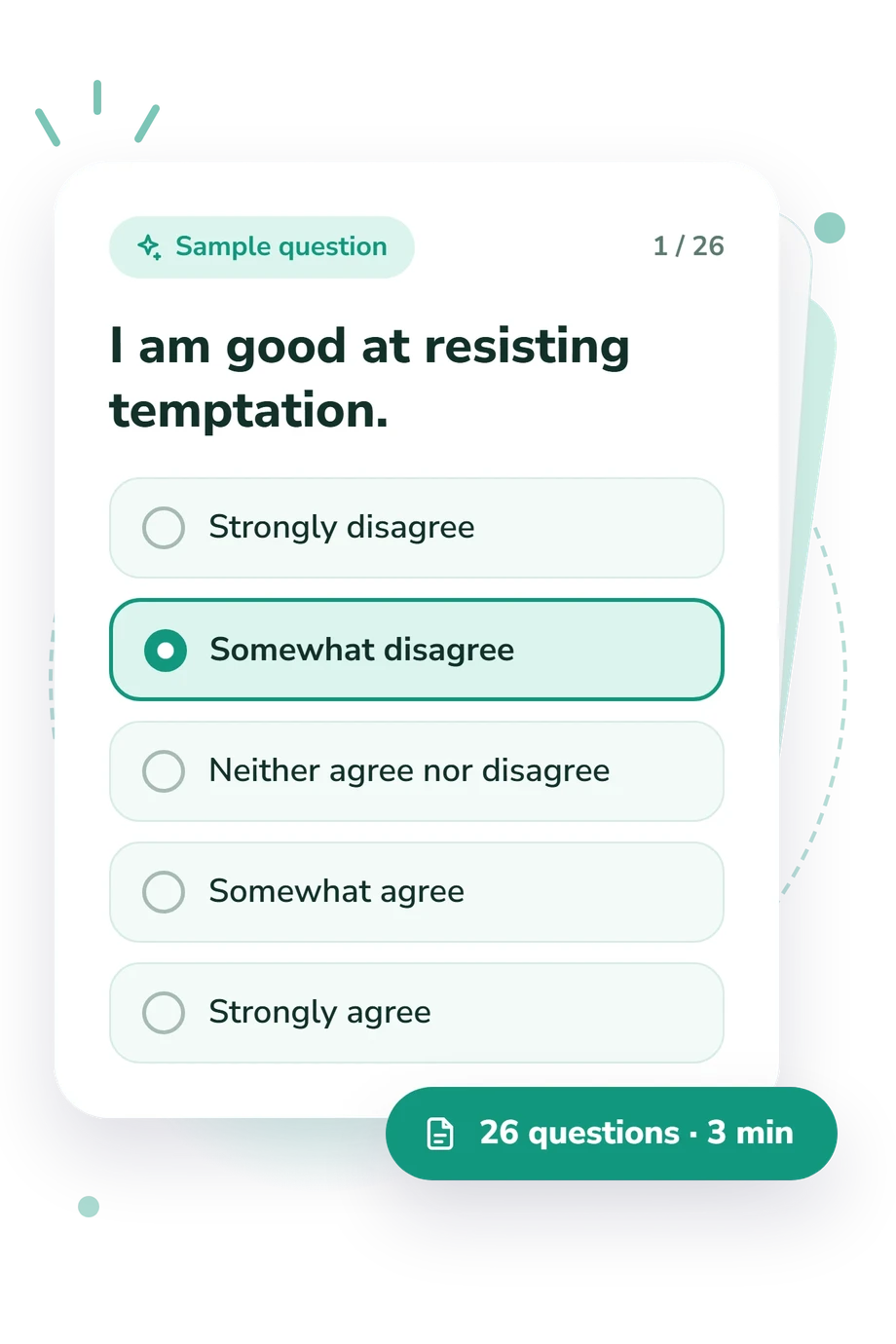
Example Questions From the Test
- Strongly disagree
- Disagree
- Neither agree nor disagree
- Agree
- Strongly agree
- Strongly disagree
- Disagree
- Neither agree nor disagree
- Agree
- Strongly agree
- Strongly disagree
- Somewhat disagree
- Neither agree nor disagree
- Somewhat agree
- Strongly agree
Brief Self-Control Scale (BSCS) Test - Description and methodology of the test
People who want to understand how they manage impulses, distractions, habits, and long-term commitments can use the Brief Self-Control Scale (BSCS) Test as a focused self-reflection tool. This self-control assessment summarizes a general tendency toward deliberate, goal-directed behavior and shows whether everyday choices more often support or interfere with persistence, discipline, and constructive coping.
What This Assessment Explores
The questionnaire treats self-control as a broad pattern of regulating behavior while pursuing valued outcomes. Its statements address temptation, habits, distraction, impulsive remarks, concentration, and sustained effort toward long-term goals. It suits anyone seeking a structured view of everyday regulation, rather than a judgment about one decision.
As a self-control questionnaire, its items cover these everyday expressions within the overall score:
- Temptation resistance shows how readily someone declines harmful or distracting choices.
- Discipline and habits reflect consistency when impulses compete with intentions.
- Concentration and persistence show whether effort survives competing rewards.
- Planning and goal pursuit connect present actions with longer-term aims.
The result contains one scale, Self-Control (13–65), covering goal-directedness, organization, persistence, and constructive coping. Bands are Low (13–27), Moderate (28–45), and High (46–65); higher scores indicate stronger overall self-control.
Methodology and Scientific Basis
Each statement uses a five-point agreement format, from Strongly disagree to Strongly agree, and asks about usual behavior, including temptation, habits, concentration, and long-term goals. The displayed result is a single total; the numerical range alone does not show how each answer contributes.
The reference instrument is the Brief Self-Control Scale (Tangney et al., 2004), a published measure of dispositional self-control. This online presentation uses its 13-item content, while psychometric evidence for the published BSCS does not independently establish this online presentation. The displayed output is one overall self-control score.
Evidence from the 13-item BSCS supports a broad interpretation. Lindner et al. (2015) found that narrower facets did not clearly improve prediction, supporting use of the total score as a broad estimate.
Because the result is self-reported, it can reflect self-awareness, social desirability, and current circumstances as well as habitual regulation. The displayed bands organize this questionnaire’s output; they are not universal clinical norms or evidence of a disorder.
- Tangney, J. P., Baumeister, R. F., & Boone, A. L. (2004). High self-control predicts good adjustment, less pathology, better grades, and interpersonal success. Journal of Personality, 72(2), 271–324. 10.1111/j.0022-3506.2004.00263.x
- Manapat, P. D., Edwards, M. C., MacKinnon, D. P., Poldrack, R. A., & Marsch, L. A. (2021). A psychometric analysis of the Brief Self-Control Scale. Assessment, 28(2), 395–412. 10.1177/1073191119890021
- Lindner, C., Nagy, G., & Retelsdorf, J. (2015). The dimensionality of the Brief Self-Control Scale—An evaluation of unidimensional and multidimensional applications. Personality and Individual Differences, 86, 465–473. 10.1016/j.paid.2015.07.006
Updated: