
Eysenck Personality Inventory (EPI) Test
How the Scales are Structured
Who Usually Takes This Test?
See How You Compare
Below is a preview of how scores are typically distributed across each scale.
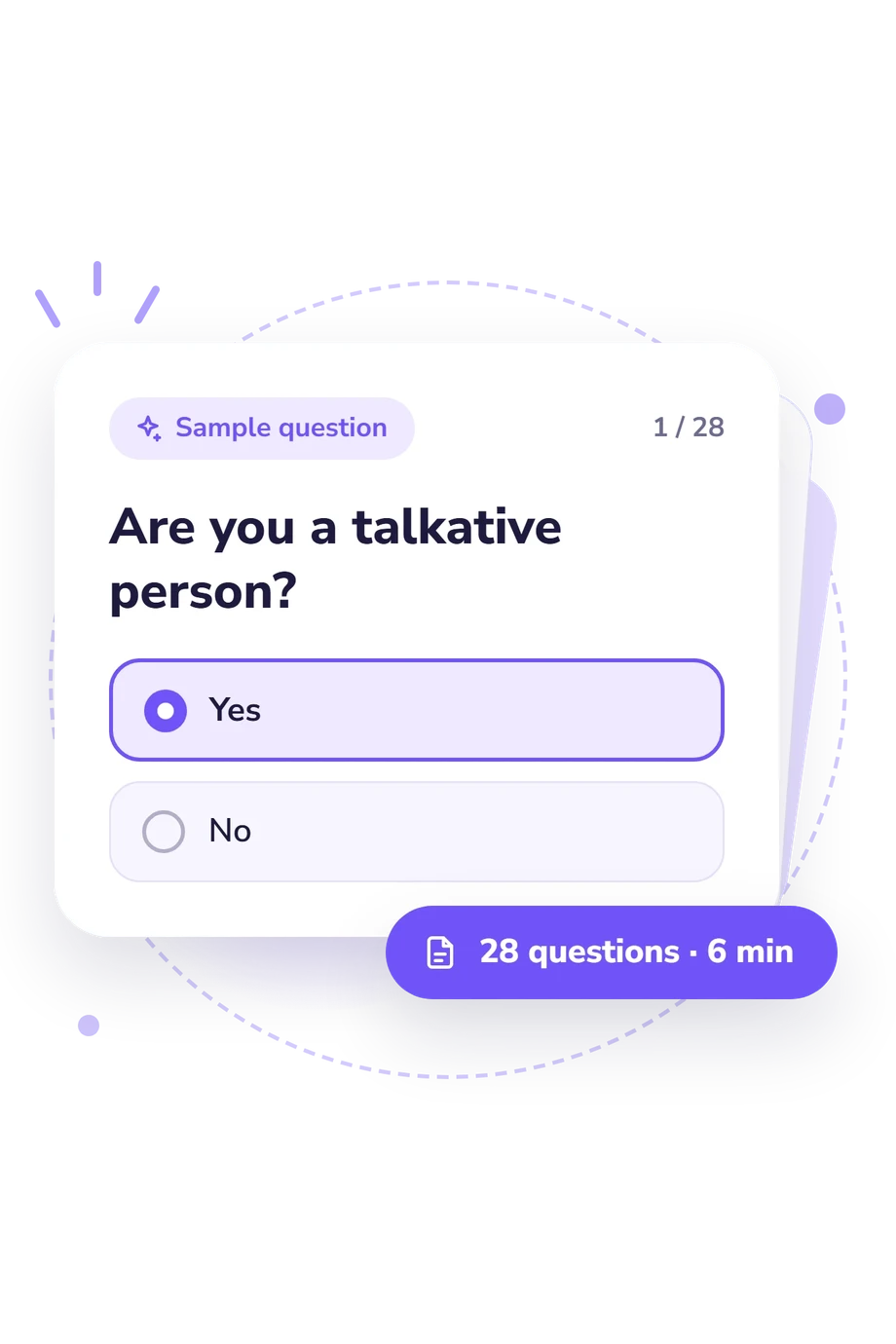
Example Questions From the Test
- Yes
- No
- Yes
- No
- Yes
- No
Eysenck Personality Inventory (EPI) Test - Description and methodology of the test
People who want a structured first look at temperament and everyday interpersonal style may find the Eysenck Personality Inventory (EPI) Test useful. It is designed for self-reflection around sociability, emotional stability, worry, stress vulnerability, unconventionality, and the candor of responding. As an Eysenck personality test, it can help you notice broad patterns in how you approach people, pressure, rules, and self-presentation.
What This Assessment Explores
The questions describe ordinary social, emotional, moral, and self-evaluative situations. Across this Eysenck personality questionnaire, the profile organizes responses into four dimensions:
- Lie Scale (0–7) indicates whether answers may be shaped by social desirability: Candid responding 0–3, Some desirability bias 4–4, or High desirability bias 5–7.
- Psychoticism (0–7) reflects independence, originality, and unconventional behavior; higher results may combine individuality with social-adjustment difficulty, whereas lower results are more conforming and traditional. The bands are Low 0–3 and High 4–7.
- Neuroticism (0–7) assesses emotional stability and worry; Low 0–2, Moderate 3–5, and High 6–7 indicate increasing emotional vulnerability.
- Extraversion (0–7) measures sociability, activity, and engagement with others; Low 0–2, Moderate 3–5, and High 6–7 describe a more reserved or outgoing pattern.
Taken together, the profile highlights interpersonal behavior, stress sensitivity, individuality, and response candor without reducing personality to one label.
Methodology and Evidence Base
The format is a brief self-report questionnaire with clear Yes/No choices. Items cover talkativeness, group behavior, guilt, worry, politeness, loneliness, empathy, risk, and reactions to mistakes. Responses are combined into separate dimension scores and read against the displayed bands rather than treated as one total personality score.
Although it carries the EPI label, the 28-item, four-scale structure corresponds to the brief Eysenck Personality Questionnaire (EPQ/LOA-K), so this online version is an adaptation of that format. The Eysenck and Eysenck manual supplies the broader Eysenck model, while Slobodskaya, Knyazev, and Safronova describe the brief form; Barrett and colleagues examined factorial similarity across 34 countries. This brief Eysenck questionnaire presents the model in a compact online format.
Answers may shift with current mood, self-image, memory, and willingness to admit socially undesirable behavior. Standardization or population norms are not established for this online version, so the displayed bands should be read as descriptive guides, not clinical thresholds; the profile is best used to identify recurring patterns and frame self-reflection rather than to make a diagnosis.
- Slobodskaya, E. R., Knyazev, G. G., and Safronova, M. V. (2006). A Brief Form of the Eysenck Personality Questionnaire (LOA-K) and Its Use for Assessing Adjustment and the Risk of Psychoactive Substance Use. Psychological Journal, 27(3), 94–105.
- Eysenck, H. J., and Eysenck, S. B. G. (1975). Manual of the Eysenck Personality Questionnaire (Junior and Adult). Hodder and Stoughton, London.
- Barrett, P. T., Petrides, K. V., Eysenck, S. B. G., and Eysenck, H. J. (1998). The Eysenck Personality Questionnaire: An Examination of the Factorial Similarity of P, E, N, and L Across 34 Countries. Personality and Individual Differences, 25(5), 805–819. 10.1016/S0191-8869(98)00026-9
Updated: