
Internet User Personality Virtualization Index Test
How the Scales are Structured
Who Usually Takes This Test?
See How You Compare
Below is a preview of how scores are typically distributed across each scale.
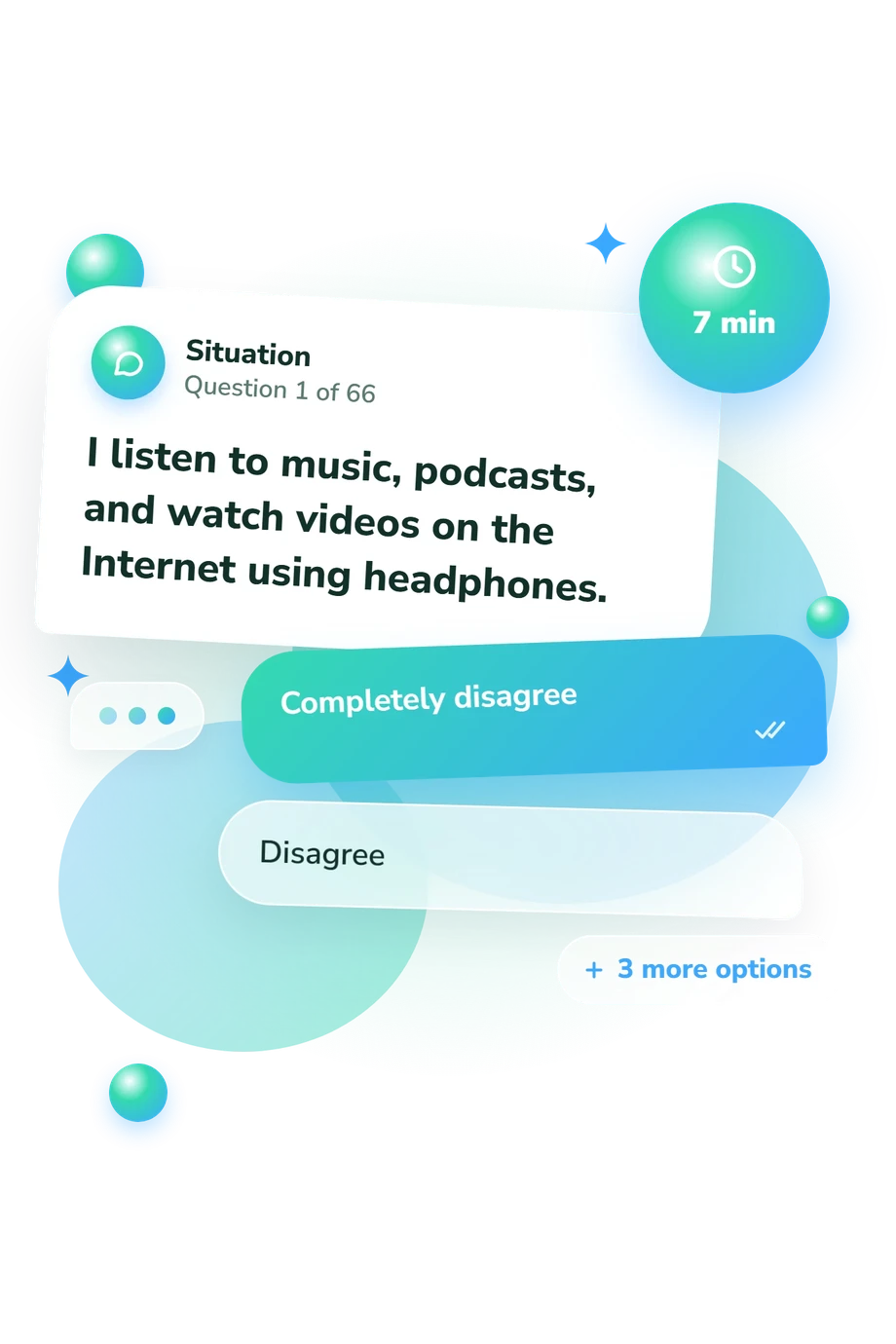
Example Questions From the Test
- Completely disagree
- Disagree
- Somewhere in between
- Agree
- Completely agree
- Completely disagree
- Disagree
- Somewhere in between
- Agree
- Completely agree
- Strongly disagree
- Disagree
- Neither agree nor disagree
- Agree
- Strongly agree
Internet User Personality Virtualization Index Test - Description and methodology of the test
People who want to understand how digital environments shape their feelings, attention, and social behavior can use this questionnaire as a structured self-reflection exercise. The Internet User Personality Virtualization Index Test translates everyday online experiences into a profile of participation, belonging, absorption, and personality integration. As a virtual personality assessment, it can help readers notice patterns without treating one score as a fixed identity.
What This Test Measures
The questionnaire examines experiences in virtual environments rather than judging internet use as good or bad. Items cover media, sharing, social contact, digital rules, emotion, and absorption that can reduce awareness of nearby events. This online engagement test suits people reflecting on digital habits.
These four result dimensions are:
- Involvement (11-55) measures participation, identification, and commitment: Low engagement 11-25; Moderate engagement 26-40; High engagement 41-55.
- Engagement (11-55) measures belonging, rule adaptation, and defending online values: Low engagement 11-25; Moderate engagement 26-40; High engagement 41-55.
- Immersion (11-55) measures sensory absorption, focus, real-world detachment, and distinction between real and virtual settings: Low immersion 11-25; Moderate immersion 26-40; High immersion 41-55.
- Virtualization Index (0-100) measures overall virtual integration and possible effects on self-perception and behavior: Low 0-33; Moderate 34-66; High 67-100.
Methodology and Evidence Base
Because this is an Internet use questionnaire, each statement uses a five-point agreement scale, from complete disagreement to complete agreement, and asks about ordinary online actions, emotional responses, social connection, attention, and perceived freedom. The questionnaire reports separate component results alongside the overall result, without explaining how scores combine or comparing their relative contribution.
The questionnaire is conceptually consistent with Internet User Personality Virtualization Index (Rasina, 2023), a published psychometric method that describes virtualization through involvement, engagement with the virtual environment, and immersion. The 2023 approbation study reported reliability and validity evidence from a student sample. A 2025 study examined the index alongside online activity, motives, communication, and instrumental competence, linking higher virtualization with more complex virtual-personality characteristics.
Those findings provide a relevant evidence base, but they do not create universal norms for every age, culture, or pattern of internet use. The result is also influenced by honest self-report, current circumstances, and self-awareness. It describes current tendencies rather than a diagnosis or complete account of personality, so a high or low profile should be interpreted in context.
- Rasina, E. O. (2023). Internet User Personality Virtualization Index: Psychometric Technique Approbation. SibScript, 25(2), 228-239. 10.21603/sibscript-2023-25-2-228-239
- Rasina, E. O. (2025). Virtualization Level as a Criterion for the Formation of an Internet User’s Virtual Personality. Scientific Result. Pedagogy and Psychology of Education, 11(1), 164-178. 10.18413/2313-8971-2025-11-1-0-12
Updated: