
Peritraumatic Distress Index Test
How the Scales are Structured
Who Usually Takes This Test?
See How You Compare
Below is a preview of how scores are typically distributed across each scale.
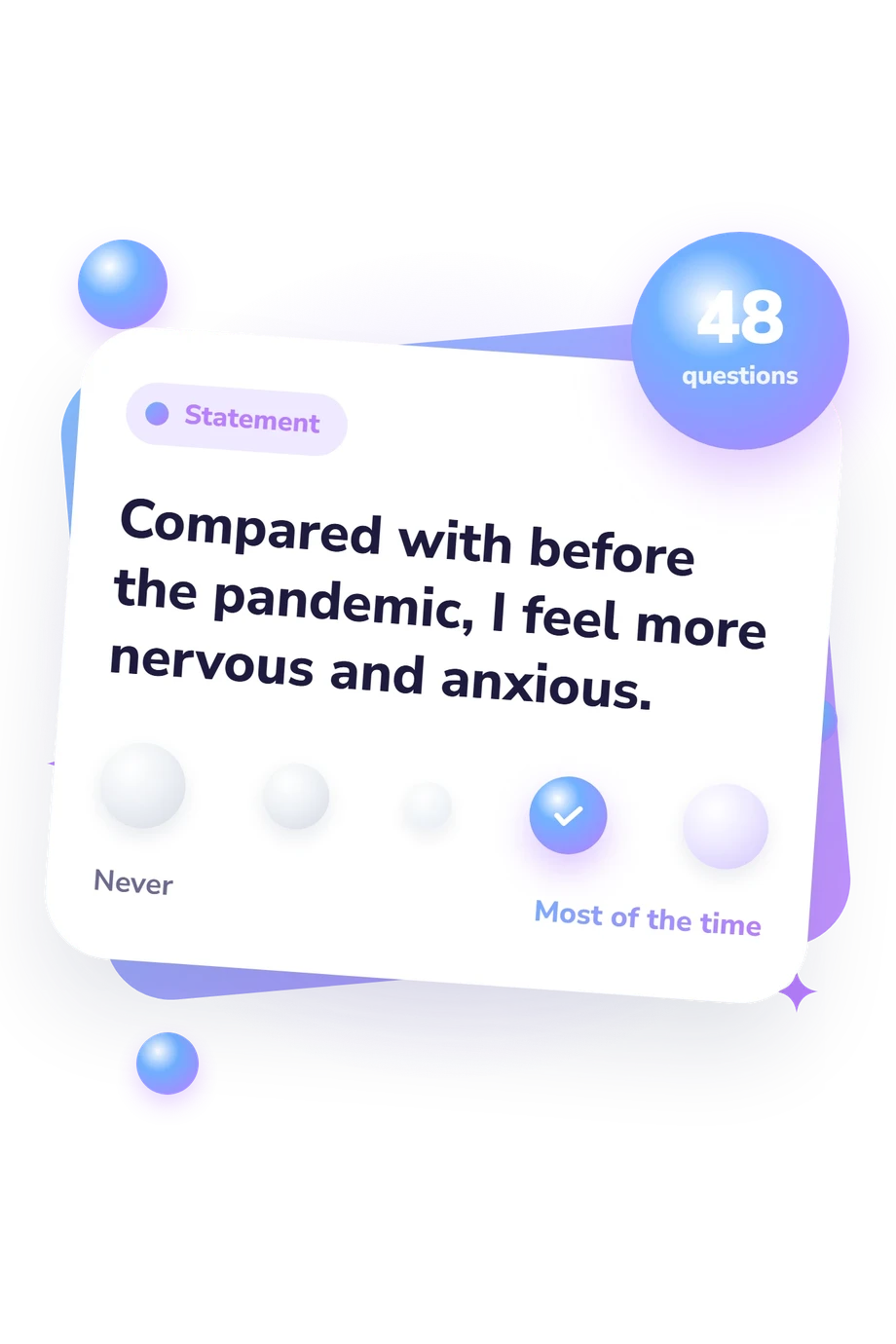
Example Questions From the Test
- Never
- Rarely
- Sometimes
- Often
- Most of the time
- Never
- Rarely
- Sometimes
- Often
- Most of the time
- Never
- Rarely
- Sometimes
- Often
- Most of the time
Peritraumatic Distress Index Test - Description and methodology of the test
People dealing with an infectious-disease outbreak or another acute public-health threat may use this self-report profile to examine current emotional, bodily, and interpersonal reactions. The Peritraumatic Distress Index Test presents separate dimensions that can help respondents decide which reactions deserve closer attention and interpret each result without treating the profile as a single undifferentiated score. It provides a peritraumatic distress assessment for focused review during a difficult period.
What This Assessment Explores
Questions address anxiety, helplessness, irritability, concentration, sleep, bodily discomfort, social unease, information worry, and empathy during an infectious-disease outbreak. As a peritraumatic stress questionnaire, it suits people reflecting on responses during or soon after an outbreak; the index addresses distress after traumatic or stressful events.
The reported scales are:
- Prosociality (0–32) shows readiness to support and care for others: Low 0–8; Moderate 9–17; High 18–32.
- Physiological Reactions (0–24) shows bodily stress severity: Low 0–6; Moderate 7–13; High 14–24.
- Psychological Overstrain (0–40) shows emotional and cognitive strain: Low strain 0–11; Moderate strain 12–21; High strain 22–40.
- Peritraumatic Distress Index (0–96) shows distress after traumatic or stressful events: Low distress 0–26; Moderate distress 27–76; High distress 77–96.
Separate levels describe dimensions; raw scores are not compared.
Methodology and Evidence Base
The self-report format asks how often experiences occurred, using five ordered choices from Never to Most of the time; some wording uses Occasionally as the second option. The questions cover emotional, cognitive, bodily, and interpersonal reactions.
Four scores are reported with displayed bands. Because no weighting formula is stated, do not infer how many points an answer contributes from a range; interpret each score within its own band rather than ranking raw scores across dimensions.
COVID-19 Peritraumatic Distress Index (Qiu et al., 2020) is the closest published counterpart, with Italian validation by Costantini and Mazzotti (2020). Brunet et al. (2001) proposed the original PDI, and Bunnell et al. (2018) examined its factor structure in traumatically injured patients. The online questionnaire is conceptually consistent with the named instruments but is not documented as a standardised adaptation carrying their norms, reliability estimates, or validated cutoffs.
A peritraumatic distress screening result should be read with the event, timing, and differences between dimensions. Context, memory, self-awareness, and willingness to disclose can influence self-report, so these bands are descriptive rather than universal clinical thresholds.
- Qiu J, Shen B, Zhao M, Wang Z, Xie B, Xu Y. A nationwide survey of psychological distress among Chinese people in the COVID-19 epidemic: implications and policy recommendations. General Psychiatry. 2020;33(2):e100213. 10.1136/gpsych-2020-100213
- Costantini A, Mazzotti E. Italian validation of CoViD-19 Peritraumatic Distress Index and preliminary data in a sample of general population. Rivista di Psichiatria. 2020;55(3):145-151. 10.1708/3382.33570
- Brunet A, Weiss DS, Metzler TJ, Best SR, Neylan TC, Rogers C, Fagan J, Marmar CR. The peritraumatic distress inventory: a proposed measure of PTSD criterion A2. American Journal of Psychiatry. 2001;158(9):1480-1485. 10.1176/appi.ajp.158.9.1480
- Bunnell BE, Davidson TM, Ruggiero KJ. The Peritraumatic Distress Inventory (PDI): Factor structure and predictive validity in traumatically injured patients admitted through a Level I trauma center. Journal of Anxiety Disorders. 2018;55:8-13. 10.1016/j.janxdis.2018.03.002
Updated: