
Brief Psychological Adaptation Scale (BPAS) Test
How the Scales are Structured
Who Usually Takes This Test?
See How You Compare
Below is a preview of how scores are typically distributed across each scale.
Example Questions From the Test
- Not at all
- Very rarely
- Rarely
- Sometimes
- Often
- Very often
- All the time
- Not at all
- Very rarely
- Rarely
- Sometimes
- Often
- Very often
- All the time
- Not at all
- Very rarely
- Rarely
- Sometimes
- Often
- Very often
- All the time
Brief Psychological Adaptation Scale (BPAS) Test - Description and methodology of the test
People adjusting to a new country often want a clearer way to notice how relocation is affecting daily life. The Brief Psychological Adaptation Scale (BPAS) Test organizes those recent experiences around emotional well-being, belonging, and satisfaction in the host country. This psychological adaptation questionnaire offers a focused starting point for personal reflection, helping readers decide which parts of their adjustment deserve closer attention.
What This Assessment Explores
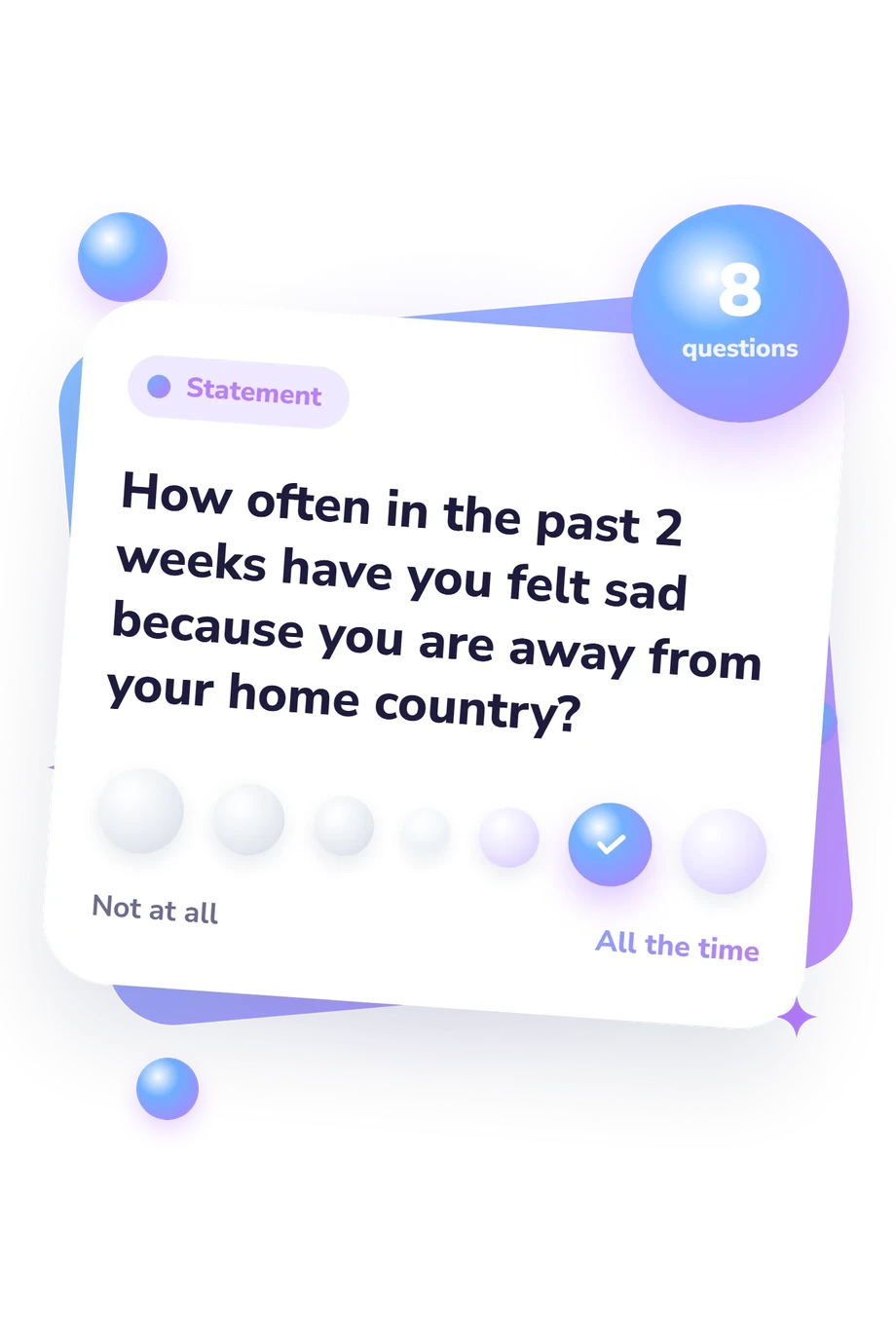
Questions cover the past two weeks in a host country, asking about inspiration, belonging, anxiety, homesickness, loneliness, frustration, and everyday satisfaction. Together, these items bring positive engagement and relocation strain into one view.
This questionnaire displays Psychological Adaptation (8–56), with Low adaptation (8–23), Moderate adaptation (24–40), and High adaptation (41–56). Higher scores indicate better adaptation, including emotional well-being and life satisfaction across psychological and sociocultural adjustment.
These are the thematic item groups:
- Belonging and cultural fit show how included you feel.
- Homesickness and connection to home show the pull of familiar people and places.
- Emotional strain shows how often anxiety, loneliness, sadness, and frustration occur.
- Everyday well-being shows whether life feels satisfying and inspiring.
As a host-country adjustment questionnaire, it suits people reflecting on life away from home and areas they want to understand.
Methodology and Evidence Base
Each item uses a seven-point frequency response, from Not at all to All the time. The format captures recent experience rather than a fixed personality trait, so answers may shift with current stress, support, and circumstances.
The BPAS, described by Demes and Geeraert (2014), is the closest published instrument to these themes. This online questionnaire is conceptually consistent with that work, not a verified adaptation, and should not be assumed to reproduce the published instrument's full administration or validation conditions.
The questionnaire produces the displayed result, but its recoding and item weighting are not specified, so individual item contributions cannot be determined.
Berry's framework treats adaptation as psychological and sociocultural, while Demes and Geeraert's 2015 longitudinal study shows that it can change during cultural transition. Published BPAS research reported reliability and cross-language evidence in large sojourner samples, but those findings do not establish norms for this online version.
Use this adaptation self-assessment as a snapshot of recent well-being. Mood, memory, self-awareness, and impression management can affect self-report, so the result describes the respondent's current perspective rather than a permanent characteristic.
- Demes, K. A., & Geeraert, N. (2014). Measures Matter: Scales for Adaptation, Cultural Distance, and Acculturation Orientation Revisited. Journal of Cross-Cultural Psychology, 45(1), 91–109. 10.1177/0022022113487590
- Demes, K. A., & Geeraert, N. (2015). The Highs and Lows of a Cultural Transition: A Longitudinal Analysis of Sojourner Stress and Adaptation Across 50 Countries. Journal of Personality and Social Psychology, 109(2), 316–337. 10.1037/pspp0000046
- Berry, J. W. (1997). Immigration, Acculturation, and Adaptation. Applied Psychology, 46(1), 5–34. 10.1111/j.1464-0597.1997.tb01087.x
Updated: