
Freudly+971 508685814hello@freudly.ai
Freudly
well-being

Psychological General Well-Being Index (PGWBI) Test
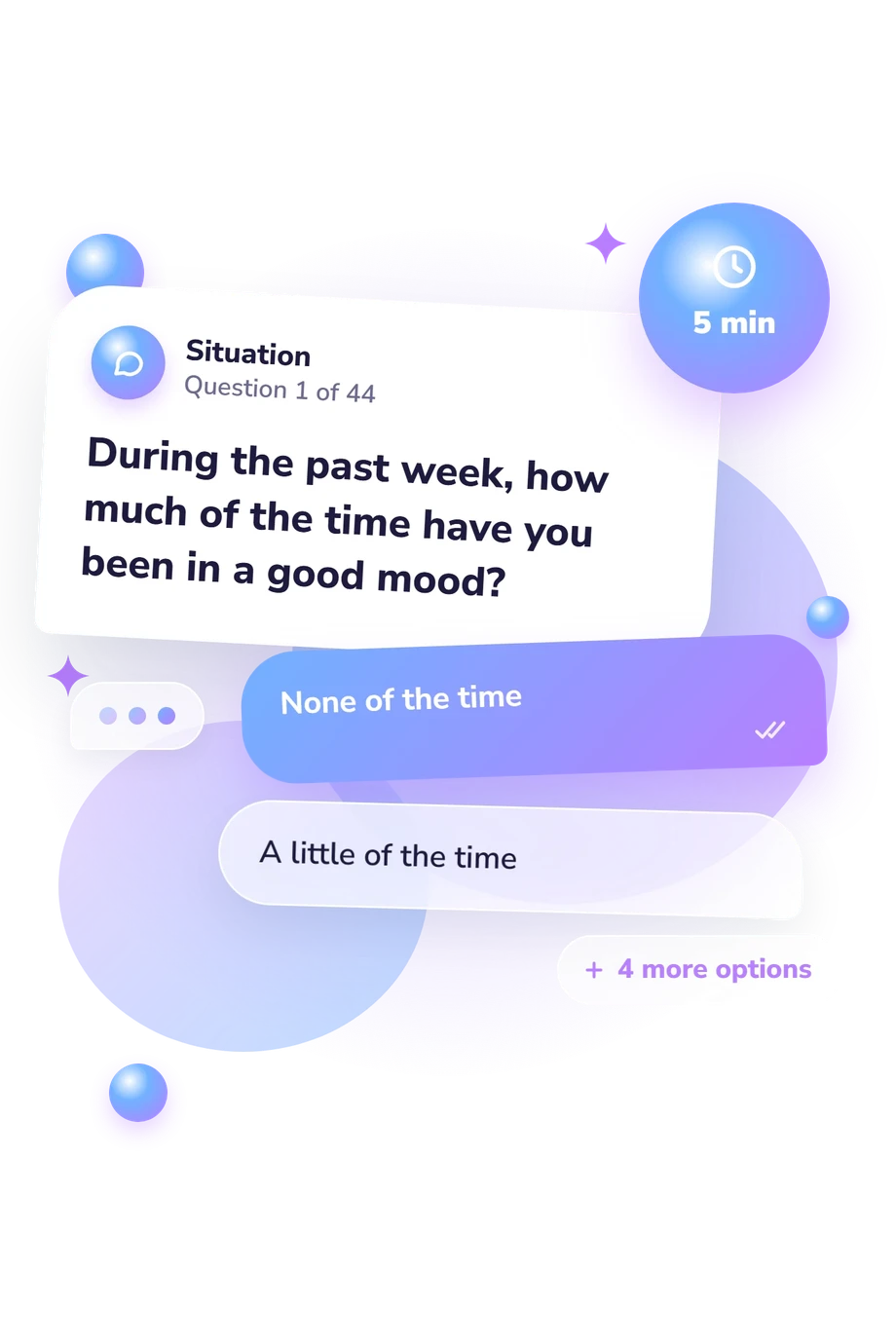
Take the online Psychological General Well-Being Index (PGWBI) Test - AI psychologist FreudlyYou can take Psychological General Well-Being Index (PGWBI) Testhere. Online version of a simple and accurate psychological test with interpretation.en
Understand your emotional well-being and inner state in about 5 minutes. This 22-item check-in captures key mood signals like anxiety and depression to support care and track change.
Start Online Test
Questions: 225 minutes
08:30
October 2, 2025
October 2, 2025
Material has been updated
October 2, 2025
Material has been published
15,303 views
1,201 completion
904 likes
Verified by Daniel Hall
Psychologist with 25 years of experience
Share
Scale Explorer

How the Scales are Structured

example score
14/20
Vitality (V)
Measures perceived vitality and available energy for daily activity and engagement.
Low energy
Moderate energy
High energy
06: Low energy | 713: Moderate energy | 1420: High energy
A score of 14 indicates high perceived life energy, suggesting a relatively strong sense of vigor and activity.
example score
12/20
Emotional Well-Being (EWB)
Measures positive emotional tone and life satisfaction as a component of overall psychological well-being.
Low
Moderate
High
06: Low | 713: Moderate | 1420: High
A score of 12 falls in the Moderate range, suggesting an overall average level of positive mood and life satisfaction with some room for improvement.
example score
6/15
General Health (GH)
Assesses your self-rated overall physical and mental well-being, where higher scores reflect better perceived health.
Low well-being
Moderate well-being
High well-being
05: Low well-being | 610: Moderate well-being | 1115: High well-being
A score of 6 falls in the Moderate well-being range, suggesting an average self-perceived overall health state with room for improvement.
example score
6/15
Depression (D)
Measures the severity of depressive experiences and low mood, where higher scores reflect fewer depressive symptoms.
Higher depressive symptoms
Moderate depressive symptoms
Lower depressive symptoms
05: Higher depressive symptoms | 610: Moderate depressive symptoms | 1115: Lower depressive symptoms
A score of 6 falls in the moderate depressive symptoms range, indicating a mid-level presence of low mood and depressive experiences on this scale.
example score
13/25
Anxiety (A)
This scale assesses the person’s subjective level of worry and tension, where higher scores reflect lower anxiety intensity.
Higher anxiety
Moderate anxiety
Lower anxiety
08: Higher anxiety | 916: Moderate anxiety | 1725: Lower anxiety
A score of 13 falls in the Moderate anxiety range, suggesting a moderate level of worry and tension at the time of assessment.
example score
48/110
General Psychological Well-Being Index (GPWBI)
Measures overall perceived psychological comfort and life satisfaction over recent experiences.
Low well-being
Moderate well-being
High well-being
055: Low well-being | 5680: Moderate well-being | 81110: High well-being
A score of 48 falls in the Low well-being range, suggesting reduced perceived psychological comfort and life satisfaction relative to higher scores on this scale.
example score
8/15
Self-Control (SC)
Measures how well a person can regulate emotions and behavior in daily life.
Low
Moderate
High
05: Low | 610: Moderate | 1115: High
A score of 8 falls in the Moderate range, suggesting a typical ability to manage emotions and impulses with occasional difficulty under stress.
Start Online Test
just completed the test
DATA-BASED USER COHORTS

Who Usually Takes This Test?

Stressed or burned-out adults
41%OF USERS
People juggling work, family, or major life changes take it to quickly gauge anxiety, mood, and overall emotional well-being.
People managing illness
34%OF USERS
Those living with chronic conditions or recovering from medical events use it to see how health issues are affecting their emotional state and sense of control.
Therapy and counseling clients
25%OF USERS
Individuals in psychological support use it to track changes in depression, tension, and self-satisfaction over time.
BASED ON AGGREGATED, ANONYMIZED DATA FROM TENS OF THOUSANDS OF FREUDLY USERS.
Benchmarking

See How You Compare

Once you complete the test, your results are compared with real-world data from people in your country.
Below is a preview of how scores are typically distributed across each scale.
Life Energy (LE)
Life Energy (LE)
Average
5.5
Normal range
38
min.
0
max.
20
This curve shows how scores are typically distributed.
Once you complete the test, your result will appear on the scale so you can see how you compare.
Emotional Well-being (EW)
Average
8
Normal range
4.511.4
min.
0
max.
20
This curve shows how scores are typically distributed.
Once you complete the test, your result will appear on the scale so you can see how you compare.
Overall Health (OH)
Overall Health (OH)
Average
5.2
Normal range
2.57.9
min.
0
max.
15
This curve shows how scores are typically distributed.
Once you complete the test, your result will appear on the scale so you can see how you compare.
Depression (D)
Depression (D)
Average
9.9
Normal range
7.312.5
min.
0
max.
15
This curve shows how scores are typically distributed.
Once you complete the test, your result will appear on the scale so you can see how you compare.
Anxiety (A)
Anxiety (A)
Average
7.9
Normal range
3.412.5
min.
0
max.
25
This curve shows how scores are typically distributed.
Once you complete the test, your result will appear on the scale so you can see how you compare.
Index of Overall Psychological Well-Being (IoOPW)
Average
56.3
Normal range
41.371.3
min.
0
max.
110
This curve shows how scores are typically distributed.
Once you complete the test, your result will appear on the scale so you can see how you compare.
Self-control (S)
Self-control (S)
Average
6.9
Normal range
4.39.5
min.
0
max.
15
This curve shows how scores are typically distributed.
Once you complete the test, your result will appear on the scale so you can see how you compare.
Featured On
SAMPLE QUESTIONS

Example Questions From the Test

Please answer the questions by rating your condition over the past week.
    • None of the time
    • A little of the time
    • Some of the time
    • A good bit of the time
    • Most of the time
    • All of the time
    • None of the time
    • A small part of the time
    • Some of the time
    • A significant part of the time
    • Most of the time
    • All of the time
    • None of the time
    • A brief period of time
    • Some of the time
    • A significant part of the time
    • Most of the time
    • All of the time
WHAT THE TEST MEASURES
About This Assessment
Index of General Psychological Well-Being, PGWBI Test

Psychological General Well-Being Index (PGWBI) Test - Symptoms and Signs

well-being
psychopathology

This self-report measure is designed to assess subjective psychological well-being and emotional comfort over a recent period. The Psychological General Well-Being Index (PGWBI) is commonly used in clinical and research settings to describe perceived distress and well-being in the context of stress, health conditions, or other life circumstances.

The instrument includes 22 items and typically takes about 5 minutes to complete. Items sample a range of affective and functional experiences (e.g., anxiety, depressed mood, perceived self-control, and general positive well-being), providing a brief profile of perceived psychological health.

In practice, the Psychological General Well-Being Index (PGWBI) can support screening and baseline characterization of well-being, and it may be repeated to monitor perceived change over time alongside other clinical information. It is attributed to Dupuy, H.; Revicki, D.

Author: Dupuy, H., Revicki, D.
Literature: Dupuy, H. J. The psychological general well-being (PGWB) index. In N. K. Wenger, M. E. Mattson, C. D. Furberg, & J. Elinson (Eds.), Assessment of quality of life in clinical trials of cardiovascular therapies. Le Jacq Publishing. 1984.
Popular tests
Comments
Leave a Comment