
Team Group Cohesion Index Test
How the Scales are Structured
Who Usually Takes This Test?
See How You Compare
Below is a preview of how scores are typically distributed across each scale.
Example Questions From the Test
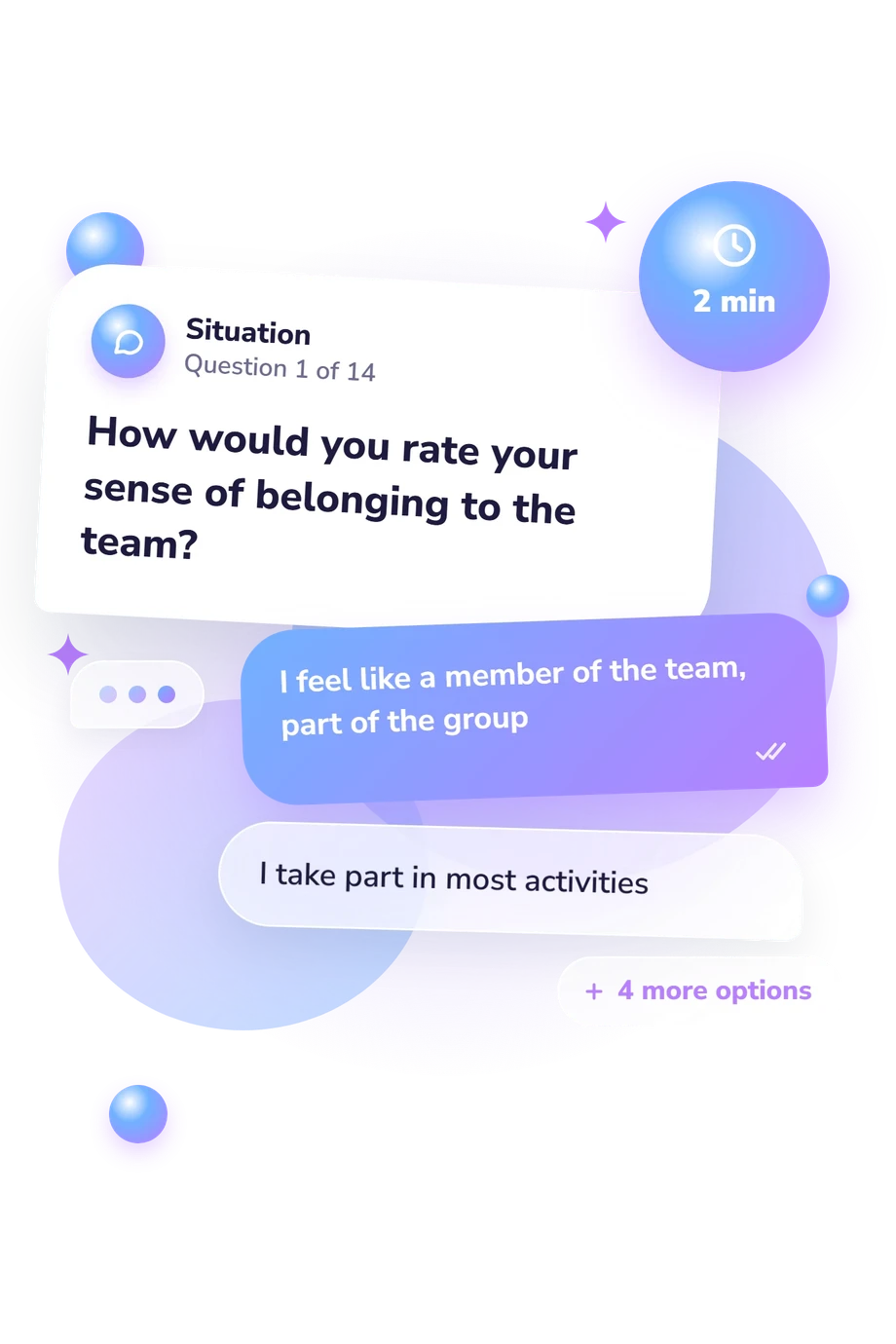
- I feel that I am a member of the team and part of the group
- I take part in most activities
- I take part in some activities but not in others
- I do not feel that I am a member of the team
- I train separately from the other team members
- I do not know / I am unsure
- Yes, I would very much like to transfer
- I would be more likely to transfer than to stay
- I do not see any difference
- I would be more likely to stay with my team
- I would very much like to stay with my team
- I do not know; it is hard to say
- Better than in most teams
- About the same as in most teams
- Worse than in most teams
- I do not know
Team Group Cohesion Index Test - Description and methodology of the test
Designed for team members considering communication and inclusion, this Team Group Cohesion Index Test helps one respondent identify experiences that may merit a team conversation. It draws attention to whether everyday interactions feel welcoming and coordinated. This team cohesion assessment organizes those reflections into a result that can support discussion with teammates or a coach.
What This Assessment Explores
This questionnaire reads team connection and relationships in training, competition, and shared activities. Belonging, willingness to stay, peer and coach relations, and work attitude contribute to the cohesion reading, not as separate dimensions. As a group cohesion questionnaire, it describes interpersonal favorability and team unity.
The result reflects:
- Belonging indicates whether you feel involved as a team member.
- Peer and coach relations show how interactions compare with other teams.
- Willingness to stay and work attitude add context about attachment and activity.
The Group Cohesion Index spans 7–25: Low cohesion 7–13, Moderate cohesion 14–19, and High cohesion 20–25. The catalogue interprets higher scores as more favorable relationships and unity; absence of isolation or rejection is part of that definition, not a separate finding. Cohesion may reflect performance, development, or practical aims, and an extreme rating can invite discussion.
Methodology and Scientific Basis
Each item uses an ordered statement or comparison, with an unsure option on several questions. The answers form the displayed total, but individual point values are not specified and should not be inferred from the score range. The resulting team cohesion score is descriptive and summarizes the respondent’s ratings.
The framework is conceptually consistent with the Seashore Group Cohesion Index, which emphasizes unity and attraction within a group. It also overlaps with Carron, Widmeyer, and Brawley’s (1985) sport-team perspective and Group Environment Questionnaire; Brawley, Carron, and Widmeyer (1987) examined that instrument’s validity. This questionnaire is not presented as a direct adaptation or standardized administration of either source.
Because responses are self-reported, the result represents one respondent’s perspective and may be shaped by current experiences or social desirability. Comparing results from several members can show shared patterns and differences, while the displayed bands remain descriptive catalogue categories rather than reported population norms.
- Seashore, S. E. (1954). Group Cohesiveness in the Industrial Work Group. Ann Arbor, MI: Survey Research Center, Institute for Social Research, University of Michigan.
- Carron, A. V., Widmeyer, W. N., & Brawley, L. R. (1985). The Development of an Instrument to Assess Cohesion in Sport Teams: The Group Environment Questionnaire. Journal of Sport Psychology, 7(3), 244–266. 10.1123/jsp.7.3.244
- Brawley, L. R., Carron, A. V., & Widmeyer, W. N. (1987). Assessing the Cohesion of Teams: Validity of the Group Environment Questionnaire. Journal of Sport Psychology, 9(3), 275–294. 10.1123/jsp.9.3.275
Updated: