
Brief Illness Perception Questionnaire (BIPQ) Test
How the Scales are Structured
Who Usually Takes This Test?
See How You Compare
Below is a preview of how scores are typically distributed across each scale.
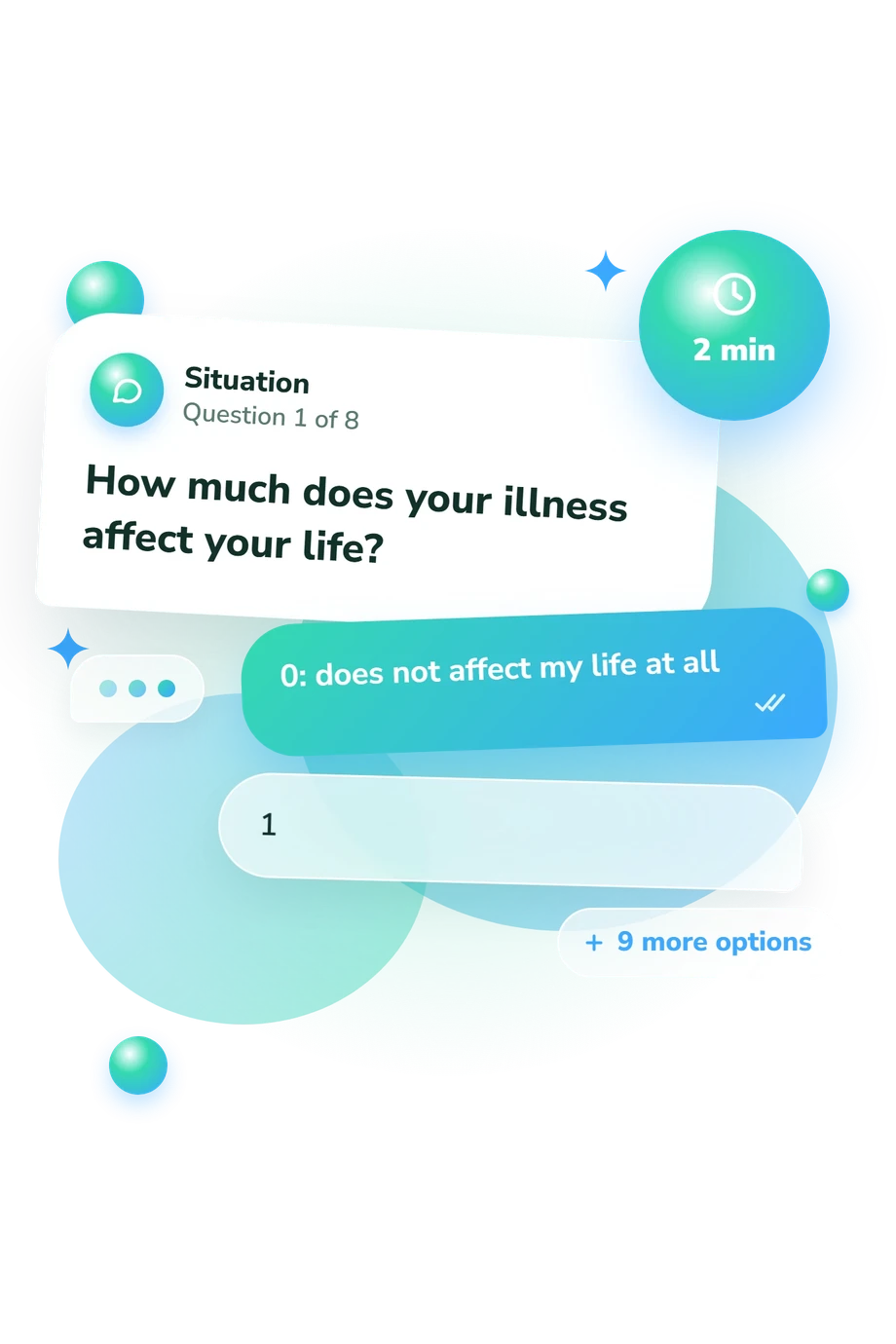
Example Questions From the Test
- 0: does not affect my life at all
- 1
- 2
- 3
- 4
- 5
- 6
- 7
- 8
- 9
- 10: affects my life extremely
- 0: a very short time
- 1
- 2
- 3
- 4
- 5
- 6
- 7
- 8
- 9
- 10: forever
- 0: I have absolutely no control
- 1
- 2
- 3
- 4
- 5
- 6
- 7
- 8
- 9
- 10: I have complete control
Brief Illness Perception Questionnaire (BIPQ) Test - Description and methodology of the test
People living with a health condition, or trying to understand their reactions to one, may use an illness perception questionnaire to organize thoughts about symptoms, consequences, control, and emotional impact. The Brief Illness Perception Questionnaire (BIPQ) Test offers a structured snapshot of these beliefs, helping respondents see whether their current view is centred more on manageability or perceived threat.
What This Assessment Explores
These questions examine the personal model of illness: what it changes, how long it may last, how symptoms feel, and how strongly it affects emotions. Control, treatment expectations, understanding, concern, and danger remain related but distinct appraisals.
For someone considering a BIPQ test, the result separates confidence in management from perceived threat. The three displayed dimensions are:
- Perceived Illness and Treatment Control (0–30) shows confidence that the condition can be managed, treatment can help, and its course can be understood; Low controllability 0–10, Moderate controllability 11–20, High controllability 21–30.
- Perceived Life-Threatening Nature of Illness (0–50) reflects perceived life threat, including consequences, timeline, identity, concern, and emotional response; Low threat 0–16, Moderate threat 17–33, High threat 34–50.
- Overall Illness Threat (0–80) summarizes perceived illness-related danger, concern, and anxiety; Low threat 0–26, Moderate threat 27–53, High threat 54–80.
Methodology and Scientific Basis
Every prompt uses a 0–10 response line with verbal anchors at both ends. The eight topics cover consequences, timeline, control, treatment, symptoms, concern, understanding, and emotional response, capturing both cognitive judgments and feelings.
The result reports the three displayed scores and their bands; each band describes current appraisal rather than medical severity. The questionnaire is conceptually consistent with Brief IPQ (Broadbent et al., 2006), while the Common-Sense Model of Self-Regulation (Leventhal, Phillips, and Burns, 2016) explains how illness beliefs and emotions can shape self-management.
Broadbent et al. (2015) reviewed the Brief IPQ across health contexts. The revised instrument (Moss-Morris et al., 2002) provides related background, but this online presentation should not be assumed to have identical reliability, norms, or validity to every published version.
As an illness perception test, it is a snapshot that may shift with symptoms, information, treatment, and support. Self-report also leaves scores open to current distress, recall, and response style; they do not determine prognosis or establish a diagnosis.
- Broadbent, E., Petrie, K. J., Main, J., & Weinman, J. (2006). The Brief Illness Perception Questionnaire. Journal of Psychosomatic Research, 60(6), 631–637. 10.1016/j.jpsychores.2005.10.020
- Broadbent, E., Wilkes, C., Koschwanez, H., Weinman, J., Norton, S., & Petrie, K. J. (2015). A systematic review and meta-analysis of the Brief Illness Perception Questionnaire. Psychology & Health, 30(11), 1361–1385. 10.1080/08870446.2015.1070851
- Moss-Morris, R., Weinman, J., Petrie, K. J., Horne, R., Cameron, L. D., & Buick, D. (2002). The revised illness perception questionnaire (IPQ-R). Psychology and Health, 17(1), 1–16. 10.1080/08870440290001494
- Leventhal, H., Phillips, L. A., & Burns, E. (2016). The Common-Sense Model of Self-Regulation (CSM): A dynamic framework for understanding illness self-management. Journal of Behavioral Medicine, 39(6), 935–946. 10.1007/s10865-016-9782-2
Updated: