
Student Sociocultural Safety Index Test
How the Scales are Structured
Who Usually Takes This Test?
See How You Compare
Below is a preview of how scores are typically distributed across each scale.
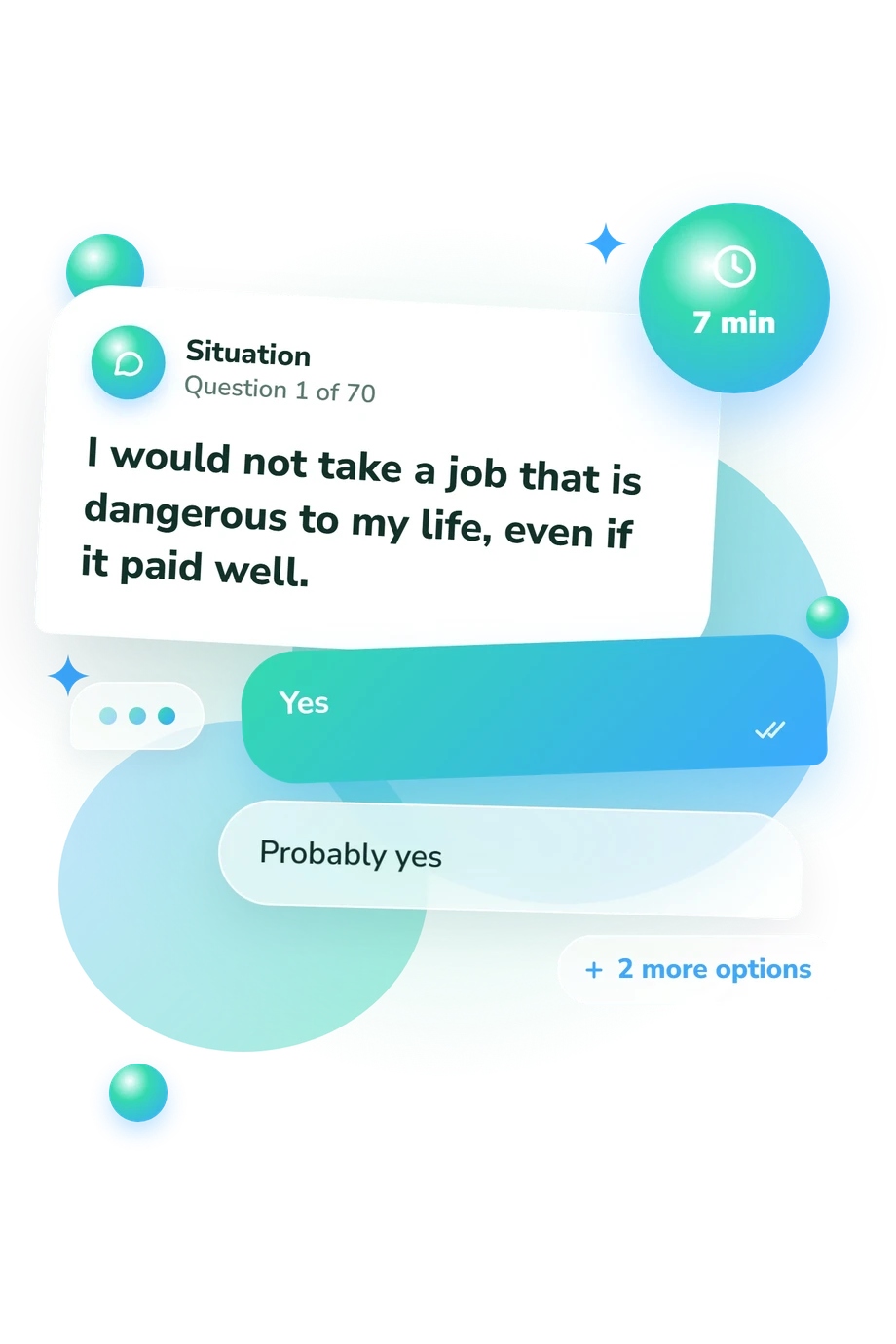
Example Questions From the Test
- Yes
- Probably yes
- Probably not
- No
- Yes
- Probably yes
- Probably no
- No
- Yes
- Probably yes
- Probably no
- No
Student Sociocultural Safety Index Test - Description and methodology of the test
For students and the adults supporting them, the Student Sociocultural Safety Index Test offers a structured way to examine experiences of belonging, communication, influence, and adjustment at school. It is suited to reflection when a learner's social experience feels difficult to interpret. A student sociocultural safety assessment can organize discussion around resilience, relationships, and possible areas of support.
What This Assessment Explores
The questionnaire examines a learner's relations with classmates, classroom expectations, online communication, and social influence. Themes include belonging, climate, self-blame, openness to difference, mediated contact, and confidence expressing views. Its school integration assessment examines integration alongside participation and perceived safety.
Four displayed scales describe the result:
- Virtual Autization (8-32) measures reduced social contact and depersonalized interaction; higher scores signal greater isolation risk. Low: 8-14; Elevated: 15-32.
- Disintegration (6-24) measures poor fit with educational demands and peers; higher scores signal adjustment risk. Low disintegration: 6-18; Elevated disintegration: 19-24.
- Vulnerability (7-28) measures passivity, suggestibility, and social sensitivity; higher scores signal greater social risk. Lower vulnerability: 7-20; Higher vulnerability: 21-28.
- Sociocultural Safety Index (35-140) measures protection and resilience at school; higher scores reflect favorable integration, resilience, and safety. Low safety: 35-69; Moderate safety: 70-104; High safety: 105-140.
Methodology and Scientific Basis
The representative statements use four-step agreement responses, usually Yes to No with intermediate choices. Results appear through the displayed dimensions, but the questionnaire does not state an item-by-item key or weighting scheme; readers should interpret reported ranges and bands as outputs, not infer points assigned to one response.
Conceptually, the questionnaire is consistent with the Adolescence Socio-Cultural Safety Index (Gilemkhanova, 2019), a related conceptual comparator. It is not that published instrument or a validated adaptation. Gilemkhanova's 2019 school-safety study describes related work, while the 2025 dataset documents a related student questionnaire; neither source establishes validation or population norms for this online version.
As a sociocultural safety profile, the result is most useful alongside the learner's circumstances and relationships. Self-report can be shaped by current mood, recent conflict, self-awareness, and willingness to answer openly. The bands should not be treated as a diagnosis or complete judgment of school wellbeing; context and broader assessment still matter.
- Gilemkhanova, E. N. (2019). Technique “Adolescence Socio-Cultural Safety Index.” Lomonosov Psychology Journal, 2, 164-183. 10.11621/vsp.2019.02.164
- Gilemkhanova, E. N. (2019). Socio-Psychological Safety of Schools in the Context of the Settlement Type and Socio-Economic Status of the Region. Behavioral Sciences, 9(12), 139. 10.3390/bs9120139
- Gilemkhanova, E. N. (2025). Questionnaire “Index of Sociocultural Safety of the School Student”: Dataset. RusPsyData Repository of Psychological Studies and Instruments, Moscow. 10.48612/MSUPE/rgu1-hrga-ukt2
Updated: