
How Your Organization Is Developing Test
How the Scales are Structured
Who Usually Takes This Test?
See How You Compare
Below is a preview of how scores are typically distributed across each scale.
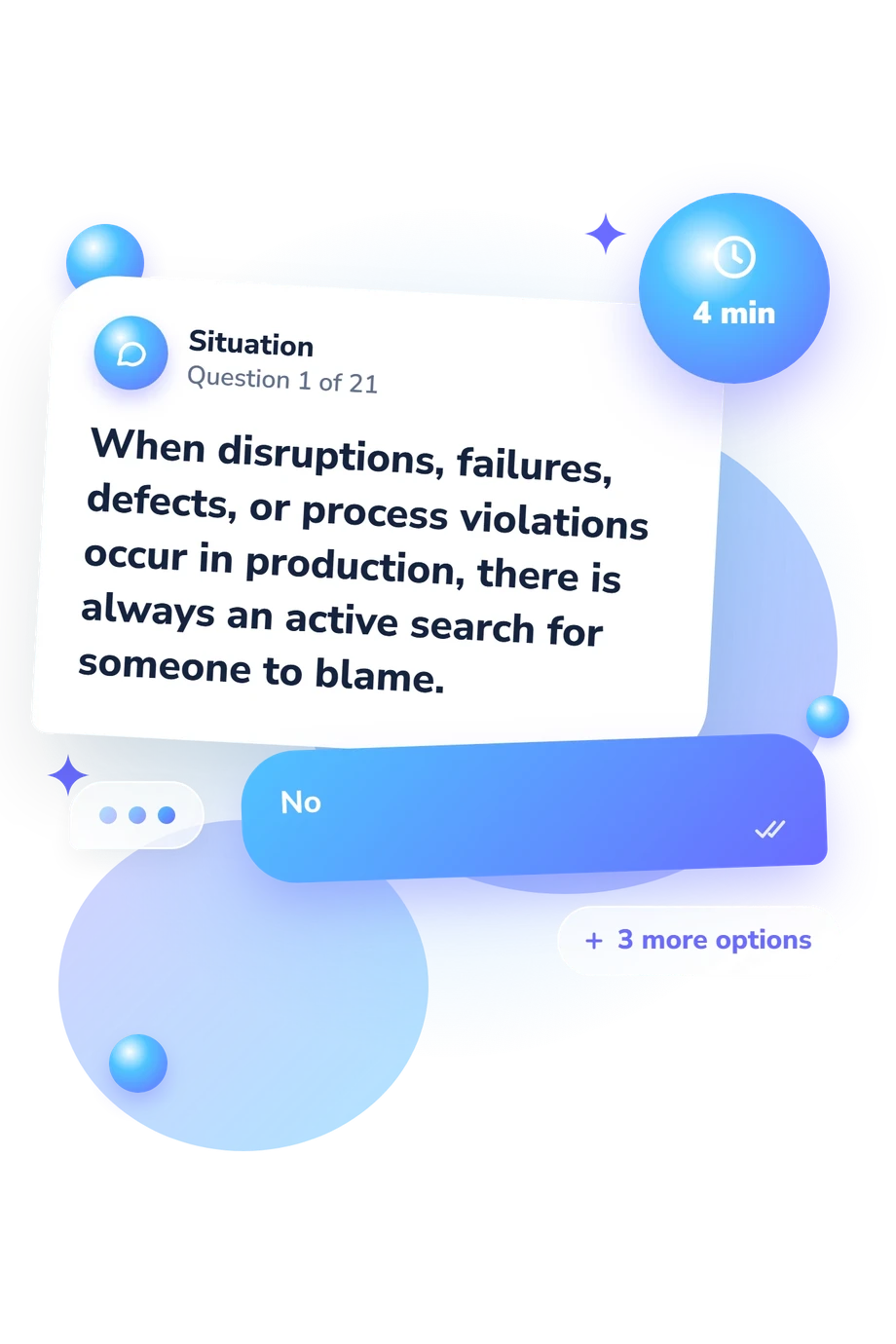
Example Questions From the Test
- No
- Probably no
- Probably yes
- Yes
- No
- Probably not
- Probably yes
- Yes
- No
- Probably no
- Probably yes
- Yes
How Your Organization Is Developing Test - Description and methodology of the test
Managers, team leads, consultants, and employees who want a structured view of workplace functioning can use the How Your Organization Is Developing Test to examine patterns shaping change, coordination, and accountability. This organizational development assessment is intended for reflection on shared practices: it shows where an organization may support experimentation, rely on continuity, or combine both in ways that affect future development.
What This Assessment Explores
The items describe organizational conditions rather than personality. They address authority, information access, responsibility for mistakes, conflict, feedback, initiative, identification with decisions, and shared goals. As an organizational culture questionnaire, it helps people examine how everyday arrangements enable or obstruct development.
The profile presents two dimensions:
- Creative-Innovative Style (0-42) indicates how strongly the organization leans toward experimentation and new ideas. Its bands are Low innovation focus (0-14), Balanced innovation (15-28), and High innovation drive (29-42). Higher levels may also bring instability and risk.
- Conservative Style (0-42) indicates consistency, proven methods, and risk minimization. Its bands are Low conservatism (0-14), Balanced conservatism (15-28), and High conservatism (29-42). Excessive levels may limit innovation.
Read together, these results show whether development may need more permission for experimentation, stronger continuity, or a more deliberate balance between the two.
Methodology and Scientific Basis
Each statement asks respondents to judge a workplace condition using four ordered choices, generally ranging from No or Probably no to Probably yes or Yes. Minor wording changes retain the same response direction.
Responses produce two totals shown through result bands. The score ranges identify totals, but they do not by themselves establish how each response contributes to a total. The displayed labels identify the interpretation attached to each range.
The questionnaire is independently written, not a translation or direct adaptation of the organizational culture framework discussed by Siegert and Lang (1985). That framework addresses leadership control, communication, responsibility, and resistance to change, offering conceptual comparison rather than authorship or scoring for this online test. Al-Khatib et al. (2022) examine conservative and innovative cultures and how their relationship with innovative performance can vary by job type; this study does not establish the online questionnaire's authorship, scoring, or validation.
Interpretation of this innovation and stability assessment should account for current organizational context, role, and self-report bias, including defensive or idealized answers. Results can guide discussion and questions for organizational review.
- Siegert, Werner, and Lucia Lang. Leading Without Conflict. Part 1. Sindelfingen: Expert Verlag, 1985. 122 pp. ISBN 3-88508-987-4.
- Siegert, Werner, and Lucia Lang. Leading Without Conflict. Abridged translation from German. Moscow: Ekonomika, 1990. 335 pp. ISBN 5-282-00109-8.
- Al-Khatib, Ayman Wael, Moayyad A. Al-Fawaeer, Mohammed Iqbal Alajlouni, and Firas A. Rifai. Conservative culture, innovative culture, and innovative performance: a multi-group analysis of the moderating role of the job type. International Journal of Innovation Science, 14(3-4), 675-692, 2022. 10.1108/IJIS-10-2020-0224
Updated: