
Freudly+971 508685814hello@freudly.ai
Freudly
religiosity

Religious Activity Assessment Test
Take the online Religious Activity Assessment Test - AI psychologist FreudlyYou can take Religious Activity Assessment Testhere. Online version of a simple and accurate psychological test with interpretation.en
Understand how someone experiences and expresses faith, from motivation to practice, in about 13 minutes. A 69 question profile supports research and clinical work by linking spiritual values to daily behavior.
Start Online Test
Questions: 6913 minutes
08:30
October 2, 2025
October 2, 2025
Material has been updated
October 2, 2025
Material has been published
16,696 views
1,135 completions
934 likes
Verified by Daniel Hall
Psychologist with 25 years of experience
Share
Scale Explorer

How the Scales are Structured

example score
6/10
Religious Behaviors (RB)
Measures how regularly and consciously a person engages in religious practices such as rituals, adherence to principles, and turning to God.
Low practice
Moderate practice
High practice
03: Low practice | 47: Moderate practice | 810: High practice
A score of 6 indicates a moderate level of religious practice, suggesting periodic participation and adherence that may vary by context or life circumstances.
example score
5/10
Religious vs. Natural Science Worldview (RvNSW)
Measures whether a person’s worldview is predominantly religious (theistic) versus natural-scientific, including how literally religious symbols are perceived.
Natural-scientific lean
Mixed / balanced
Religious (theistic) lean
04: Natural-scientific lean | 57: Mixed / balanced | 810: Religious (theistic) lean
A score of 5 suggests a mixed worldview in which religious meanings may be important while a natural-scientific understanding remains influential.
example score
4/10
Intrinsic and Extrinsic Religious Motivation Scale (IaERMS)
Measures whether a person’s religiosity is driven more by internal personal meaning and self-actualization or by external social and situational reasons.
External-leaning
Mixed motivation
Internal-leaning
03: External-leaning | 47: Mixed motivation | 810: Internal-leaning
A score of 4 indicates mixed religious motivation, where personal meaning is present but external or situational factors still play a noticeable role.
example score
8/10
Prereligious Experiences (PE)
Measures the frequency and intensity of transcendent-oriented experiences not centered on Theos, such as harmony with nature or altered states of consciousness.
Low
Moderate
High
03: Low | 47: Moderate | 810: High
A score of 8 indicates a high level of pre-religious experiences, suggesting these transcendent states are a prominent part of your lived experience.
example score
8/10
Sthenic (S)
Measures the intensity of energizing, uplifting religious experiences marked by strength, inspiration, and rapture.
Low
Moderate
High
04: Low | 57: Moderate | 810: High
A score of 8 falls in the High range, suggesting religious experiences are often accompanied by pronounced feelings of energy, inspiration, and uplift.
example score
2/10
Asthenic Experiences (AE)
Measures the intensity of asthenic religious experiences such as feelings of weakness, imperfection, guilt, and shame before the Divine.
Low
Moderate
High
03: Low | 47: Moderate | 810: High
A score of 2 indicates low asthenic religious experiences, with relatively infrequent or mild feelings of guilt, shame, or spiritual inadequacy.
example score
5/10
Overall Religious Experience (ORE)
Measures the breadth and richness of a person’s religious experiences, integrating asthenic, sthenic, and pre-religious components.
Limited
Moderate
Diverse
04: Limited | 57: Moderate | 810: Diverse
A score of 5 suggests a moderate variety of religious experiences, indicating some subjective engagement with transcendent meanings without a highly diverse experiential profile.
example score
4/10
Religious Activity Scale (RAS)
Measures the overall level of personal religiosity development by integrating internal experience, motivation, and religious practices.
Low
Moderate
High
03: Low | 47: Moderate | 810: High
A score of 4 indicates a moderate overall level of religiosity, suggesting some stable religious involvement and meaning without strong, pervasive expression across all areas.
Start Online Test
just completed the test
DATA-BASED USER COHORTS

Who Usually Takes This Test?

Practicing believers
41%OF USERS
People who actively participate in prayers, services, or rituals and want a clearer picture of their inner motivations and lived faith.
Counseling and clergy support seekers
34%OF USERS
Individuals exploring spiritual struggles, doubts, or value conflicts who need language to discuss their religiosity in counseling or pastoral guidance.
Researchers and students
25%OF USERS
Psychology, sociology, or religious-studies learners and professionals who need a structured way to assess religious activity for studies or assessments.
BASED ON AGGREGATED, ANONYMIZED DATA FROM TENS OF THOUSANDS OF FREUDLY USERS.
Benchmarking

See How You Compare

Once you complete the test, your results are compared with real-world data from people in your country.
Below is a preview of how scores are typically distributed across each scale.
Religious Practices Scale (RPS)
Average
6.9
Normal range
5.38.6
min.
0
max.
10
This curve shows how scores are typically distributed.
Once you complete the test, your result will appear on the scale so you can see how you compare.
Scale of Religious/Natural-Scientific Worldview (SoRW)
Average
3.6
Normal range
1.75.5
min.
0
max.
10
This curve shows how scores are typically distributed.
Once you complete the test, your result will appear on the scale so you can see how you compare.
Scale of Internal/External Religious Motivation (SoIRM)
Average
6.4
Normal range
4.87.9
min.
0
max.
10
This curve shows how scores are typically distributed.
Once you complete the test, your result will appear on the scale so you can see how you compare.
Pre-religious (P)
Pre-religious (P)
Average
6.3
Normal range
5.17.5
min.
0
max.
10
This curve shows how scores are typically distributed.
Once you complete the test, your result will appear on the scale so you can see how you compare.
Sthenic (S)
Sthenic (S)
Average
3.2
Normal range
1.74.7
min.
0
max.
10
This curve shows how scores are typically distributed.
Once you complete the test, your result will appear on the scale so you can see how you compare.
Asthenic (A)
Asthenic (A)
Average
4.2
Normal range
2.85.5
min.
0
max.
10
This curve shows how scores are typically distributed.
Once you complete the test, your result will appear on the scale so you can see how you compare.
Overall Indicator of Religious Experiences (OIoRE)
Average
3.4
Normal range
24.8
min.
0
max.
10
This curve shows how scores are typically distributed.
Once you complete the test, your result will appear on the scale so you can see how you compare.
Religious Activity Scale (RAS)
Average
5.8
Normal range
4.47.3
min.
0
max.
10
This curve shows how scores are typically distributed.
Once you complete the test, your result will appear on the scale so you can see how you compare.
Featured On
SAMPLE QUESTIONS

Example Questions From the Test

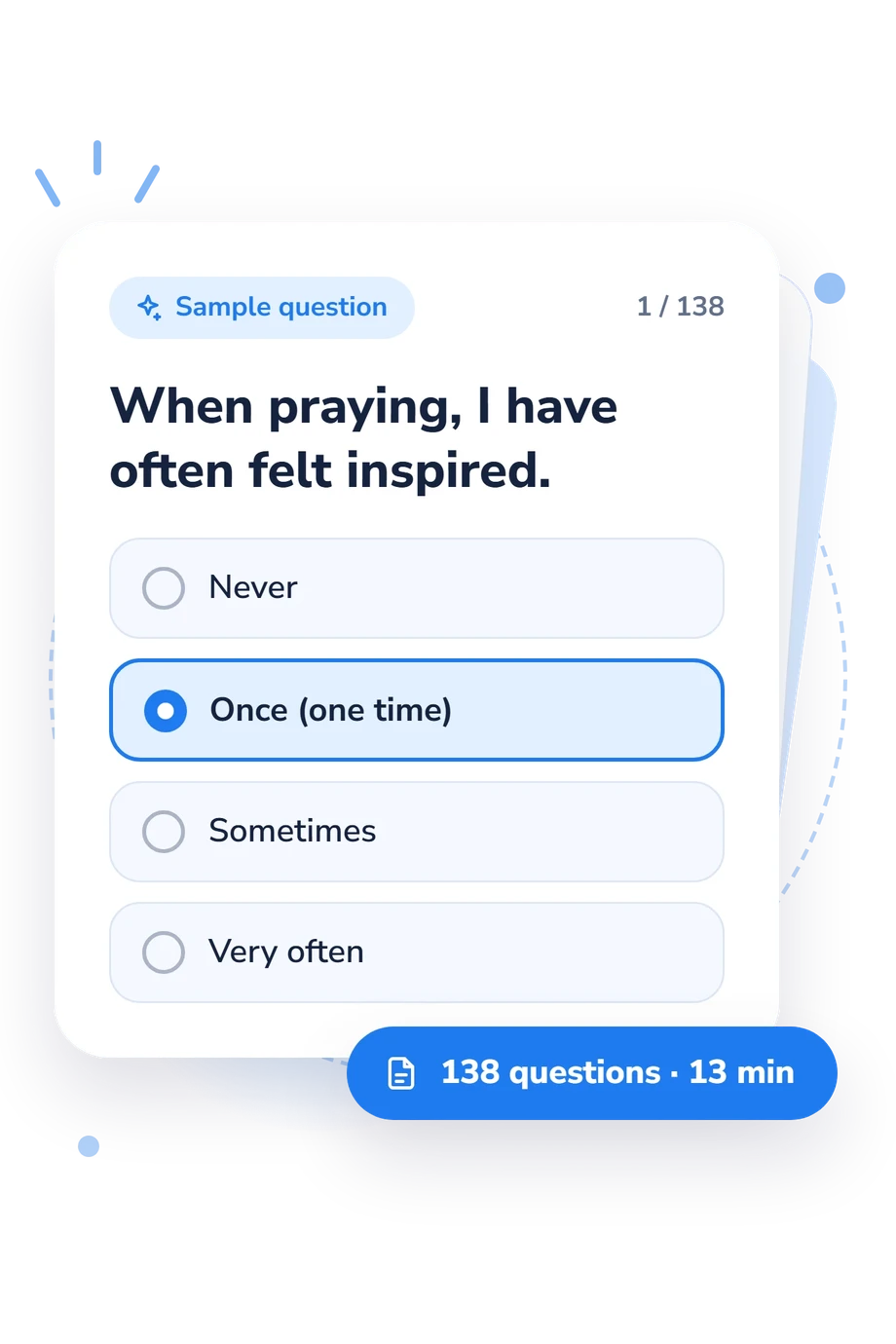
The questionnaire consists of three parts. Part 1. Below is a list of states that people may experience. For each state, compare it with your own experience and select the response that best reflects how often you have experienced it. Part 2. For each statement in the list, select the response option that is most appropriate for you: option “A” or option “B.” Part 3. Below is a list of questions, each with four response options (A, B, C, D). Select the option that is most appropriate for you.
    • Never
    • Once (one time)
    • Sometimes
    • Very often
    • Never
    • Once (one time)
    • Sometimes
    • Very often
    • Never
    • Once (one time)
    • Sometimes
    • Very often
WHAT THE TEST MEASURES
About This Assessment
Methodology for Measuring Religious Activity, MIRA Test

Religious Activity Assessment Test - Symptoms and Signs

religiosity

This measure is designed to evaluate multiple dimensions of religious involvement and related motivation. The Religious Activity Assessment can help clinicians and researchers characterize patterns of religious practice, internal experiences, and the personal meanings associated with spirituality.

The instrument includes 69 items and typically requires about 13 minutes to complete. It is intended to support a structured appraisal of religious activity and attitudes, including distinctions between intrinsic and extrinsic religious motivation and the extent to which religious engagement is expressed through private and public behaviors.

In clinical settings, results from the Religious Activity Assessment may be used to inform case conceptualization, clarify value- and faith-related coping resources, and guide discussion of how spiritual commitments interface with daily functioning. The measure is attributed to Kenneth I. Pargament.

Author: Kenneth I. Pargament
Literature: Hill, P. C., & Hood, R. W., Jr. Measures of religiosity. Religious Education Press. 1999.; Paloutzian, R. F., & Park, C. L. Handbook of the psychology of religion and spirituality. Guilford Press. 2005.
Popular tests
Comments
Leave a Comment