
Personal Belief in a Just World Scale Test
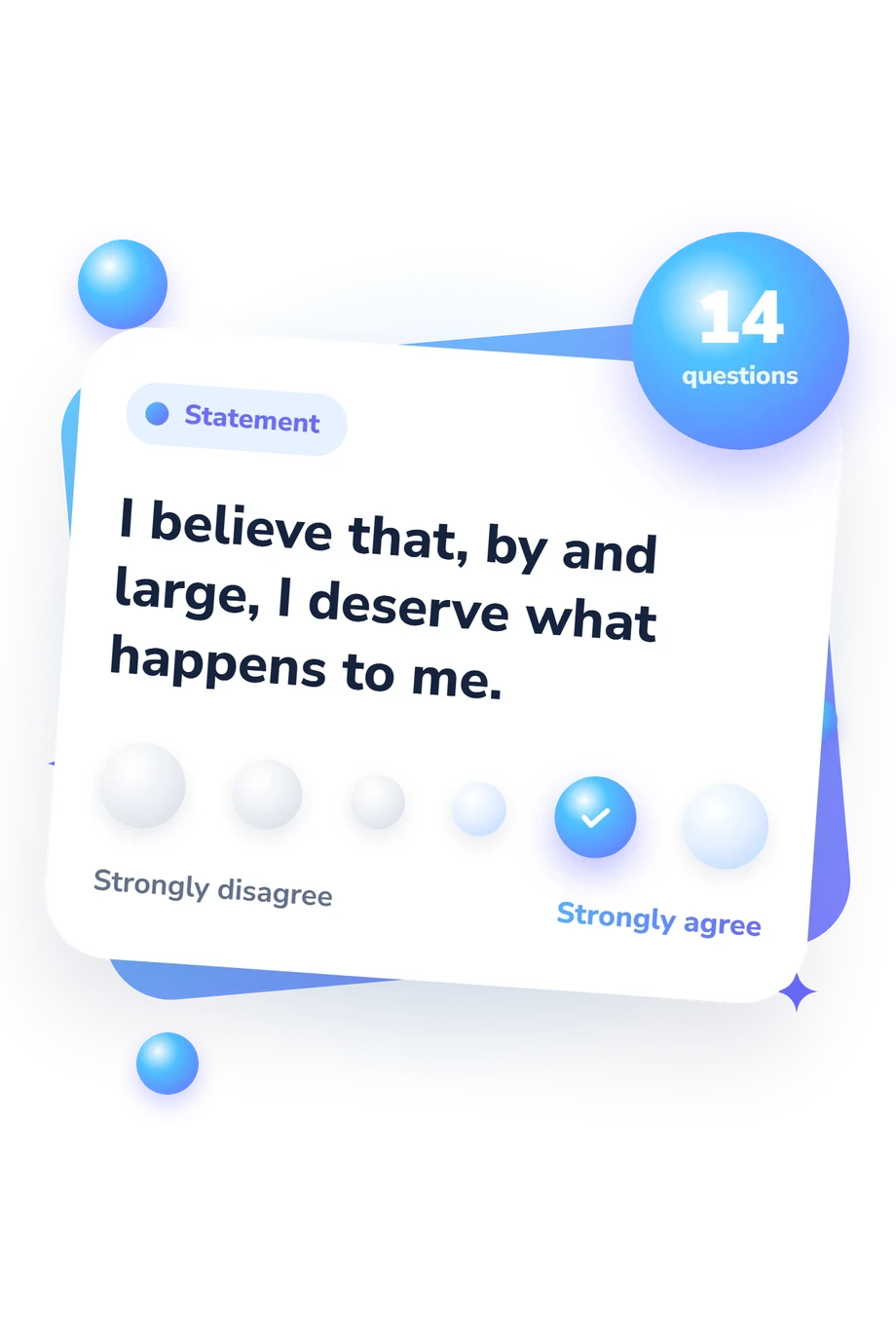
How the Scales are Structured
Who Usually Takes This Test?
See How You Compare
Below is a preview of how scores are typically distributed across each scale.
Example Questions From the Test
- Strongly disagree
- Disagree
- Somewhat disagree
- Somewhat agree
- Agree
- Strongly agree
- Strongly disagree
- Disagree
- Somewhat disagree
- Somewhat agree
- Agree
- Strongly agree
- Strongly disagree
- Disagree
- Somewhat disagree
- Somewhat agree
- Agree
- Strongly agree
Personal Belief in a Just World Scale Test - Description and methodology of the test
People who want to examine how they interpret fairness in their own lives may find this assessment useful. The Personal Belief in a Just World Scale Test focuses on whether outcomes, treatment, and important decisions seem deserved and fair. A personal belief in a just world questionnaire can offer a focused starting point for reflecting on expectations about consequences and justice.
What This Assessment Explores
Rather than measuring abstract opinions about society alone, the items ask how fairness appears in the respondent’s own life. They cover perceived deservingness, fair treatment, the connection between actions and consequences, and whether injustice seems unusual or common in personal decisions. The result supports self-reflection about expectations and interpretations of everyday events without treating one score as a fixed personality label.
The just world belief scale reports one dimension: Personal Belief in a Just World, scored from 1-6. Its result bands describe these levels:
- Skeptical 1-3.6 indicates that you question whether life treats you fairly or whether outcomes match what you deserve.
- Balanced 3.7-5 indicates that your view of personal fairness falls between strong confidence and marked doubt.
- Strong belief 5.1-6 indicates that you see events, treatment, and consequences in your life as fair and deserved.
Methodology and Scientific Basis
Each statement uses six agreement options, from Strongly disagree to Strongly agree. First-person wording makes this a self-report of perceived justice in the respondent’s own experience, not an observer rating. Responses are summarized on the displayed continuum: higher values indicate a stronger belief that the world is just toward oneself, while the bands organize interpretation without creating a clinical cutoff.
The construct is conceptually consistent with the Personal Belief in a Just World Scale (Dalbert, 1999), which separates fairness judgments about one’s own life from broader beliefs about justice for people generally. Melvin J. Lerner’s justice-motive theory explains the search for meaning and predictability in outcomes, and Dalbert’s 2001 work presents personal belief in justice as a resource during challenges.
For anyone taking this belief in a just world test, this version is a concise reflection tool, not a normed clinical measure. Reliability coefficients, population norms, and independent cutoffs are not established, so its result should not be equated with validation evidence. Stress, unfair experiences, and response tendencies can shape answers, making the score one perspective on your outlook.
- Dalbert, C. (1999). The world is more just for me than generally: About the personal belief in a just world scale's validity. Social Justice Research, 12(2), 79–98. 10.1023/A:1022091609047
- Dalbert, C. (2001). The justice motive as a personal resource: Dealing with challenges and critical life events. New York, NY: Kluwer Academic/Plenum Publishers. 10.1007/978-1-4757-3383-9
- Lerner, M. J. (1980). The belief in a just world: A fundamental delusion. New York, NY: Plenum Press. 10.1007/978-1-4899-0448-5
Updated: