
Index of Autonomous Functioning (IAF) Test
How the Scales are Structured
Who Usually Takes This Test?
See How You Compare
Below is a preview of how scores are typically distributed across each scale.
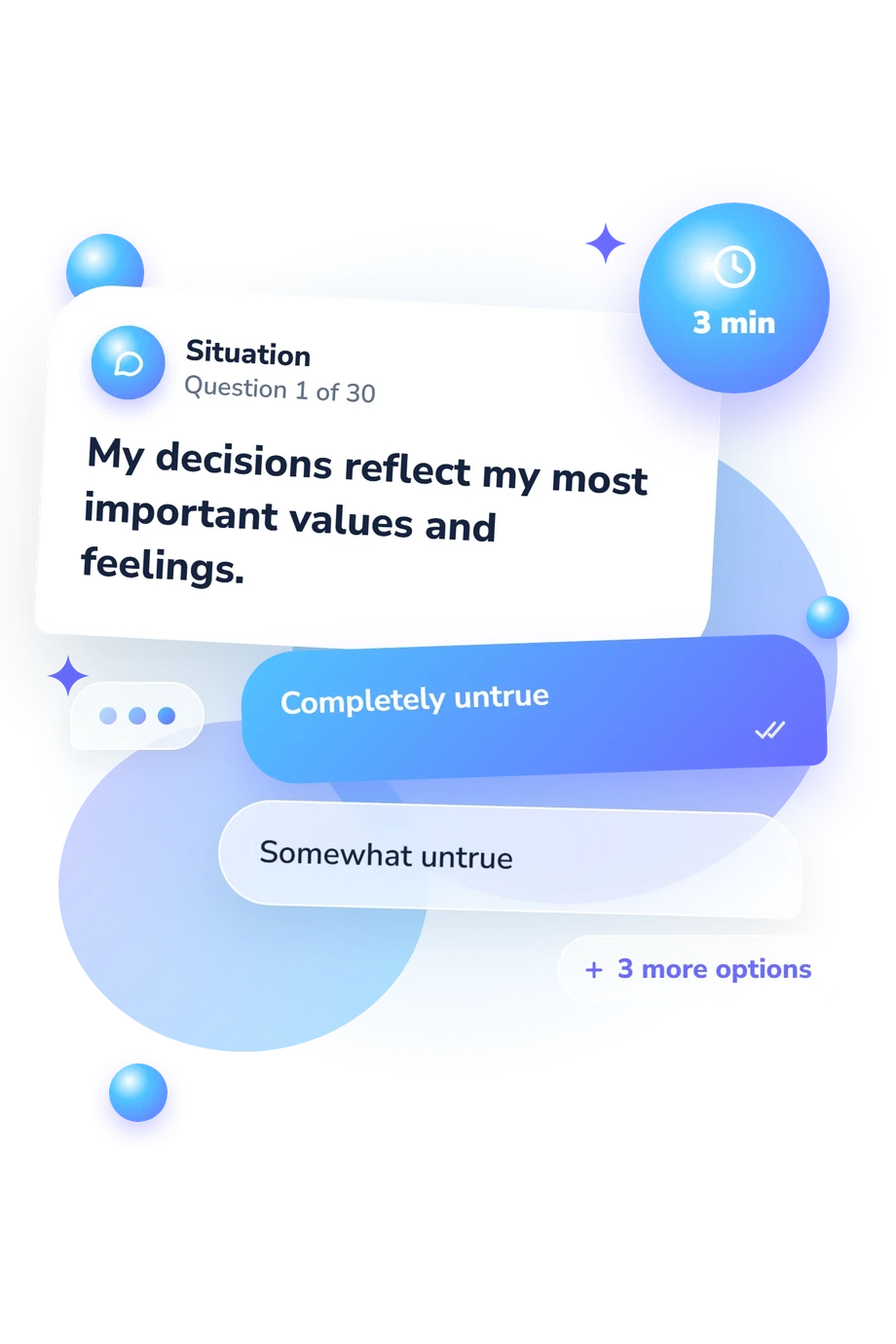
Example Questions From the Test
- Not at all true
- Mostly untrue
- Somewhat true
- Mostly true
- Completely true
- Completely untrue
- Mostly untrue
- Somewhat true
- Mostly true
- Completely true
- Completely untrue
- Mostly untrue
- Somewhat true
- Mostly true
- Completely true
Index of Autonomous Functioning (IAF) Test - Description and methodology of the test
People considering this autonomy assessment may find it useful when they want a structured way to observe how self-directed their everyday choices feel. The Index of Autonomous Functioning (IAF) Test is intended for people seeking a structured autonomy profile, not a personality label. Its profile can organize self-observation around moments when action feels internally guided or when expectations and self-criticism seem more influential.
What This Assessment Explores
Items cover value-aligned decisions, inner experience, and shame-avoidant, approval-seeking, or forced actions; in this autonomy questionnaire, noticing fear and anxiety supports mindfulness and self-regulation.
The scales are:
- Susceptibility to Control (1-5) reflects external and internal pressure: Low susceptibility (1-2.4), Moderate susceptibility (2.5-3.5), High susceptibility (3.6-5).
- Interest (1-5) reflects attention to experience: Low (1-2.4), Moderate (2.5-3.5), High (3.6-5).
- Authorship (1-5) reflects alignment with values and beliefs: Low (1-2.3), Moderate (2.4-3.6), High (3.7-5).
- Autonomous Functioning Index (1-5) reflects autonomy through self-congruence, interest-taking, and low susceptibility to control; higher scores indicate action from internal values and interests: Lower autonomy (1-2.4), Moderate autonomy (2.5-3.6), Higher autonomy (3.7-5).
Scores offer context, not a verdict.
Methodology and Scientific Basis
Each statement uses a five-point agreement response, with anchors ranging from not at all or mostly untrue to completely true. Wording varies slightly, but every choice asks how accurately the statement describes the respondent’s experience.
Responses from the autonomy test produce component and overall results. The online scoring is not standardized, so the result is best read as a profile rather than reconstructed item-by-item arithmetic.
The evidence framework is the Index of Autonomous Functioning (Weinstein et al., 2012), a published autonomous functioning scale organized around control, interest, and authorship. This questionnaire is conceptually consistent with that instrument; its online results are not the research scale’s psychometric findings. Self-determination theory from Deci and Ryan (2000) supplies the broader model of internally endorsed action versus behavior governed by pressure.
Interpret the result as a current self-report snapshot. Mood, context, self-awareness, and self-presentation can affect answers, and the displayed bands are descriptive rather than clinical thresholds. One score cannot establish a diagnosis or explain the causes of a person’s choices.
- Weinstein, N., Przybylski, A. K., & Ryan, R. M. (2012). The index of autonomous functioning: Development of a scale of human autonomy. Journal of Research in Personality, 46(4), 397-413. 10.1016/j.jrp.2012.03.007
- Deci, E. L., & Ryan, R. M. (2000). The “What” and “Why” of Goal Pursuits: Human Needs and the Self-Determination of Behavior. Psychological Inquiry, 11(4), 227-268. 10.1207/S15327965PLI1104_01
Updated: