
Cognitive Errors in Sport Assessment Test
How the Scales are Structured
Who Usually Takes This Test?
See How You Compare
Below is a preview of how scores are typically distributed across each scale.
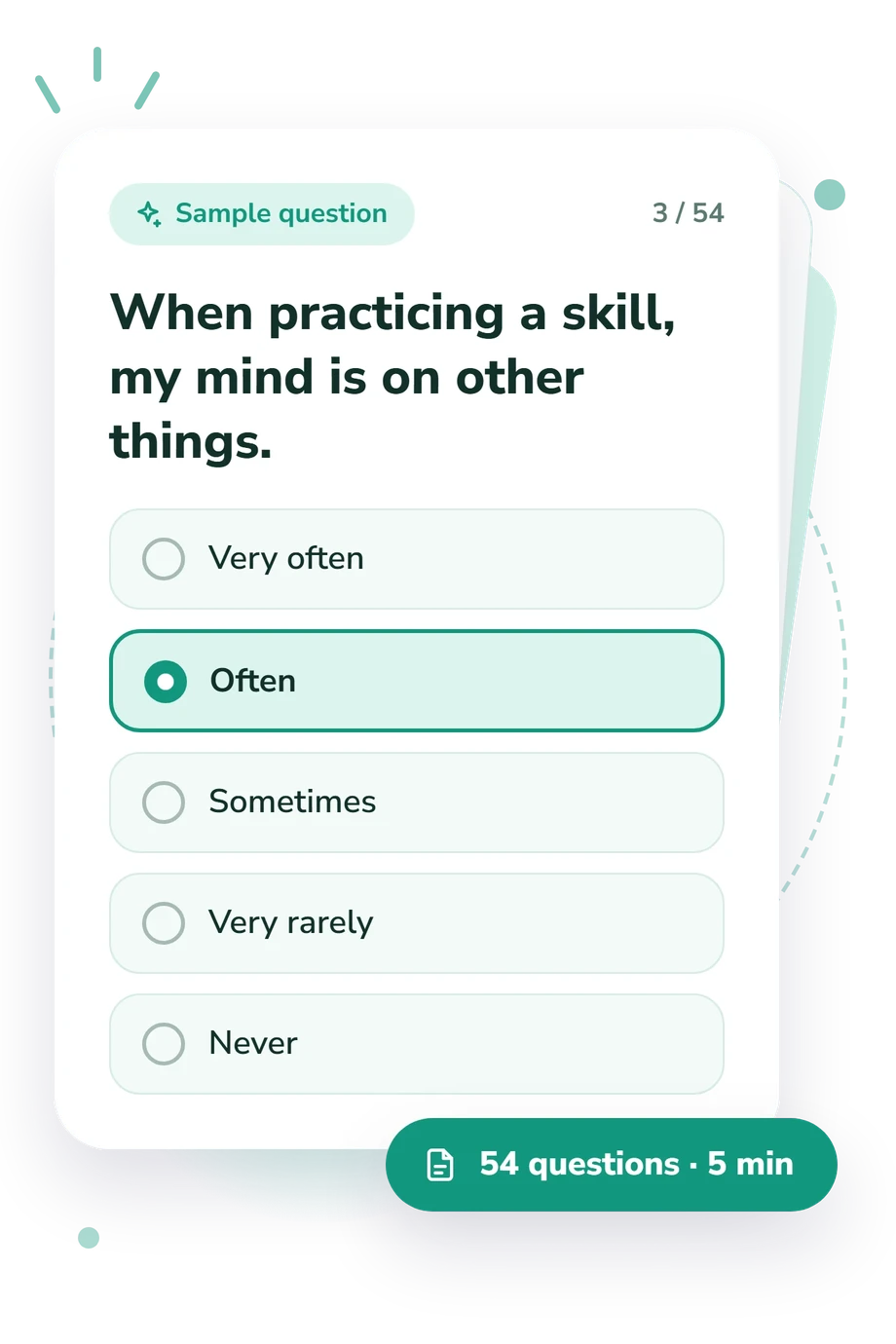
Example Questions From the Test
- Very often
- Often
- Sometimes
- Very rarely
- Never
- Very often
- Often
- Sometimes
- Very rarely
- Never
- Very often
- Often
- Sometimes
- Very rarely
- Never
Cognitive Errors in Sport Assessment Test - Description and methodology of the test
For athletes who want to see how focus, confidence, or technical execution may vary between training and competition, the Cognitive Errors in Sport Assessment Test offers structured self-reflection. As a sports performance questionnaire, it examines mental distractions, self-monitoring, and repeated mistakes across practice and competition. The result summarizes displayed patterns, helping a respondent identify tendencies worth discussing with a coach or exploring through training.
What This Assessment Explores
Across the items, the questionnaire examines attention, metacognitive control, present-moment awareness, mental rehearsal, confidence, mistakes, stress tolerance, and focus in training and competition. It addresses cognitive errors in sport by showing where mistakes are likely and how thinking may interfere with performance.
These are the displayed dimensions:
- Control (0-36) reflects metacognitive organization: higher scores indicate lower activity; lower scores indicate stronger organization. High control (0-12), Moderate control (13-24), Low control (25-36).
- Mindfulness (0-36) reflects awareness: lower scores indicate present focus; higher scores indicate past/future focus. Present-focused (0-12), Mixed focus (13-24), Past/future-focused (25-36).
- Situational Focus (0-36) indicates whether errors lean toward competition at lower scores or training at higher scores. Competition-leaning (0-12), Mixed (13-24), Training-leaning (25-36).
- Overall Score (0-108) indicates maladaptive patterns and stress tolerance: lower scores indicate fewer errors and greater stress tolerance. Low (0-36), Moderate (37-72), High (73-108).
Methodology and Scientific Basis
The questionnaire combines responses into displayed scale totals and an overall result. Five frequency choices, from Very often to Never, ask about concentration, distraction, mental rehearsal, confidence, mistakes, or recovery of focus. The format produces a pattern of self-reported tendencies rather than a judgment from any single answer.
These results form an athlete self-assessment, but the questionnaire does not state how individual responses are weighted, so readers should not reconstruct a point-by-point scoring rule.
Its conceptual frame is consistent with Girinskaya's Cognitive Sphere of the Athlete framework, which connects athletic mistakes with attentional control and cognitive organization. Related work on correction practices with highly qualified athletes and on self-regulation styles provides context for the questionnaire's attention to coach feedback, performance errors, and coping with pressure. The questionnaire is conceptually consistent with this framework and related studies, not a documented adaptation of any one source.
The displayed bands are descriptive categories rather than established population norms or clinical cutoffs, and current stress, fatigue, competitive pressure, self-awareness, and candor can influence self-report; interpret the result alongside training context and coaching feedback.
- Girinskaya, A. Yu., Kukhtova, N. V., Melnik, E. V., and Sivitsky, V. G. (2018). Cognitive Sphere of the Athlete (Theory and Practice): Methodological Recommendations. Vitebsk: P. M. Masherov Vitebsk State University, 75 pp.
- Girinskaya, A. Yu. (2017). Cognitive Errors from the Position of a Coach and Athlete. Law, Economy, Psychology, 3(8), 72-78.
- Allahverdov, V. M., Gershkovich, V. A., Karpinskaya, V. Yu., Kuvaldina, M. B., Moroshkina, N. V., Mednikov, S. V., Andriyanova, N. V., and Volkov, D. N. (2013). Correction of Cognitive Errors in Highly Qualified Athletes. Sports Psychologist, 1(28), 32-39.
- Palyutina, P. A., Vaskova, E. V., and Mokina, E. S. (2025). Features of Cognitive Errors and Self-Regulation Styles of Athletes of the Olympic Reserve School. Current Issues of Sports Psychology and Pedagogy, 5(2), 50-61. 10.15826/spp.2025.2.139
Updated: