
Whiteley Index (WI-8) Test
How the Scales are Structured
Who Usually Takes This Test?
See How You Compare
Below is a preview of how scores are typically distributed across each scale.
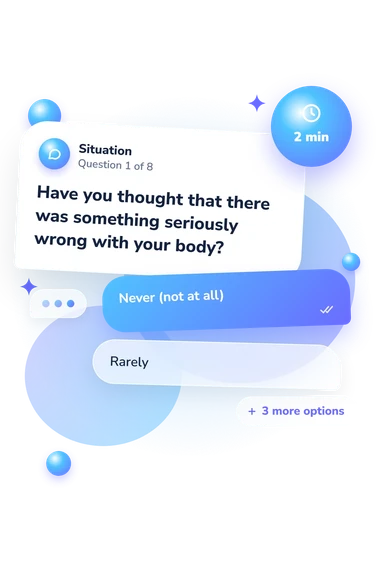
Example Questions From the Test
- Never (not at all)
- Rarely
- Sometimes
- Often
- Always (all the time)
- Never (not at all)
- Rarely
- Sometimes
- Often
- Always (all the time)
- Never (not once)
- Rarely
- Sometimes
- Often
- Always (all the time)
Whiteley Index (WI-8) Test - Description and methodology of the test
People who find health worries difficult to settle can use this brief self-report to examine patterns in illness-related thoughts, bodily sensations, and reassurance seeking. The Whiteley Index (WI-8) Test is intended for someone who wants a structured snapshot of these concerns rather than a broad personality profile. As a Whiteley Index questionnaire, it helps organize experiences that may otherwise feel difficult to describe.
What This Assessment Explores
The questionnaire addresses hypochondriacal symptoms through concern about illness, attention to bodily sensations, and difficulty accepting reassurance. It examines health-related anxiety and somatic complaints without deciding whether any symptom has a medical cause.
Questions cover fear of serious disease, recurring illness thoughts, bodily discomfort, worry after hearing about another illness, and doubt after a doctor’s reassurance. This makes the WI-8 health anxiety test useful for reflecting on repeated illness worry.
The result uses one scale: Whiteley Index, 0–40. Its bands are Low 0–18 and Clinically significant 19–40. The themes are:
- Illness worry shows how persistently someone fears that something serious may be wrong.
- Bodily symptoms indicate how much aches, pains, discomfort, or multiple complaints contribute to concern.
- Reassurance and rumination describe difficulty releasing illness thoughts after reassurance or new health information.
Methodology and Scientific Basis
Each item uses a five-point frequency response from Never to Always. The displayed result is read as a severity continuum; because no point-by-point weighting rule is documented, interpretation should follow the stated bands rather than an inferred scoring formula.
The closest named evidence is Whiteley Index-8 (Carstensen et al., 2020), which addresses illness worry and the Whiteley Index. Fink et al. (1999) provide related work on hypochondriasis and somatization, while Pilowsky (1967) supplies a conceptual account of hypochondriasis. Chen et al. (2021) evaluated WI-8 psychometrics in Chinese general-hospital outpatients. These publications support conceptual comparison, but they do not establish this online questionnaire as a direct adaptation with independent norms or the same validation status.
Used as a Whiteley Index screening tool, it supports structured self-reflection. Results depend on current context, memory, and honest self-report; a clinically significant band indicates elevated reported symptoms within this questionnaire, not a medical explanation or psychiatric diagnosis.
- Carstensen, T. B. W., Ørnbøl, E., Fink, P., Pedersen, M. M., Jørgensen, T., Dantoft, T. M., Benros, M. E., & Frostholm, L. (2020). Detection of illness worry in the general population: A specific item on illness rumination improves the Whiteley Index. Journal of Psychosomatic Research, 138, 110245. 10.1016/j.jpsychores.2020.110245
- Fink, P., Ewald, H., Jensen, J., Sørensen, L., Engberg, M., Holm, M., & Munk-Jørgensen, P. (1999). Screening for somatization and hypochondriasis in primary care and neurological in-patients: A seven-item scale for hypochondriasis and somatization. Journal of Psychosomatic Research, 46(3), 261–273. 10.1016/S0022-3999(98)00092-0
- Pilowsky, I. (1967). Dimensions of hypochondriasis. The British Journal of Psychiatry, 113(494), 89–93. 10.1192/bjp.113.494.89
- Chen, Y., Fink, P., Wei, J., Toussaint, A.-K., Zhang, L., Zhang, Y., Chen, H., Ma, X., Li, W., Ren, J., Lu, W., Leonhart, R., Fritzsche, K., & Wu, H. (2021). Psychometric Evaluation of the Whiteley Index-8 in Chinese Outpatients in General Hospitals. Frontiers in Psychology, 12, 557662. 10.3389/fpsyg.2021.557662