
Coping Behavior Assessment (MDICS) Test
How the Scales are Structured
Who Usually Takes This Test?
See How You Compare
Below is a preview of how scores are typically distributed across each scale.
Example Questions From the Test
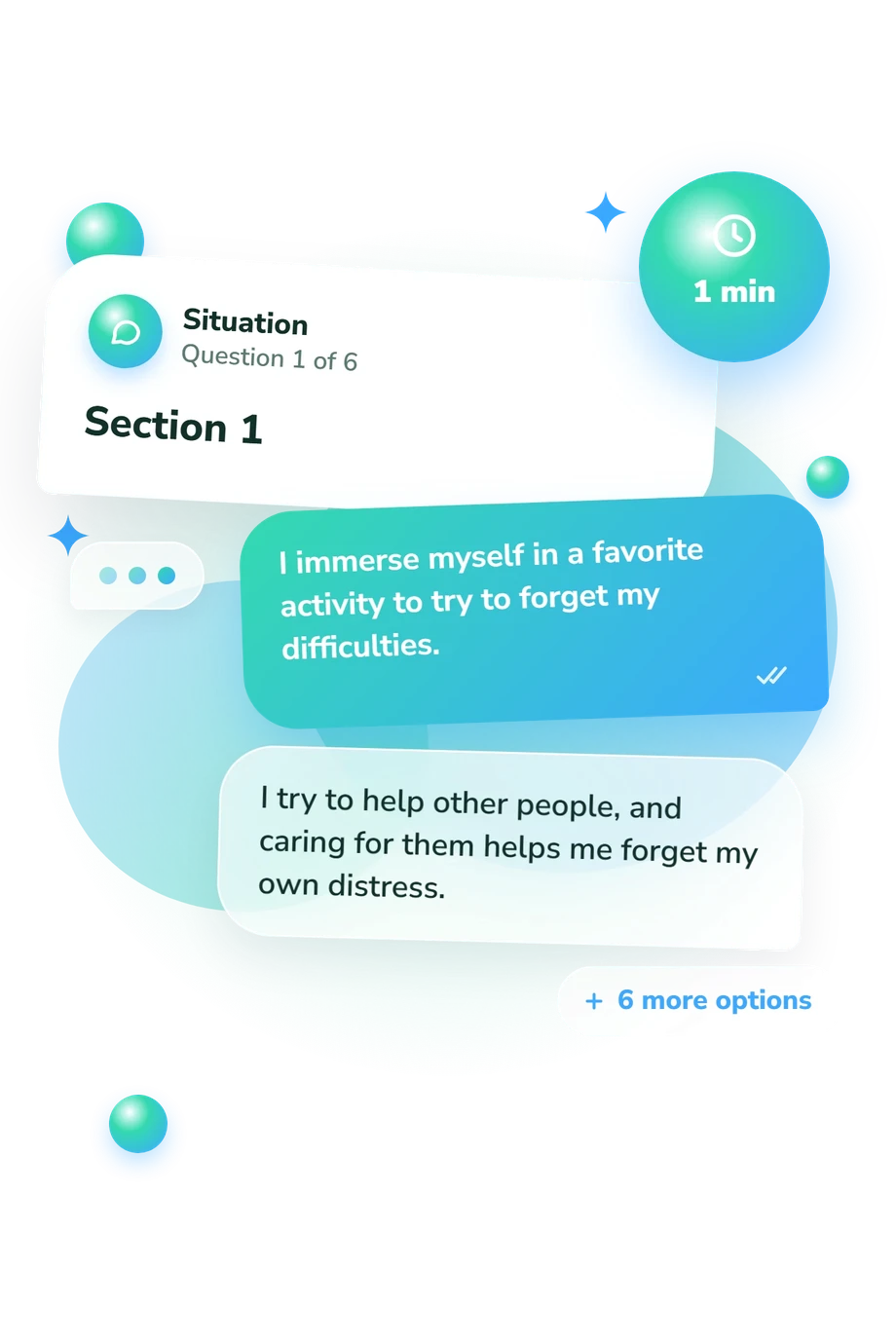
- I immerse myself in a favorite activity to try to forget my difficulties.
- I try to help other people, and caring for them helps me forget my own troubles.
- I try not to think about it and avoid thinking about my problems.
- I try to distract myself and relax (for example, with alcohol, sedatives, enjoyable food).
- To get through these difficulties, I work toward fulfilling a long-held dream (for example, travel, professional development, learning a foreign language).
- I isolate myself and try to be alone.
- I work together with people who are important to me to overcome difficulties (discuss the problem, seek support).
- I usually look for people who can help me with advice.
- I tell myself that right now there are things more important than these difficulties and problems.
- I tell myself that this is fate, and I must accept it.
- These are minor difficulties; things are not that bad—overall, everything is fine.
- I don't lose my composure or self-control during difficult moments and try not to show anyone my true state.
- I try to analyze it, weigh everything up, and explain to myself what happened.
- I tell myself that, compared with other people’s problems, mine are trivial.
- If something happens, it is by God's will.
- I do not know what to do, and at times it seems that I will not be able to get out of these difficulties.
- I give my difficulties a special meaning; by overcoming them, I improve myself.
- At present, I cannot fully cope with the difficulties that keep arising, but over time I will be able to cope with them more successfully, and with more difficult ones, as before.
- I am always deeply outraged by the unfairness of my fate and I protest.
- I feel despair; I cry and become upset.
- I keep my emotions inside.
- I am always confident that there is a way out of a difficult situation.
- I rely on other people who are willing to help me to deal with my difficulties.
- I feel hopeless.
- I blame myself and feel I am getting what I deserve.
- I fly into a rage and become aggressive.
Coping Behavior Assessment (MDICS) Test - Description and methodology of the test
People who want to understand their habitual reactions under pressure may use the Coping Behavior Assessment (MDICS) Test as a compact self-reflection exercise. It assesses coping with stress by examining how difficult situations are appraised, emotionally managed, and behaviorally handled. The result can help you notice patterns affecting problem-solving, self-criticism, withdrawal, or temporary relief, while keeping interpretation tied to the tendencies measured here.
What This Assessment Explores
These questions examine how people respond when stressful circumstances create emotional strain. The assessment is intended for readers reflecting on their own coping patterns, not for assigning one overall label. The assessment connects coping behavior to appraisal, emotion, and action.
The result is organized around three dimensions:
- Self-Blame (0-100) measures blaming yourself for causing a stressful situation or failing to resolve it; Low 0-33, Moderate 34-66, and High 67-100 are the displayed bands.
- Dissimilation (0-100) measures distorted appraisal or denial of a difficulty's significance, which may hinder problem-solving and adaptation; Low 0-33, Moderate 34-66, and High 67-100 are the displayed bands.
- Distraction (0-100) measures shifting attention to other activities for temporary relief; Low use 0-33, Moderate use 34-66, and High use 67-100 are the displayed bands.
Together, the profile indicates which coping tendencies deserve closer reflection in context.
Methodology and Evidence Base
The form uses first-person statements rather than a graded agreement scale. Options describe seeking support, analyzing events, suppressing feelings, withdrawing, self-blame, anger, acceptance, and distraction. The profile therefore reflects selected coping tendencies rather than symptom severity. Each section presents several first-person statements about coping strategies, and you select the option that best fits your way of handling difficulty.
Its methodological anchor is the Method for the Determination of Individual Coping Strategies (MDICS). The online form is conceptually consistent with MDICS and Lazarus and Folkman’s model, where appraisal and coping interact during stress, but it is not a verified adaptation of those published sources. Heim’s studies and Karvasarskii and colleagues’ methodology provide context for distinguishing coping responses across situations.
Displayed scores summarize selected responses, but the item weights, reverse-keying, normative sample, reliability, and validity statistics are not established for this online form. Current circumstances, self-awareness, and response style can affect self-report, so the profile is best read as focused reflection on coping tendencies rather than a diagnosis or complete assessment.
- Heim, E. (1988). Coping and psychological adaptation: Is there appropriate and inappropriate coping? Psychotherapy, Psychosomatics, Medical Psychology, 38(1), 8-18.
- Heim, E., Augustiny, K. F., Schaffner, L., and Valach, L. (1993). Coping with breast cancer over time and situation. Journal of Psychosomatic Research, 37(5), 523-542. 10.1016/0022-3999(93)90008-4
- Karvasarskii, B. D., Ababkov, V. A., Vasil'eva, A. V., Isurina, G. L., Karavaeva, T. A., Nazyrov, R. K., and Chekh, E. I. (2005). Methodology for studying coping behavior in patients with neuroses: In connection with the tasks of evaluating psychotherapy effectiveness. St. Petersburg: V. M. Bekhterev Psychoneurological Research Institute.
- Lazarus, Richard S., and Folkman, Susan. (1984). Stress, appraisal, and coping. New York: Springer Publishing Company.
Updated: