
Subjective Well-Being Assessment Test
How the Scales are Structured
Who Usually Takes This Test?
See How You Compare
Below is a preview of how scores are typically distributed across each scale.
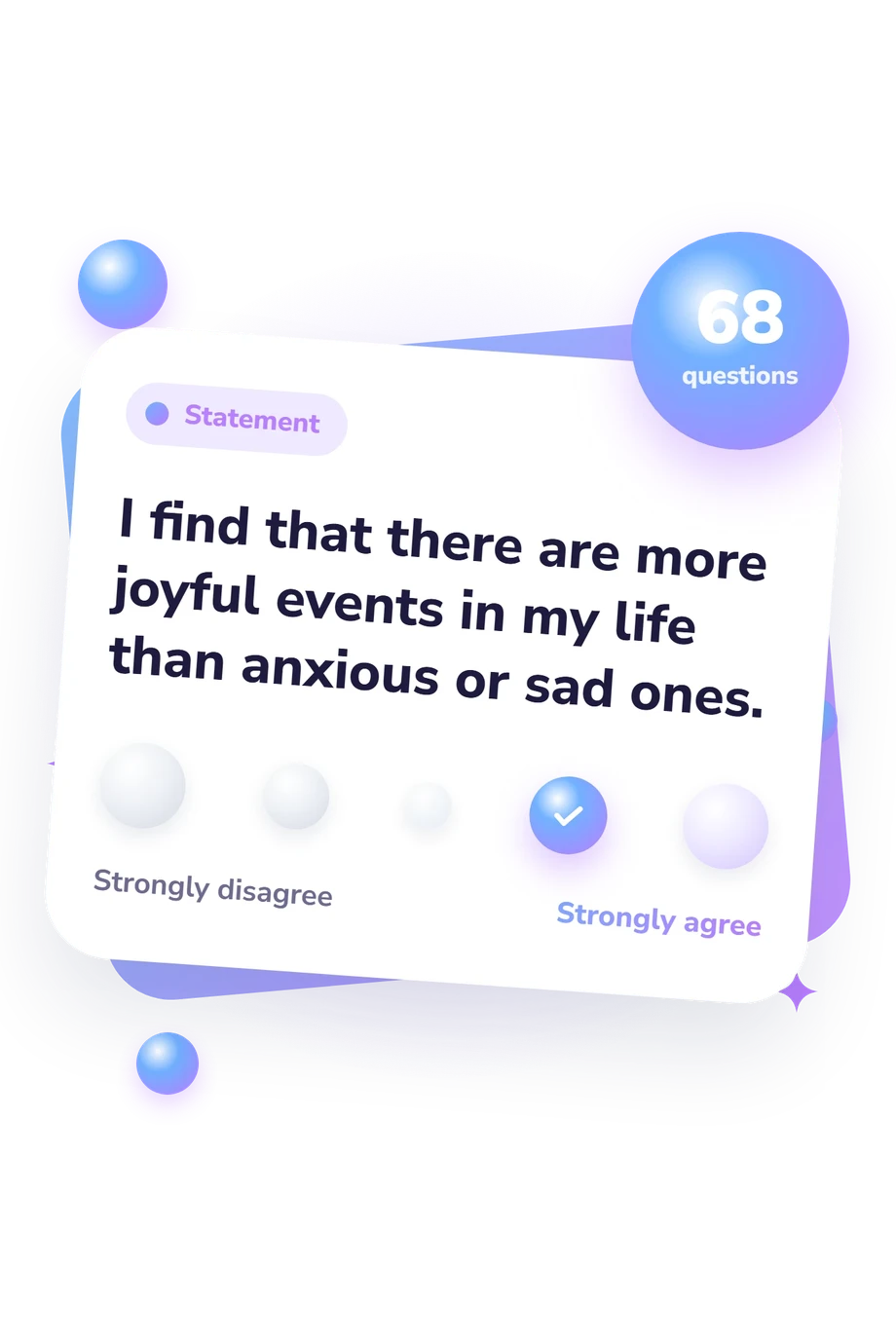
Example Questions From the Test
- Strongly disagree
- Disagree
- Neither agree nor disagree
- Agree
- Strongly agree
- Strongly disagree
- Disagree
- Neither agree nor disagree
- Agree
- Strongly agree
- Strongly disagree
- Disagree
- Neither agree nor disagree
- Agree
- Strongly agree
Subjective Well-Being Assessment Test - Description and methodology of the test
People who want a structured look at how satisfied, secure, purposeful, and emotionally positive life feels can use the Subjective Well-Being Assessment Test to organize their responses. It suits anyone exploring personal experience through self-report, and the result highlights areas that appear more harmonious or more difficult. This subjective well-being test can support focused self-reflection without reducing well-being to a single mood.
What This Assessment Measures
Six dimensions shape this well-being assessment: conditions, conduct, self-view, activity, meaning, emotion.
- Subjective Well-Being (1-5) measures satisfaction, happiness: Low 1-2.6; Moderate 2.7-3.6; High 3.7-5.
- Social-Normative Well-Being (1-5) reflects moral and social alignment: Low alignment 1-2.4; Moderate alignment 2.5-3.5; High alignment 3.6-5.
- Hedonic (1-5) measures basic-needs satisfaction: Low 1-2; Moderate 3-3; High 4-5.
- Ego Well-Being (1-5) measures self-satisfaction, confidence: Low 1-2.4; Moderate 2.5-3.4; High 3.5-5.
- Existential-Activity Well-Being (1-5) measures effort, effectiveness, meaning, eventfulness: Low 1-2.3; Moderate 2.4-3.6; High 3.7-5.
- Emotional Well-Being (1-5) measures joy, optimism, happiness, positive mood, enthusiasm: Low 1-2.3; Moderate 2.4-3.6; High 3.7-5.
Methodology and Scientific Basis
Each item is a self-report statement answered with five ordered agreement responses ranging from disagreement to agreement; endpoint wording varies between “Strongly” and “Completely.” The wording asks for self-reported evaluations of life, behavior, surroundings, and feelings across usual patterns, life history, overall impressions, and self-perceptions, so the result reflects the respondent’s reported perspective rather than an external evaluation.
The questionnaire turns ordered answers into six displayed scores ranging from 1 to 5 and places each score in the displayed descriptive band. The answer choices alone do not establish weighting, reverse-keying, or a separate clinical cutoff, so interpretation should stay with the values and labels shown. The displayed bands are descriptive categories rather than clinical thresholds.
Thematic arrangement is conceptually consistent with Shamionov and Beskova (2018), grouping overall satisfaction with social conduct, basic conditions, self-view, purposeful activity, and emotional tone. Ryff and Keyes (1995) provide complementary theoretical context for viewing well-being through distinct psychological dimensions, especially self-related and purposeful aspects. As a psychological well-being questionnaire, this assessment is sensitive to current circumstances, mood, self-awareness, and socially desirable responding. Read the profile as a structured aid to reflection, not as a diagnosis.
- Shamionov, R. M., & Beskova, T. V. (2018). Methods of diagnostics of subjective well-being of the person. Psychological Studies, 11(60), Article 8. 10.54359/ps.v11i60.277
- Ryff, C. D., & Keyes, C. L. M. (1995). The structure of psychological well-being revisited. Journal of Personality and Social Psychology, 69(4), 719-727. 10.1037/0022-3514.69.4.719
Updated: