
Brief Resilience Scale (BRS) Test
How the Scales are Structured
Who Usually Takes This Test?
See How You Compare
Below is a preview of how scores are typically distributed across each scale.
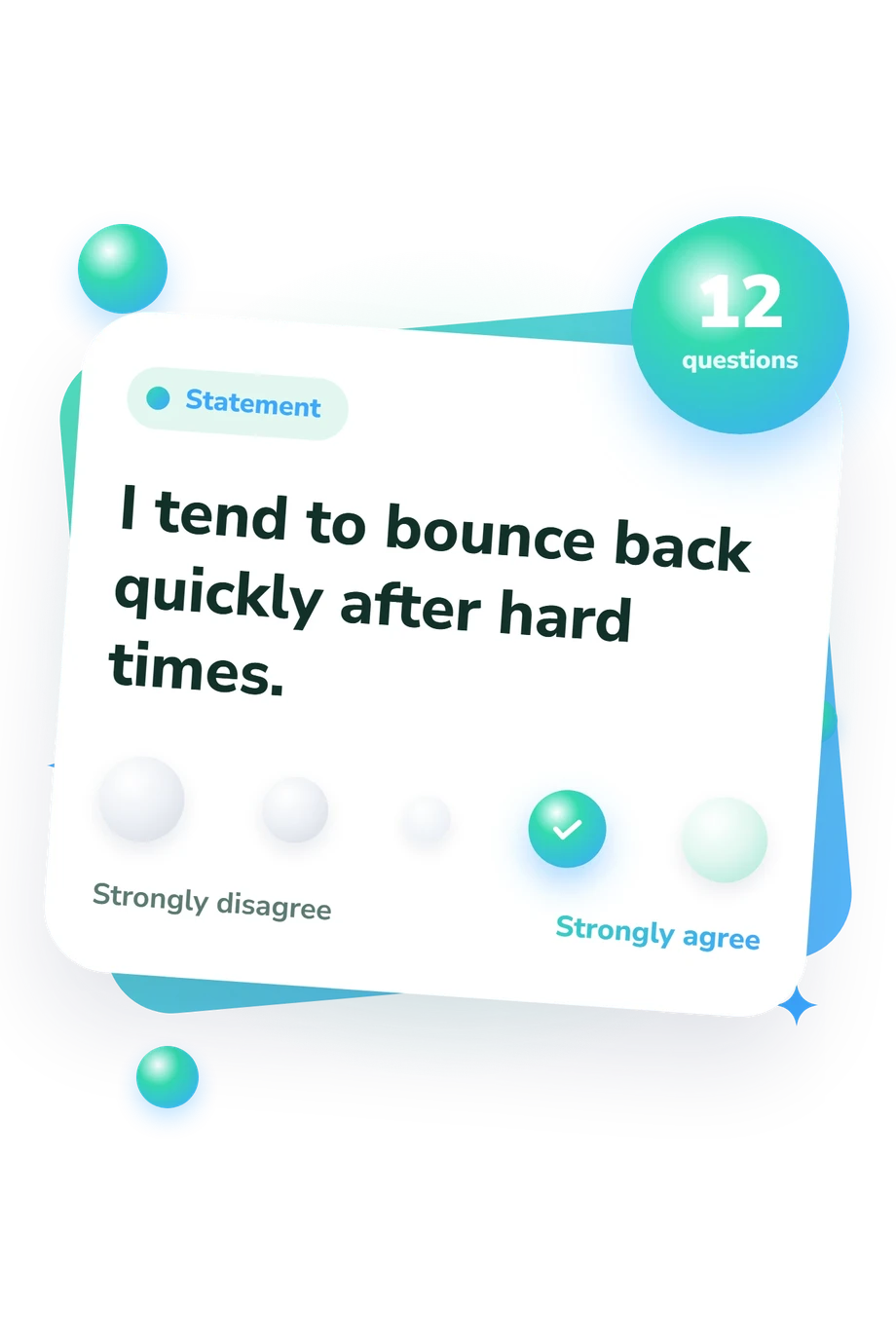
Example Questions From the Test
- Strongly disagree
- Disagree
- Neither agree nor disagree
- Agree
- Strongly agree
- Strongly disagree
- Disagree
- Neither agree nor disagree
- Agree
- Strongly agree
- Strongly disagree
- Disagree
- Neither agree nor disagree
- Agree
- Strongly agree
Brief Resilience Scale (BRS) Test - Description and methodology of the test
People seeking a focused way to examine recovery after adversity can use the Brief Resilience Scale (BRS) Test to reflect on how stress affects their return to balance. It is suited to anyone who wants to consider personal coping patterns after difficult events. As a resilience assessment, the result offers a structured snapshot of perceived recovery rather than a broad profile of personality or wellbeing.
What This Assessment Explores
The questionnaire measures resilience as successful adaptation in adverse conditions: the tendency to recover after trauma, tragedy, threat, or other negative events. Its focus is recovery rather than general confidence or optimism. Items ask whether recovery feels quick, whether stressful experiences remain difficult to get through, and whether a person becomes overly upset during hardship. This makes the resilience questionnaire relevant to readers examining responses to setbacks, without treating the result as a fixed identity.
The result is reported on one scale, Resilience (6–30), with these bands:
- Low resilience (6–14) indicates that recovery may often feel slow or difficult.
- Moderate resilience (15–22) indicates a mixed or intermediate pattern across stressful situations.
- High resilience (23–30) indicates a stronger reported tendency to regain balance relatively quickly.
These labels describe the answer pattern at completion and may vary with circumstances.
Methodology and Scientific Basis
All six statements use a five-point agreement format, from Strongly disagree to Strongly agree. The middle response is neutral or neither agree nor disagree, depending on the item. In the original BRS, responses to slower-recovery statements are reverse-coded so higher scores represent greater resilience. The online questionnaire presents a resilience band, but its calculation is not specified.
Items move in two directions: some describe quick recovery and limited recovery time, while others describe difficulty recovering, prolonged effects, or becoming overly upset.
The source instrument is the Brief Resilience Scale (BRS; Smith et al., 2008), a six-item measure of perceived recovery after stress. The present online resilience test is conceptually consistent with that instrument, but it should not be described as a separately validated adaptation. The online version has no separately reported validation or population norms.
Because responses are self-reported, current mood, recent events, memory, self-awareness, and a wish to appear capable may shape the score. The displayed bands therefore support structured self-reflection, while interpretation benefits from considering the circumstances behind each answer.
- Smith, Bruce W., Jeanne Dalen, Kathryn Wiggins, Erin Tooley, Paulette Christopher, and Jennifer Bernard. (2008). The brief resilience scale: Assessing the ability to bounce back. International Journal of Behavioral Medicine, 15(3), 194–200. 10.1080/10705500802222972
- Smith, B. W., Tooley, E. M., Christopher, P. J., and Kay, V. S. (2010). Resilience as the ability to bounce back from stress: A neglected personal resource? The Journal of Positive Psychology, 5(3), 166–176. 10.1080/17439760.2010.482186
Updated: