
Adolescent Anxiety Measurement Method Test
How the Scales are Structured
Who Usually Takes This Test?
See How You Compare
Below is a preview of how scores are typically distributed across each scale.
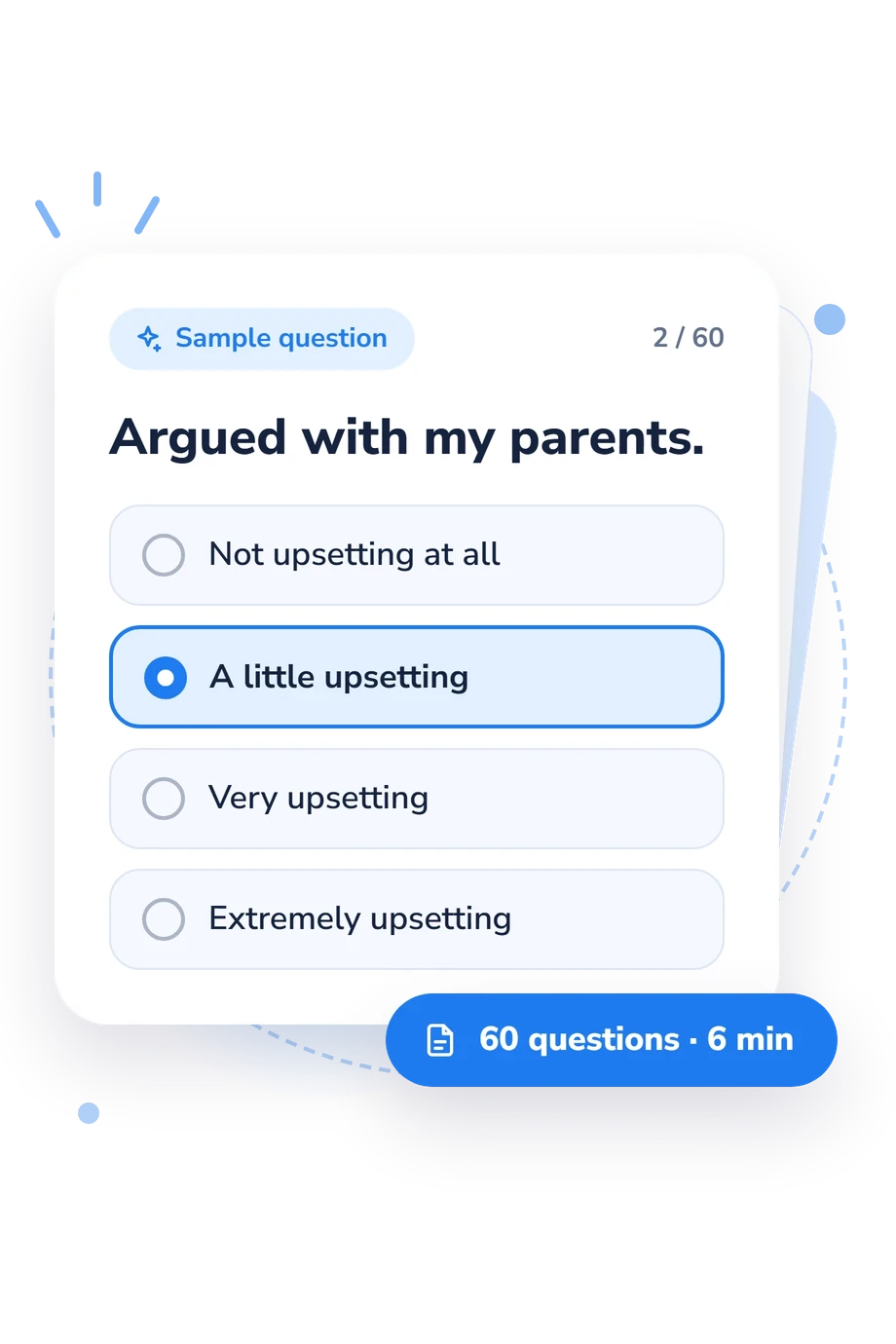
Example Questions From the Test
- Does not bother me at all
- Bothers me a little
- Bothers me a lot
- Bothers me very much
- Does not bother me at all
- Worries me a little
- Worries me a lot
- Worries me very much
- Not upsetting at all
- Slightly upsetting
- Very upsetting
- Extremely upsetting
Adolescent Anxiety Measurement Method Test - Description and methodology of the test
People who want to understand how pressures affect an adolescent can use this self-report profile to organize concerns across familiar areas. The Adolescent Anxiety Measurement Method Test supports reflection by showing how concerns are distributed across its profile. As an adolescent anxiety questionnaire, it shows where tension is noticeable and where conversation may help.
What This Assessment Explores
This adolescent anxiety profile includes five scales:
- Self-Rated Anxiety (0-10) measures self-confidence: high means lower self-esteem; low means higher or inflated self-esteem. Low 0-3; Moderate 4-6; High 7-10.
- Future-Related Anxiety (0-10) measures future confidence; high scores signal uncertainty, difficulty adapting. Low 0-3; Moderate 4-6; High 7-10.
- Relationships With Parents (0-10) measures family security/parent-child satisfaction; higher means low support or high expectations. Low anxiety in family relations 0-3; Moderate anxiety in family relations 4-6; High anxiety in family relations 7-10.
- Peer Relationships (0-10) measures peer influence; higher indicates evaluative dependence and low autonomy. Low influence 0-3; Moderate influence 4-6; High influence 7-10.
- General Anxiety (0-10) measures overall anxiety; high scores reflect tension and adjustment difficulty. Low 0-3; Moderate 4-6; High 7-10.
Methodology and Scientific Basis
Items cover school, money, status, responsibility, family, friends, and the future. Four ordered responses range from no distress to very strong distress, and results are reported across five scales, including general anxiety.
The closest source is MIPT, associated with Khvan and Zaitsev’s 2008 work on anxiety about the future in adolescence. Di Maggio and colleagues’ 2016 study provides a conceptually consistent perspective on future orientation and resilience; this questionnaire is not an adaptation of it. Neither source validates this version.
As an anxiety assessment for adolescents, this version is a self-report profile, not a diagnostic determination. Interpretation is scale-specific: higher self-confidence scores indicate lower self-esteem; future-related scores may indicate uncertainty and adaptation difficulty; family-related scores may indicate insufficient support and high parental expectations; peer-related scores may indicate dependence on others’ evaluations and insufficient autonomy; anxiety distinguishes higher averages from high scores. Because no item-by-item weighting rule is specified, points should not be inferred from displayed ranges. Current context, self-awareness, and response desirability can affect answers. The pattern can flag areas for attention without establishing population norms or clinical cutoffs.
- Khvan, A. A., and Zaitsev, Yu. A. (2008). Method for Measuring Anxiety in Adolescence. Psychological Diagnostics, No. 3, pp. 22-51.
- Zaitsev, Yu. A. (2008). Diagnosis and Correction of Adolescent and Youth Anxiety Regarding the Future. Candidate dissertation in developmental psychology, Novokuznetsk.
- Di Maggio, I., Ginevra, M. C., Nota, L., and Soresi, S. (2016). Development and Validation of an Instrument to Assess Future Orientation and Resilience in Adolescence. Journal of Adolescence, 51, 114-122. 10.1016/j.adolescence.2016.06.005
Updated: