
Conflict Situations Questionnaire Test
How the Scales are Structured
Who Usually Takes This Test?
See How You Compare
Below is a preview of how scores are typically distributed across each scale.
Example Questions From the Test
- I understand how important it is to you to become head of the department.
- I am hurt that you, my best friend, used my project without my permission.
- This is my project, and I must tell the manager, but I will say it was a mistake. You can be my deputy if you like the project.
- You are a traitor. I never want to see you again!
- It was a brilliant idea to use my project! You are the best candidate for the position of head of the department.
- I understand—you love Valeria!
- I feel hurt that my best friend is trying to take my girlfriend away from me.
- Let’s talk to Valeria together!
- I thought you were my friend. You’re a traitor—and a coward! You didn’t tell me anything!
- Do you really think Valeria would be with you? That’s just ridiculous!
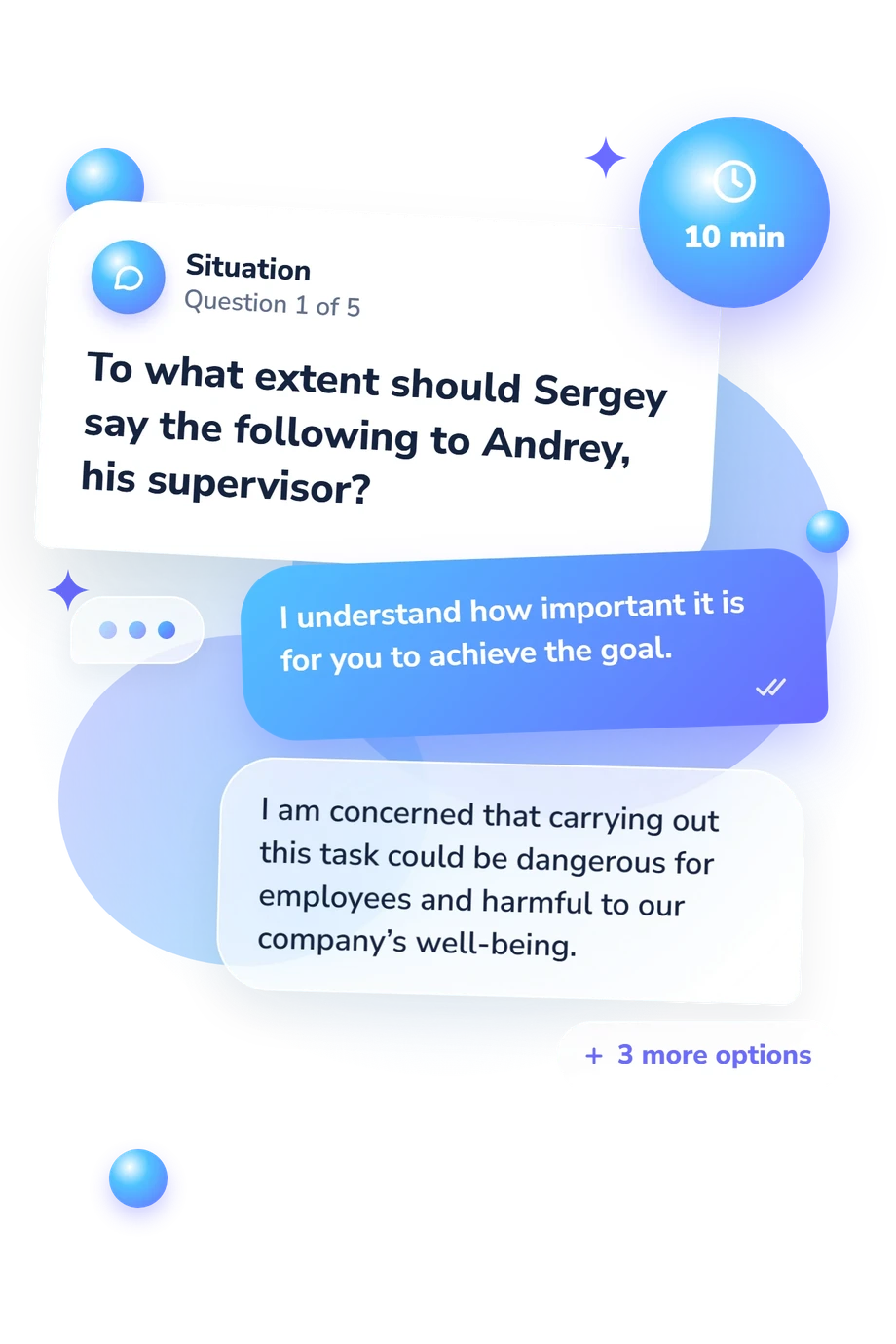
- I understand how important it is for you to achieve the goal.
- I am concerned that carrying out this task could be dangerous for employees and harmful to our company’s well-being.
- Let’s think about how we can achieve the goal in a different way.
- You are a criminal. I will report your behavior to the authorities!
- Do you really think this can be done? And where did you even get your education?
Conflict Situations Questionnaire Test - Description and methodology of the test
People who want to examine how they communicate during disagreement can use the Conflict Situations Questionnaire Test to compare several response tendencies across interpersonal dilemmas. The questionnaire offers a structured way to reflect on conflict communication, including competing needs, hurt, responsibility, and possible solutions. Its profile describes endorsed response patterns to the presented situations, not behaviour observed repeatedly over time.
What This Assessment Measures
Scenarios depict disagreements. Ratings describe patterns, not correct answers.
Dimensions:
- Irony (5-35) measures indirect, covert partner-directed verbal aggression, including mockery and sarcasm: Low 5-14; Moderate 15-24; High 25-35.
- Partner Blaming (5-35) measures partner-directed anger, including blame, insults, and threats: Low accusing 5-15; Moderate accusing 16-25; High accusing 26-35.
- Problem-Solving Proposals (5-35) measures solution-seeking and compromise: Low solution focus 5-15; Moderate solution focus 16-25; High solution focus 26-35.
- Expression of Feelings (5-35) measures expressing feelings and viewpoints: Reserved expression 5-15; Situational openness 16-25; Open expression 26-35.
- Acknowledgment of Partner's Feelings (5-35) acknowledges a partner's feelings and goals: Low acknowledgment 5-15; Moderate acknowledgment 16-25; High acknowledgment 26-35.
These dimensions show interpersonal conflict responses captured by the questionnaire.
Methodology and Evidence Base
This scenario-based self-report format presents five possible statements in each scenario, and respondents rate each one on a 1-7 scale for how strongly the person should say it. Separate displayed results are provided for the five dimensions. The statements represent distinct interpersonal moves.
Conceptually, the questionnaire is consistent with a 2021 study by Sinelnikova and Wigboldus on conflict interaction through socially meaningful situations. It is also compatible with the conflict-mode perspective associated with the MODE instrument developed by Kilmann and Thomas, where responses are discussed as competing, collaborating, compromising, avoiding, or accommodating. Its displayed bands are descriptive categories rather than validated population norms.
Read this questionnaire’s conflict response patterns comparatively: a higher result signals more endorsement of the behavior described by that dimension, while a lower result signals less. Hypothetical situations remain sensitive to mood, experience, social desirability, and scenario interpretation; the profile is therefore a self-reflection aid, not a clinical diagnosis.
- Sinelnikova, E. S. (2021). Emotional intelligence and conflict interaction in Russia and in the Netherlands. European Proceedings of Social and Behavioural Sciences, 494-499. 10.15405/epsbs.2021.12.61
- Kilmann, R. H., & Thomas, K. W. (1977). Developing a forced-choice measure of conflict-handling behavior: The "MODE" instrument. Educational and Psychological Measurement, 37(2), 309-325. 10.1177/001316447703700204
Updated: