
Belief in a Just World Scale Test
How the Scales are Structured
Who Usually Takes This Test?
See How You Compare
Below is a preview of how scores are typically distributed across each scale.
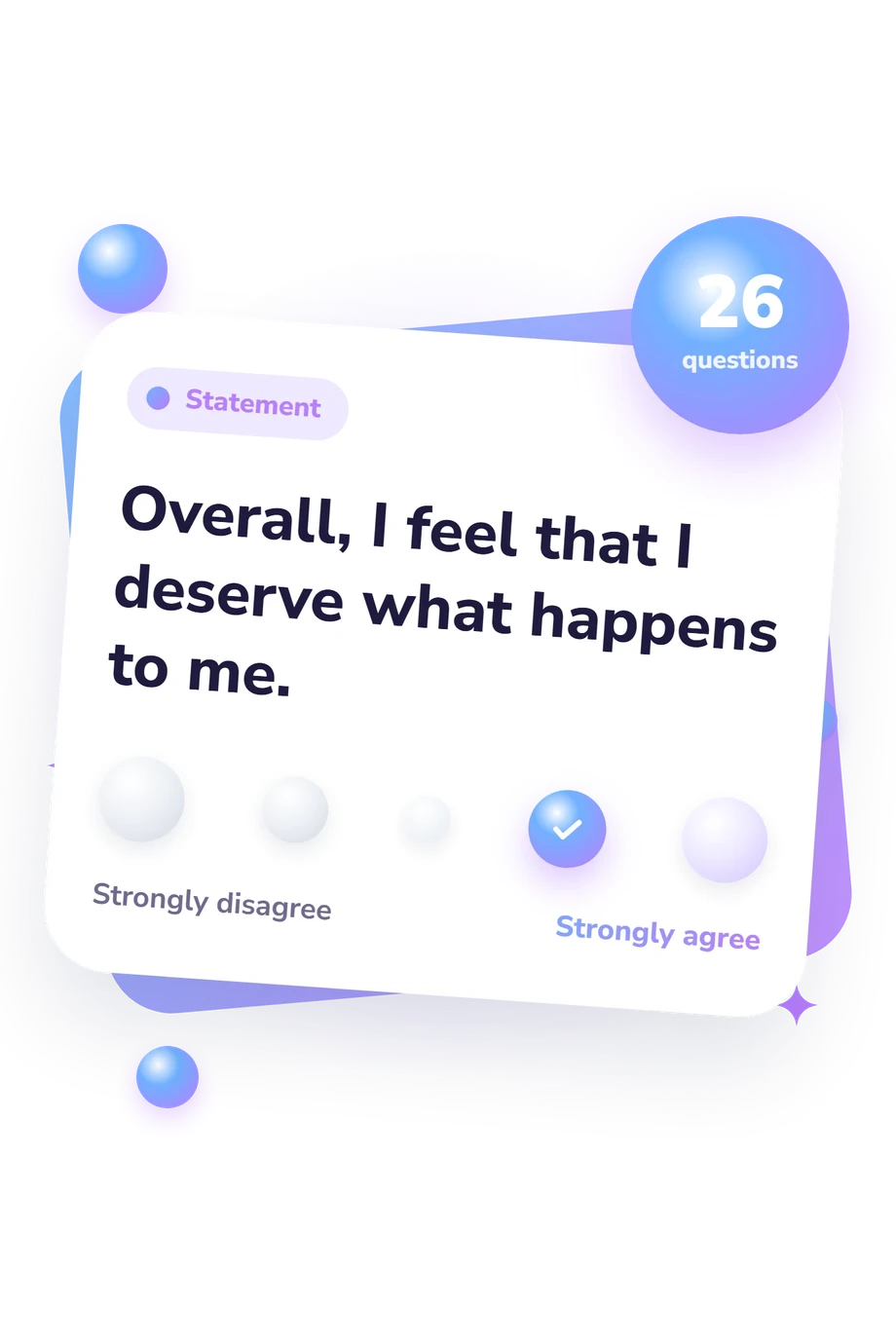
Example Questions From the Test
- Strongly disagree
- Somewhat disagree
- Not sure
- Somewhat agree
- Strongly agree
- Strongly disagree
- Somewhat disagree
- Not sure
- Somewhat agree
- Strongly agree
- Strongly disagree
- Somewhat disagree
- Not sure
- Somewhat agree
- Strongly agree
Belief in a Just World Scale Test - Description and methodology of the test
People reflecting on fairness, optimism, or setbacks may use Belief in a Just World Scale Test to organize these themes into a clearer personal profile. It focuses on expectations about justice in society and in one's own life, helping readers examine how they interpret trust, responsibility, and difficult outcomes. As a just world scale, it offers a structured starting point for self-reflection.
What This Assessment Explores
Statements ask whether fairness is a general feature of life and whether people tend to receive what they deserve. Other items turn inward, asking whether the respondent's treatment, decisions, and life events feel fair. The result separates social expectations from personal experience.
The displayed result separates these dimensions:
- General Belief in a Just World (6–30) measures whether the world is generally fair; Low 6–14, Moderate 15–22, and High 23–30 mark increasing endorsement. Higher scores may accompany optimism and stress resilience, while lower scores may reflect an unjust outlook.
- Belief in a Just World — Self (7–35) measures whether one's outcomes feel deserved; Low 7–16, Moderate 17–25, and High 26–35 mark increasing endorsement. Higher scores may relate to personal control and well-being, while lower scores may reflect personal injustice.
Together, the just world belief test maps assumptions shaping trust, coping, and responsibility.
Methodology and Scientific Basis
Each statement uses a five-point agreement format, moving from strong disagreement through uncertainty to strong agreement. The items cover broad claims about justice, fairness in everyday institutions and relationships, compensation for suffering, and the respondent's own life. Results are reported as two dimension scores, so the profile can show whether general and personal beliefs move together or differ.
The structure is conceptually consistent with Dalbert's 1999 just-world questionnaire, which distinguishes general and personal justice beliefs, and with the separate-dimensions approach examined by Lipkus, Dalbert, and Siegler (1996). It also reflects Melvin J. Lerner's just-world theory, in which people seek to understand outcomes as orderly and deserved. This online questionnaire is not presented as a validated adaptation of those published instruments.
Interpretation should remain contextual. Answers may shift with recent injustice, current stress, cultural expectations, mood, memory, and response style. The published studies do not establish population norms or diagnostic cutoffs for this online version, so its bands are descriptive prompts rather than diagnostic findings.
- Dalbert, C. (1999). The world is more just for me than generally: About the Personal Belief in a Just World Scale's validity. Social Justice Research, 12(2), 79–98. 10.1023/A:1022091609047
- Lipkus, I. M., Dalbert, C., & Siegler, I. C. (1996). The importance of distinguishing the belief in a just world for self versus for others: Implications for psychological well-being. Personality and Social Psychology Bulletin, 22(7), 666–677. 10.1177/0146167296227002
- Lerner, M. J. (1980). The belief in a just world: A fundamental delusion. New York: Plenum Press. 10.1007/978-1-4899-0448-5
Updated: