
Assessment of Educational Interaction Strategies With Children Test
How the Scales are Structured
Who Usually Takes This Test?
See How You Compare
Below is a preview of how scores are typically distributed across each scale.
Example Questions From the Test
- Strongly disagree
- Somewhat disagree
- Neither agree nor disagree
- Somewhat agree
- Strongly agree
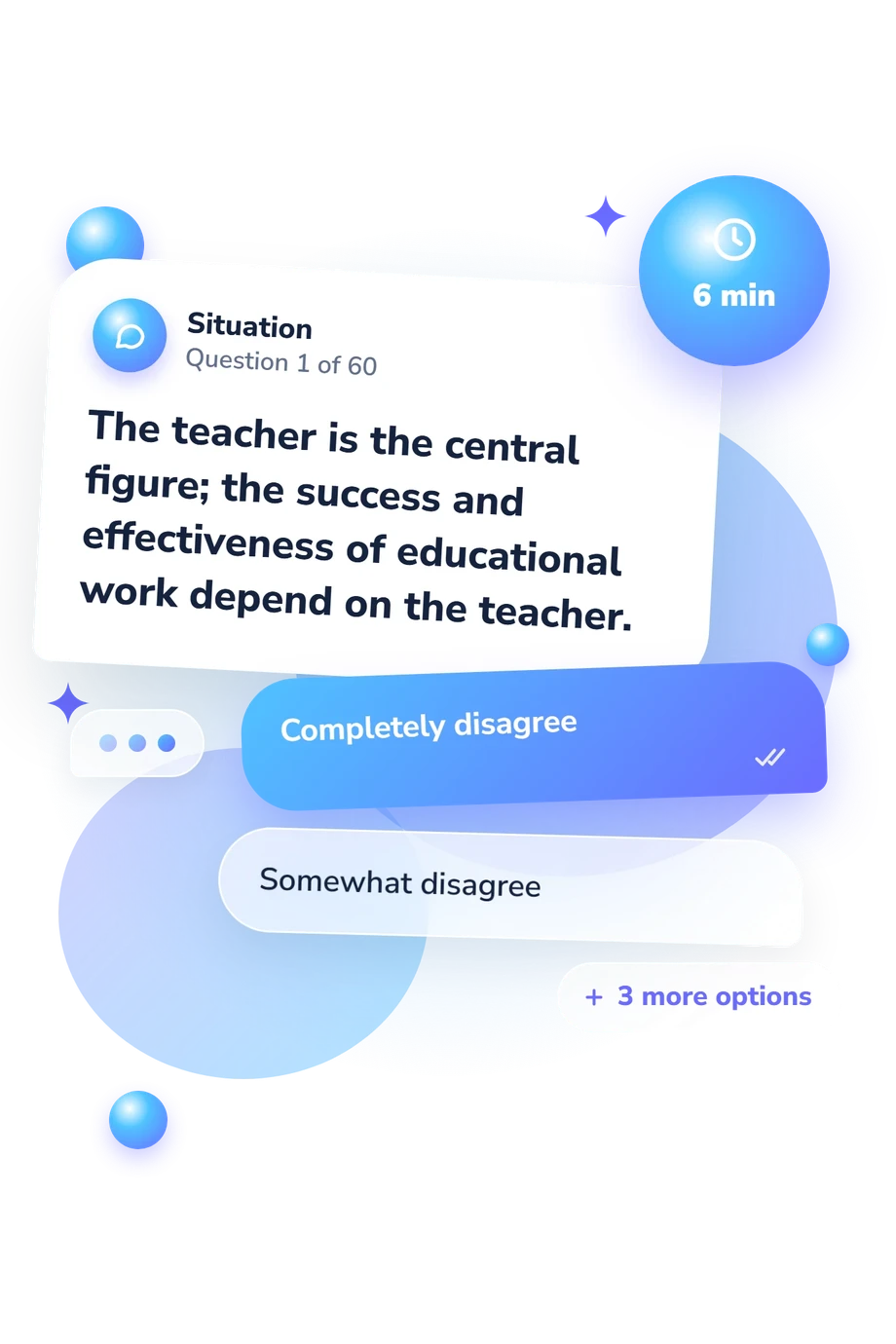
- Completely disagree
- Somewhat disagree
- Neither agree nor disagree
- Somewhat agree
- Completely agree
- Completely disagree
- Rather disagree
- Neither agree nor disagree
- Rather agree
- Completely agree
Assessment of Educational Interaction Strategies With Children Test - Description and methodology of the test
Educators, trainee teachers, and parents who reflect on classroom relationships can use the Assessment of Educational Interaction Strategies With Children Test to examine the assumptions shaping their responses to children. It focuses on educational interaction strategies, including authority, discipline, student initiative, and the balance between curriculum demands and individual needs. The outcome gives a concise profile of the interaction model expressed by the respondent's answers.
What This Assessment Explores
The questionnaire examines how respondents position teachers, children, families, and school rules within educational relationships. Statements address authority, discipline, punishment, student initiative, individual differences, parental expectations, and responsibility for upbringing.
The Interaction Model (30-150) assesses whether interaction with students reflects an instructional-disciplinary or learner-centered model. Higher scores indicate predominance of the instructional-disciplinary approach; lower scores indicate a learner-centered model. Bands indicate relative prominence: Person-centered 30-80, Mixed/Transitional 81-100, and Academic-disciplinary 101-150.
The statements represent themes that clarify beliefs in the single Interaction Model result:
- Authority and teacher centrality show how strongly success is linked to adult control and decision-making.
- Discipline and correction indicate the importance given to order, punishment, strictness, and performance.
- Student agency and individuality show how learner-centered teaching treats initiative and personal characteristics as relevant.
- Family and school responsibility reflects beliefs about who should guide a child's upbringing.
Methodology and Evidence Base
Each item presents a teaching-related statement and asks for a five-point agreement response, from strong disagreement through neutrality to strong agreement. The content covers planning, control, praise, grades, family responsibility, and student differences; respondents judge an educational position rather than recall an incident.
The result is a directional profile: higher values indicate the instructional-disciplinary approach, while lower values indicate the learner-centered approach. No norms or standardisation are stated for this questionnaire, and its response-to-score conversion is not specified. The result should therefore be read through this direction rather than reverse-engineered.
Maralov et al. (2005) provide the closest conceptual reference, distinguishing learner-centered interaction from more directive educational practice. This questionnaire is conceptually consistent with that work, not presented as a direct adaptation. Sitarov and Maralov (2000) offer a related nonviolence perspective, while Safonova et al. (2019) link learner-centered orientation with readiness for inclusive education.
As a self-report tool, teacher interaction style may be influenced by current context, social desirability, and self-awareness, so the result does not establish competence or a clinical condition.
- Maralov, V. G., Buchilova, I. A., Kleptsova, E. Yu., Makarova, N. V., Rogozhnikova, S. M., & Samofal, R. A. (2005). Psychological Features of Teachers' Orientation Toward a Person-Centered Model of Interaction With Children. Moscow: Academic Project; Paradigma. ISBN 5-8291-0563-2.
- Sitarov, V. A., & Maralov, V. G. (2000). Pedagogy and Psychology of Nonviolence in the Educational Process. Moscow: Academy. 216 pp.
- Safonova, T. V., Suntsova, A. S., & Aslaeva, R. G. (2019). Study of Orientation Toward a Person-Centered Model of Interaction With Children as a Structural Component of Teachers' Readiness for Inclusive Education. Integration of Education, 23(1), 50-65. DOI 10.15507/1991-9468.094.023.201901.050-065
Updated: