
Personality Time Disorganizers Test
How the Scales are Structured
Who Usually Takes This Test?
See How You Compare
Below is a preview of how scores are typically distributed across each scale.
Example Questions From the Test
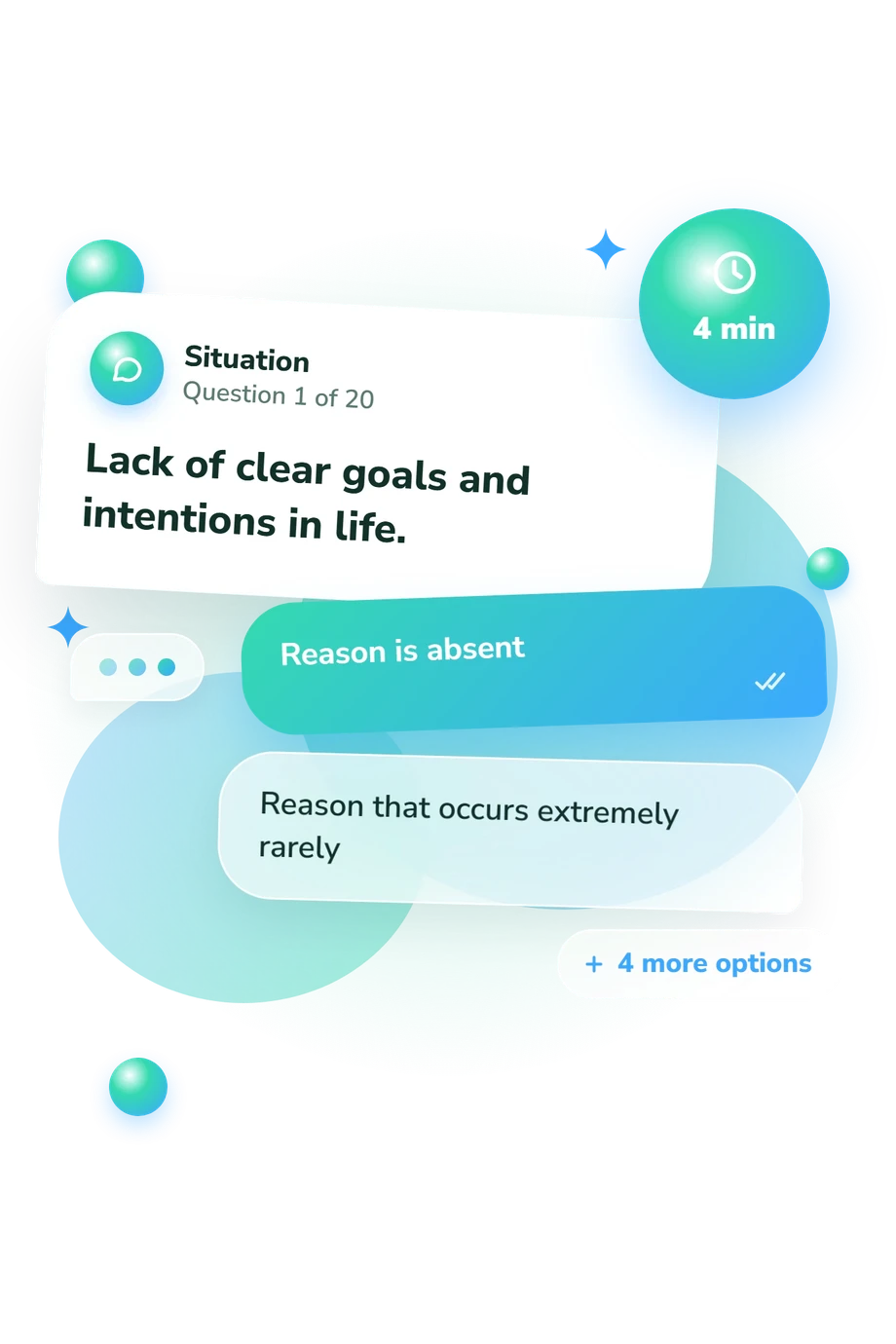
- Reason is absent
- Reason that occurs extremely rarely
- Reason that occurs rarely
- Reason is moderate
- Reason that occurs fairly often
- Reason that occurs often
- This reason is not present
- This reason occurs very rarely
- This reason occurs rarely
- This reason is moderately present
- This reason occurs fairly often
- This reason occurs often
- This reason is not present
- This reason occurs extremely rarely
- This reason occurs rarely
- This reason is moderately present
- This reason occurs fairly often
- This reason occurs often
Personality Time Disorganizers Test - Description and methodology of the test
People trying to understand why daily plans lose momentum may find the Personality Time Disorganizers Test useful for examining personal factors that make activity feel scattered, pressured, or directionless. As a time disorganization assessment, it connects work habits with motivation, emotional load, and future orientation, while pointing toward patterns worth reflecting on in everyday routines.
What This Assessment Explores
It covers motivation, emotion, organization, and life direction:
- Motivational (4-24) measures life-and-work apathy and reduced achievement motivation: Low 4-10; Moderate 11-17; High 18-24.
- Emotional Tension (4-24) measures time pressure and constraint: Low tension 4-10; Moderate tension 11-17; High tension 18-24.
- Emotional Apathy (4-24) measures fatigue and passivity: Low apathy 4-10; Moderate apathy 11-17; High apathy 18-24.
- Organizational (4-24) measures sequencing, focus, and postponement: Low disorganization 4-10; Moderate disorganization 11-17; High disorganization 18-24.
- Value-Meaning (4-24) measures missing goals, intentions, and future prospects: Goal-directed 4-10; Somewhat unclear 11-17; Directionless 18-24.
- Overall Disorganization Index (20-120) measures disorganization across values, motivation, organization, and emotion: Low disorganization 20-53; Moderate disorganization 54-86; High disorganization 87-120.
The scales form a time disorganization profile.
Methodology and Scientific Basis
Each item asks how often or to what degree a difficulty is present, using six ordered choices from absence or rarity to frequent occurrence. The statements cover goals, motivation, work, time pressure, fatigue, concentration, consistency, and postponement. Through self-report questions about daily activity and work, this time disorganization questionnaire captures perceived tendencies.
The questionnaire displays dimension scores and an overall index, interpreted through stated bands; the bands are domain-specific rather than universal measures of productivity.
Kuzmina's Personal Time Disorganizers methodology is the closest conceptual source, linking time-related disorganization with motivational, emotional, organizational, and value-meaning factors. This questionnaire is conceptually consistent with that methodology but is presented as a separate online self-report questionnaire. Tokareva and Tokarev address related motivating and organizing factors, while Zimbardo and Boyd's work on time perspective provides context on individual differences in time perspective.
The questionnaire is presented without population norms or a documented standardization procedure. Workload, mood, self-awareness, and impression management can affect self-report, so the profile is best read as structured reflection rather than a clinical diagnosis.
- Kuzmina, O. V. (2011). Methodology for diagnosing personal time disorganizers. Psychological Studies: Electronic Scientific Journal, 6(20), Article 12. 10.54359/ps.v4i20.811
- Tokareva, Y., & Tokarev, A. (2018). Motivating and Organizing Factors in the Professional Behaviour of Toxic Managers. European Proceedings of Social and Behavioural Sciences, 37, 30-37. 10.15405/epsbs.2018.03.02.3
- Zimbardo, P. G., & Boyd, J. N. (1999). Putting time in perspective: A valid, reliable individual-differences metric. Journal of Personality and Social Psychology, 77(6), 1271-1288. 10.1037/0022-3514.77.6.1271
Updated: