
Ethnocentrism Scale Test
How the Scales are Structured
Who Usually Takes This Test?
See How You Compare
Below is a preview of how scores are typically distributed across each scale.
Example Questions From the Test
- Strongly agree
- Agree
- Not sure
- Disagree
- Strongly disagree
- Strongly agree
- Agree
- Not sure
- Disagree
- Strongly disagree
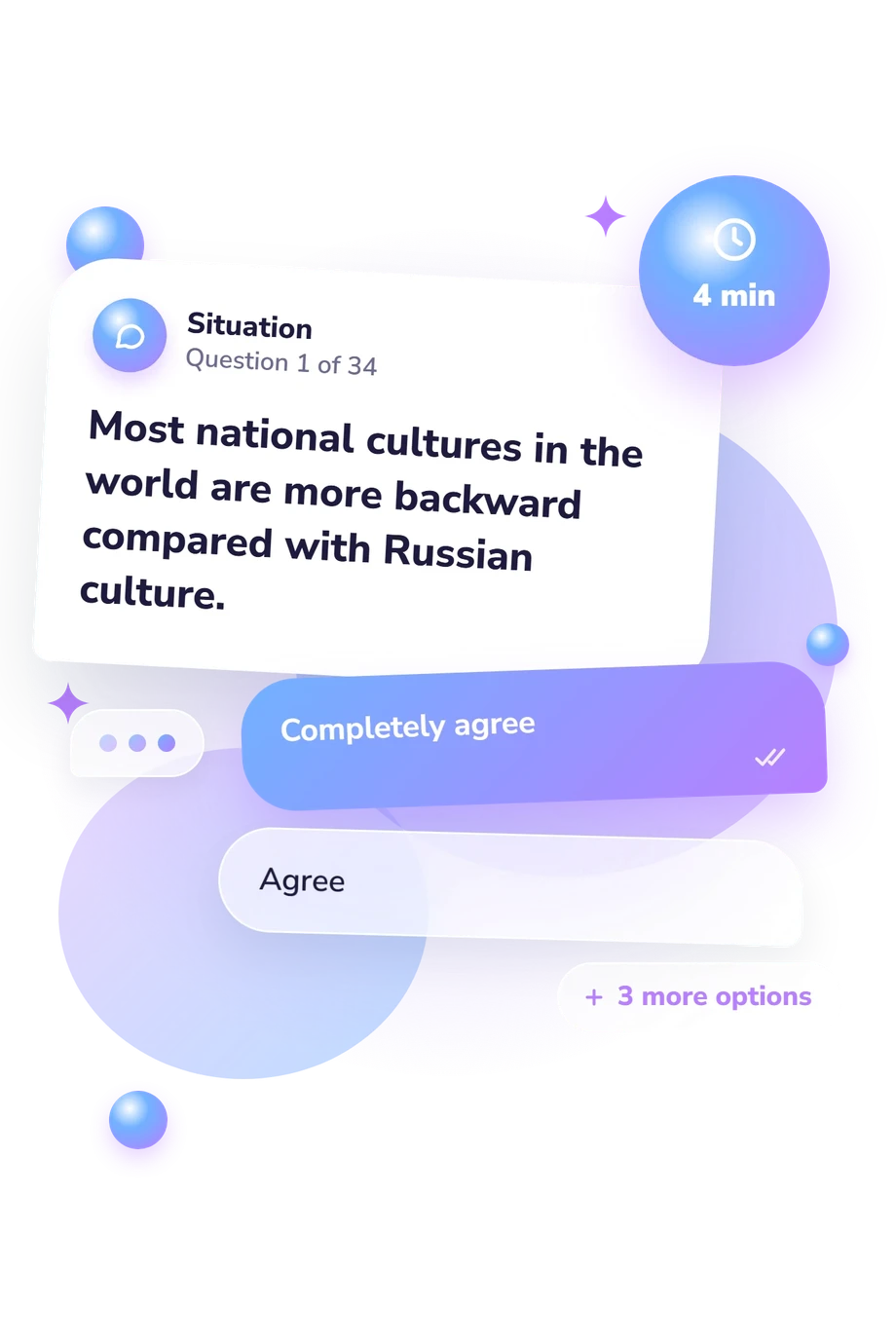
- Completely agree
- Agree
- Hard to say
- Disagree
- Completely disagree
Ethnocentrism Scale Test - Description and methodology of the test
People who want to examine assumptions about cultural difference can use the Ethnocentrism Scale Test as a structured self-reflection exercise. It is intended for general readers who are curious about how they judge unfamiliar groups, cultural practices, and cross-cultural contact. As an ethnocentrism questionnaire, it offers a summary indication of attitudes that may shape openness, trust, and everyday intercultural encounters.
What This Assessment Explores
The assessment focuses on judgments about cultural difference. It measures ethnocentrism through judgments of other cultures and ethnic groups against one's own culture. Items address cultural superiority, interest in other traditions, respect for unfamiliar values, trust, friendship, and willingness to interact across cultural boundaries.
The result is one Ethnocentrism Index (17-85). Low (17-39) suggests greater openness and tolerance; Moderate (40-62) indicates an intermediate pattern; High (63-85) suggests stronger in-group orientation and potential bias toward others. These bands describe a tendency, not a complete account of character or behavior.
The questions group into themes:
- Cultural comparison shows whether other ways of life are judged against the respondent's culture.
- Openness to difference reflects interest and respect toward unfamiliar values.
- Interpersonal contact indicates comfort with friendship and cross-cultural interaction.
- In-group certainty captures belief that one's own culture is especially correct or preferable.
Methodology and Scientific Basis
Five ordered response choices let respondents rate statements about ethnocentric attitudes, from strong agreement to strong disagreement, with some neutral or uncertain wording. The questionnaire reports one index; its displayed range does not specify how individual responses are weighted or whether any items are reverse-scored.
Its closest named source is Stadnikov’s 2007 ethnocentrism measure, which defines the construct as evaluating other groups through one’s own cultural standards. The online questionnaire is conceptually consistent with this work, but the cited research does not establish revalidation for this online version. Sumner provides classic in-group/out-group background; Neuliep and McCroskey offer later measurement comparison, and Pochebut places the topic within cross-cultural and ethnic psychology.
These bands are practical interpretation categories, not proof of a fixed trait or universal thresholds, and the cited research does not establish population norms or revalidation for this online version. Responses can be affected by current relationships, social desirability, limited contact with other cultures, and uncertainty about how a statement applies. Read the result as an indication of present attitudes alongside observed behavior and broader context.
- Stadnikov, M. G. “Method for Measuring Ethnocentrism.” In Lyudmila G. Pochebut, Mutual Understanding of Cultures: Methodology and Methods of Ethnic and Cross-Cultural Psychology; Psychology of Interethnic Tolerance, 2nd ed., pp. 186-191. Saint Petersburg: Saint Petersburg University Press, 2007.
- Neuliep, James W., and James C. McCroskey. “The Development of a U.S. and Generalized Ethnocentrism Scale.” Communication Research Reports, vol. 14, no. 4, 1997, pp. 385-398. 10.1080/08824099709388682
- Pochebut, Lyudmila G. Cross-Cultural and Ethnic Psychology. Saint Petersburg: Piter, 2012.
- Sumner, William G. Folkways: A Study of the Sociological Importance of Usages, Manners, Customs, Mores, and Morals. Boston: Ginn and Company, 1906.
Updated: