
Big Five Factor Markers (BFFM-100) Test
How the Scales are Structured
Who Usually Takes This Test?
See How You Compare
Below is a preview of how scores are typically distributed across each scale.
Example Questions From the Test
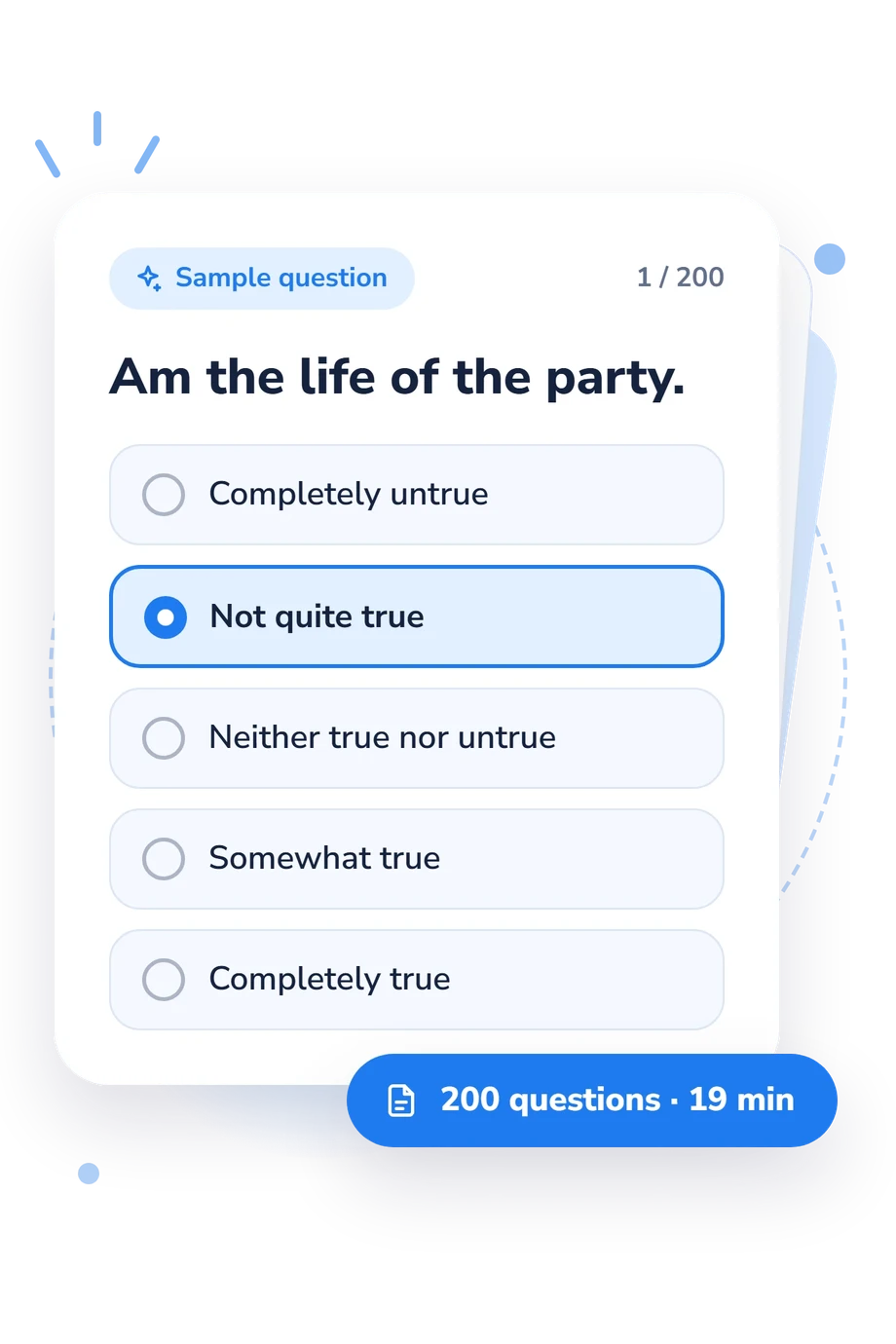
- Completely untrue
- Not quite true
- Neither true nor untrue
- Somewhat true
- Completely true
- Very inaccurate
- Somewhat inaccurate
- Neither accurate nor inaccurate
- Moderately accurate
- Very accurate
- Completely untrue
- Somewhat untrue
- Neither true nor untrue
- Somewhat true
- Completely true
Big Five Factor Markers (BFFM-100) Test - Description and methodology of the test
For people who want a structured view of everyday personality patterns, the Big Five Factor Markers (BFFM-100) Test offers a way to consider how they typically think, feel, organize tasks, relate to others, and engage socially. It is suited to people seeking a practical Big Five personality test, with results shown as a five-part profile rather than a single overall label.
What This Assessment Explores
The questionnaire examines recurring preferences and reactions in everyday situations, from curiosity and emotional reactivity to self-discipline, interpersonal warmth, and social energy. Together, the Big Five personality traits describe broad tendencies rather than fixed abilities or predictions. The profile supports reflection on relationships, work habits, communication, and personal goals.
The five displayed dimensions are:
- Intellect (O), 0-100: Low 0-31, Moderate 32-71, and High 72-100 indicate openness, curiosity, originality, and new interests.
- Emotional Stability (N), 0-100: Low 0-31, Moderate 32-71, and High 72-100 indicate worry and lability versus calm resilience.
- Conscientiousness (C), 0-100: Low 0-31, Moderate 32-71, and High 72-100 indicate organization, self-control, responsibility, and goal pursuit.
- Agreeableness (A), 0-100: Low 0-30, Moderate 31-71, and High 72-100 indicate warmth, cooperation, trust, or critical competitiveness.
- Extraversion (E), 0-100: Low 0-31, Moderate 32-71, and High 72-100 indicate sociability, activity, outgoingness, or solitude.
Methodology and Scientific Basis
The displayed statements use five ordered responses, with anchors that vary between true/untrue and accurate/inaccurate wording and a neutral midpoint. Because wording varies, answer for your usual pattern, not an isolated day.
Responses are combined into five dimension scores. The display gives each a result from 0-100, but individual answer contributions are not stated; read the profile as a composite output, not a hand-scored total.
The five-factor framework draws on related sources: Goldberg (1992) established the foundational marker approach, while Goldberg and colleagues (2006) described the IPIP public-domain item pool. Published IPIP marker studies by Zheng and colleagues (2008) and Mlačić and Goldberg (2007) reported reliability and factor-structure evidence in their samples; these findings concern the source markers, not automatic validation of this online scoring.
The result functions as a personality profile test: displayed bands are not diagnostic thresholds, and scores can reflect current mood, self-awareness, and socially desirable responding; read it as a structured snapshot, not a definitive account of personality. Interpretation is strongest when the five scores are considered together, because social energy, emotional tone, organization, curiosity, and interpersonal style can diverge.
- Goldberg, L. R. (1992). The development of markers for the Big-Five factor structure. Psychological Assessment, 4(1), 26–42. 10.1037/1040-3590.4.1.26
- Zheng, L., Goldberg, L. R., Zheng, Y., Zhao, Y., Tang, Y., & Liu, L. (2008). Reliability and concurrent validation of the IPIP Big-Five factor markers in China: Consistencies in factor structure between Internet-obtained heterosexual and homosexual samples. Personality and Individual Differences, 45(7), 649–654. 10.1016/j.paid.2008.07.009
- Mlačić, B., & Goldberg, L. R. (2007). An analysis of a cross-cultural personality inventory: The IPIP Big-Five factor markers in Croatia. Journal of Personality Assessment, 88(2), 168–177. 10.1080/00223890701267993
- Goldberg, L. R., Johnson, J. A., Eber, H. W., Hogan, R., Ashton, M. C., Cloninger, C. R., & Gough, H. G. (2006). The international personality item pool and the future of public-domain personality measures. Journal of Research in Personality, 40(1), 84–96. 10.1016/j.jrp.2005.08.007
Updated: