
Should I Elope or Have a Wedding Quiz
How the Scales are Structured
Who Usually Takes This Test?
See How You Compare
Below is a preview of how scores are typically distributed across each scale.
Example Questions From the Test
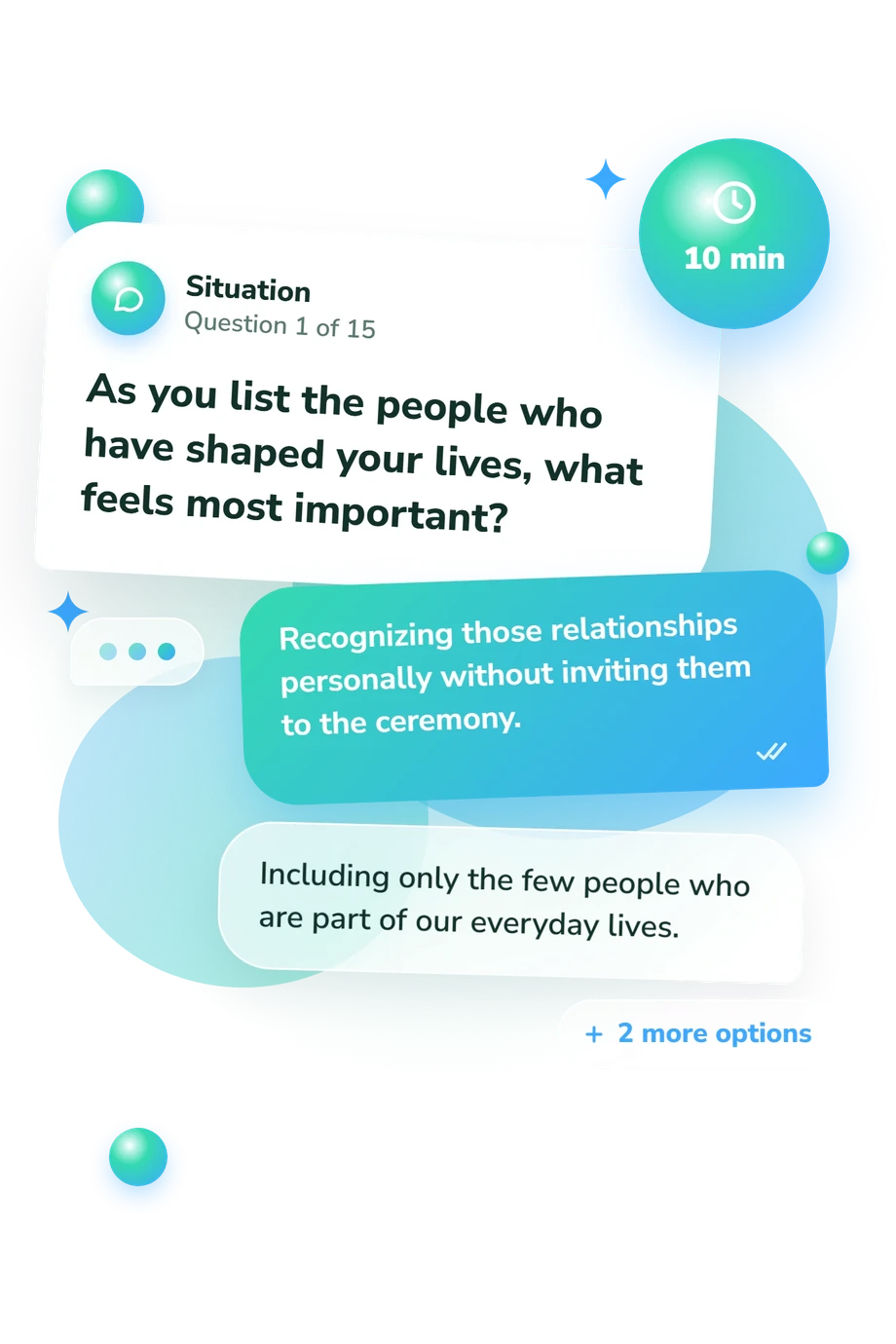
- Recognizing those relationships personally without inviting them to the ceremony.
- Including only the few people who are part of our everyday lives.
- Inviting close circles while setting a clear boundary around the list.
- Bringing together a wide network of family, friends, and community.
- A private ceremony experience or trip centered on us.
- Excellent food and personal details for a small guest group.
- A balanced event for a defined but fairly broad circle.
- Hosting a substantial shared occasion with space, entertainment, and hospitality.
- That feels like more event structure than I want.
- I would use only one small area and simplify the plan.
- I like the options if we can keep the schedule selective.
- The possibilities for a complete guest experience excite me.
Should I Elope or Have a Wedding Quiz - Description and methodology of the test
Competing guest expectations, familiar traditions, desired privacy, and the scale of the event can make this decision feel less like a binary choice than a question of atmosphere. The Should I Elope or Have a Wedding Quiz helps couples identify the experience they want to create. For couples wondering whether they should elope, this should i elope quiz opens a conversation about priorities without reducing them to a yes-or-no answer.
What This Assessment Explores
The questions map guest breadth, privacy, hosting, ceremony attention, traditions, budget, logistics, event scale, and being witnessed to the experience you want. Rather than forcing a binary choice between eloping and holding a wedding, the elope or wedding quiz preserves an intimate middle option and shows how priorities combine.
The scales describe the result:
- Elopement Affinity (0-15) measures the pull of privacy, simplicity, flexibility, and a couple-centered ceremony: Limited pull (0-5), Mixed pull (6-10), or Strong pull (11-15).
- Intimate Wedding Affinity (0-15) measures attraction to a small, hosted celebration with a close circle: Limited pull (0-5), Mixed pull (6-10), or Strong pull (11-15).
- Larger Wedding Affinity (0-15) measures the value placed on broad inclusion, traditions, full hosting, and celebratory energy: Limited Pull (0-5), Mixed Pull (6-10), or Strong Pull (11-15).
The highest score is strongest affinity; scores within one point indicate a blended result.
Methodology and Evidence Base
Each item presents a planning situation involving guests, money, venues, ceremony attention, practical work, meals, traditions, or receptions, followed by four ordered responses. The choices run from a nearly private elopement through an intimate wedding to a broader celebration, so respondents select the preference that feels closest.
Scoring produces three displayed totals. The highest is the strongest affinity; scores within one point indicate a blended profile. Because the questionnaire does not state a standardized weighting rule or population norm, the totals are relative preference indicators rather than clinical cutoffs.
Conceptually, the social framing aligns with Castrén and Maillochon (2009) on guest selection and relational constraints, Carter and Duncan (2017) on personal choice alongside wedding conventions, and Rejowska (2021) on motivations for humanist ceremonies. The questionnaire is not an adaptation of those studies.
When couples use this should we elope quiz, the result can help them clarify priorities without deciding for them; honest self-report is shaped by current circumstances, relationship dynamics, and self-awareness.
- Castrén, Anna-Maija, and Florence Maillochon. “Who Chooses the Wedding Guests, the Couple or the Family?: Individual Preferences and Relational Constraints in France and Finland.” European Societies 11, no. 3 (2009): 369-389. 10.1080/14616690902764724
- Carter, Julia, and Simon Duncan. “Wedding Paradoxes: Individualized Conformity and the ‘Perfect Day’.” The Sociological Review 65, no. 1 (2017): 3-20. 10.1111/1467-954X.12366
- Rejowska, Agata. “Humanist Weddings in Poland: The Various Motivations of Couples.” Sociology of Religion 82, no. 3 (2021): 281-304. 10.1093/socrel/sraa060
Updated: