
Should I Be a Doctor or a Lawyer Quiz
How the Scales are Structured
Who Usually Takes This Test?
See How You Compare
Below is a preview of how scores are typically distributed across each scale.
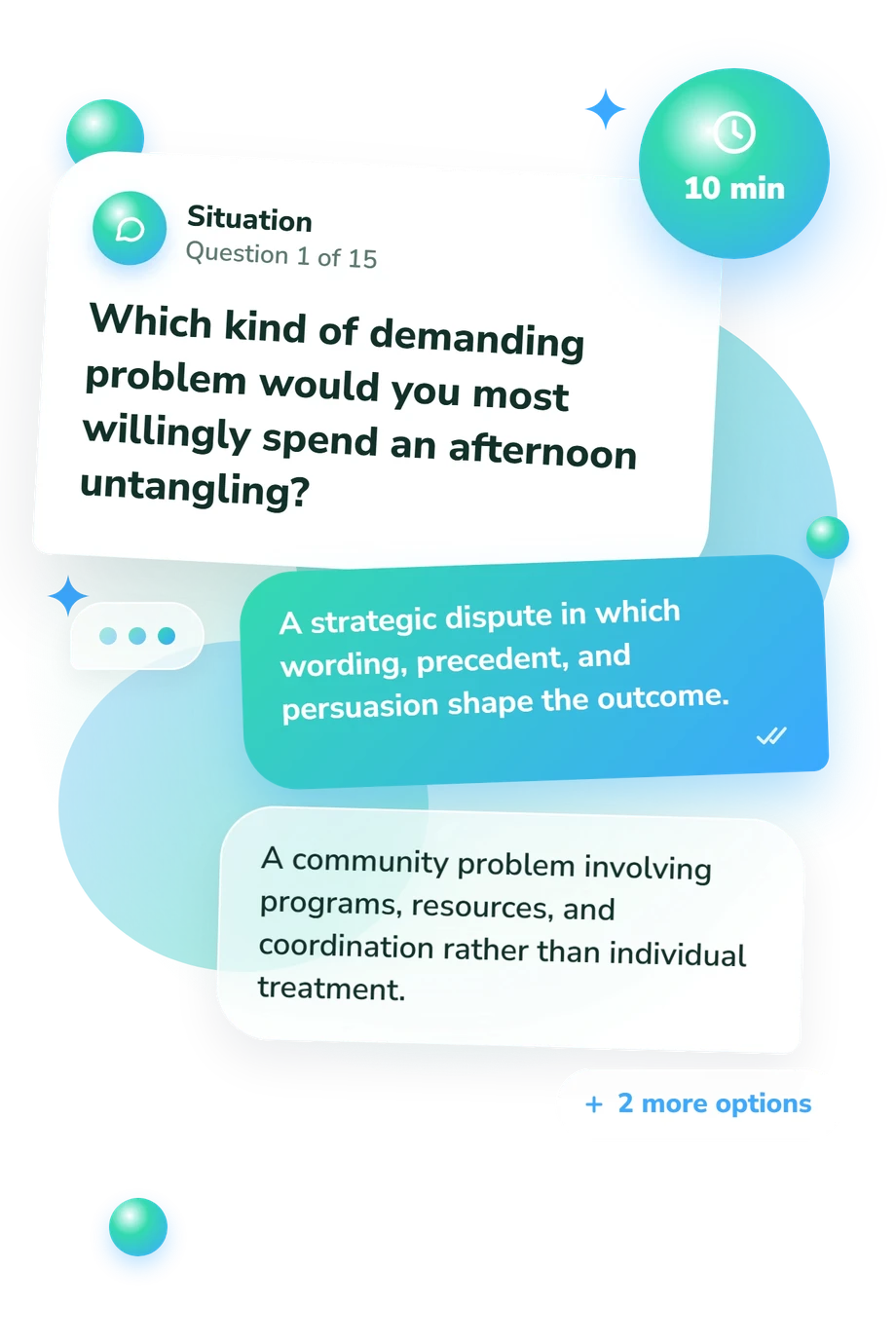
Example Questions From the Test
- A strategic dispute in which wording, precedent, and persuasion shape the outcome.
- A community problem involving programs, resources, and coordination rather than individual treatment.
- A practical health question with some data to interpret but limited patient responsibility.
- A patient's symptoms, history, and test results when several explanations remain possible.
- Very appealing; precision in language and interpretation holds my attention.
- Moderately appealing when the issue or client matters to me.
- Manageable in small amounts, but I want most of my work to be more immediate or hands-on.
- Not appealing; I would avoid a career where this is a recurring core task.
- I could manage occasional exposure, but I would seek work that minimizes it.
- I am comfortable with it when it serves diagnosis, treatment, or reassurance.
- I could adapt, though it would remain a meaningful drawback for me.
- I strongly prefer work where those experiences are not routine.
Should I Be a Doctor or a Lawyer Quiz - Description and methodology of the test
For students, career changers, and others weighing medicine against law, this assessment examines the work itself rather than prestige, family expectations, or imagined professional identities. The Should I Be a Doctor or a Lawyer Quiz highlights preferences around patient responsibility, legal advocacy, uncertainty, precision, and practical constraints. The comparison works as a lawyer or doctor quiz, helping you decide which path, or which alternatives, merits closer investigation.
What This Assessment Explores
Items contrast patient contact, bodily exposure, uncertain outcomes, close reading, evidence, advocacy, training demands, desired impact, and openness to alternatives. The result reflects current perceived fit with everyday work, not predicted achievement.
The dimensions are:
- Doctor Affinity (0-15) shows how compatible clinical reasoning, patient responsibility, and medical training seem: Limited clinical pull (0-5), Conditional medical fit (6-10), or Strong doctor affinity (11-15).
- Lawyer Affinity (0-15) shows how compatible close reading, structured advocacy, client responsibility, and legal training seem: Limited legal pull (0-5), Conditional legal fit (6-10), or Strong lawyer affinity (11-15).
- Explore Beyond Both (0-15) indicates whether reservations or outside interests support widening your shortlist: Focused comparison (0-5), Broaden the shortlist (6-10), or Strong exploration signal (11-15).
In a law school or med school quiz, this framing keeps titles secondary to tasks, values, constraints, and training.
Methodology and Scientific Basis
Each item presents four statements, and you select the response matching your comfort, motivation, likely reaction, or constraint. Themes cover clinical responsibility, legal advocacy, work style, uncertainty, training, and openness to alternatives.
Three totals are reported rather than one verdict. The highest is the strongest affinity; totals within one point of it form a blended result. Because the per-answer weighting formula and normative sample are not published, the bands organise reflection rather than establish population-based cutoffs.
For someone considering the Should I Become a Lawyer or a Doctor Quiz, this method keeps attention on tasks and training demands. It is conceptually consistent with Sci45 (Gale and Grant, 2002), but this questionnaire is not an adaptation of that instrument. Gollob (2018) addresses compatibility with legal education and practice, while Rounds, Hoff, and Lewis (2021) place interest profiling in career exploration; these sources provide context, not validation.
Self-report results can shift with mood, limited firsthand exposure, or the wish to present oneself favourably. Use them alongside observation and research into specialties, settings, and training routes; they cannot predict admission, performance, or satisfaction.
- Gale, Rodney, and Janet Grant. (2002). Sci45: the development of a specialty choice inventory. Medical Education, 36(7), 659-666. 10.1046/j.1365-2923.2002.01256.x
- Gollob, Justin. (2018). An Honest Conversation: An In-Class Tool to Help Pre-Law Students Determine Their Compatibility with Law School and a Legal Career. PS: Political Science & Politics, 51(1), 194-196. 10.1017/S1049096517001937
- Rounds, James, Kevin A. Hoff, and Phil M. Lewis, editors. (2021). O*NET Interest Profiler Manual. National Center for O*NET Development.
Updated: