
Python Control Structures Quiz
How the Scales are Structured
Who Usually Takes This Test?
See How You Compare
Below is a preview of how scores are typically distributed across each scale.
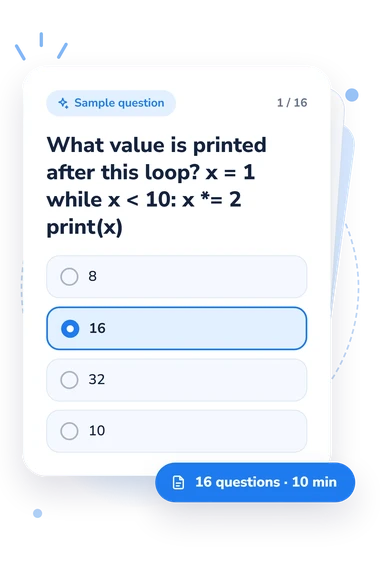
Example Questions From the Test
- 8
- 16
- 32
- 10
- True
- minor
- 18
- adult
- 6
- The code raises an error when continue is reached.
- 10
- 8
Python Control Structures Quiz - Description and methodology of the test
For learners deciding whether to revisit core Python syntax, this assessment provides a focused snapshot of control-flow performance. The 4.12.1 Python Control Structures Quiz helps students, self-directed programmers, and returning coders judge whether further practice is needed. As a Python control flow quiz, it identifies areas where current execution skills are reliable and where targeted practice may be useful.
What This Assessment Explores
The questionnaire measures control-flow knowledge: how programs select branches, repeat instructions, update loop state, and respond when control statements alter execution. It suits learners connecting syntax with behavior.
This Python control flow assessment asks you to predict output or identify what a control statement does. Topics include comparisons, truthiness, ranges, nesting, and loop control.
These are the main skill areas:
- Conditions and branching show whether you can follow comparisons, truth values, and branch order.
- Loops and ranges show whether you can predict repetition, stopping rules, updates, and skipped iterations.
- Nested control shows whether you can track an inner loop separately from an outer loop.
The displayed Python Control Structures Knowledge scale runs from 0-16: Foundations to strengthen (0-6), Developing knowledge (7-12), and Strong knowledge (13-16). These bands suggest whether to review basics, practise tracing, or extend current skill.
Methodology and Evidence Base
Each item presents four answer options. Some ask for printed output from a short program; others test pass, continue, break, conditional order, short-circuit evaluation, or a loop’s else. The assessment combines knowledge of control statements with applied execution tracing.
Each correct answer adds one point to the displayed result. The items cover rules involving branch order, skipped iterations, range boundaries, and loop exits.
The Python Tutorial and Python Language Reference provide technical context for the semantics represented in the items. The educational texts by Martelli, Ravenscroft, and Holden, and by Ekmekci, McAnany, and Mura, offer complementary examples of control-flow and introductory programming.
The result is a quiz-specific snapshot of these control-structure questions rather than a measure of overall Python ability, and because it relies on selected answers to brief code examples, performance can vary with familiarity, attention, and test conditions; additional Python control structures practice can show whether the result carries over to writing and debugging code.
- Python Software Foundation. “More Control Flow Tools.” The Python Tutorial, Python 3.14.7 Documentation, 2026.
- Python Software Foundation. The Python Language Reference, Python 3.14.7 Documentation, 2026.
- Martelli, Alex, Anna Ravenscroft, and Steve Holden. Python in a Nutshell, 3rd ed. O’Reilly Media, 2017.
- Ekmekci, Berk, Charles E. McAnany, and Cameron Mura. “An Introduction to Programming for Bioscientists: A Python-Based Primer.” PLoS Computational Biology, vol. 12, no. 6, 2016, e1004867. 10.1371/journal.pcbi.1004867