
Profile Picture Quiz
How the Scales are Structured
Who Usually Takes This Test?
See How You Compare
Below is a preview of how scores are typically distributed across each scale.
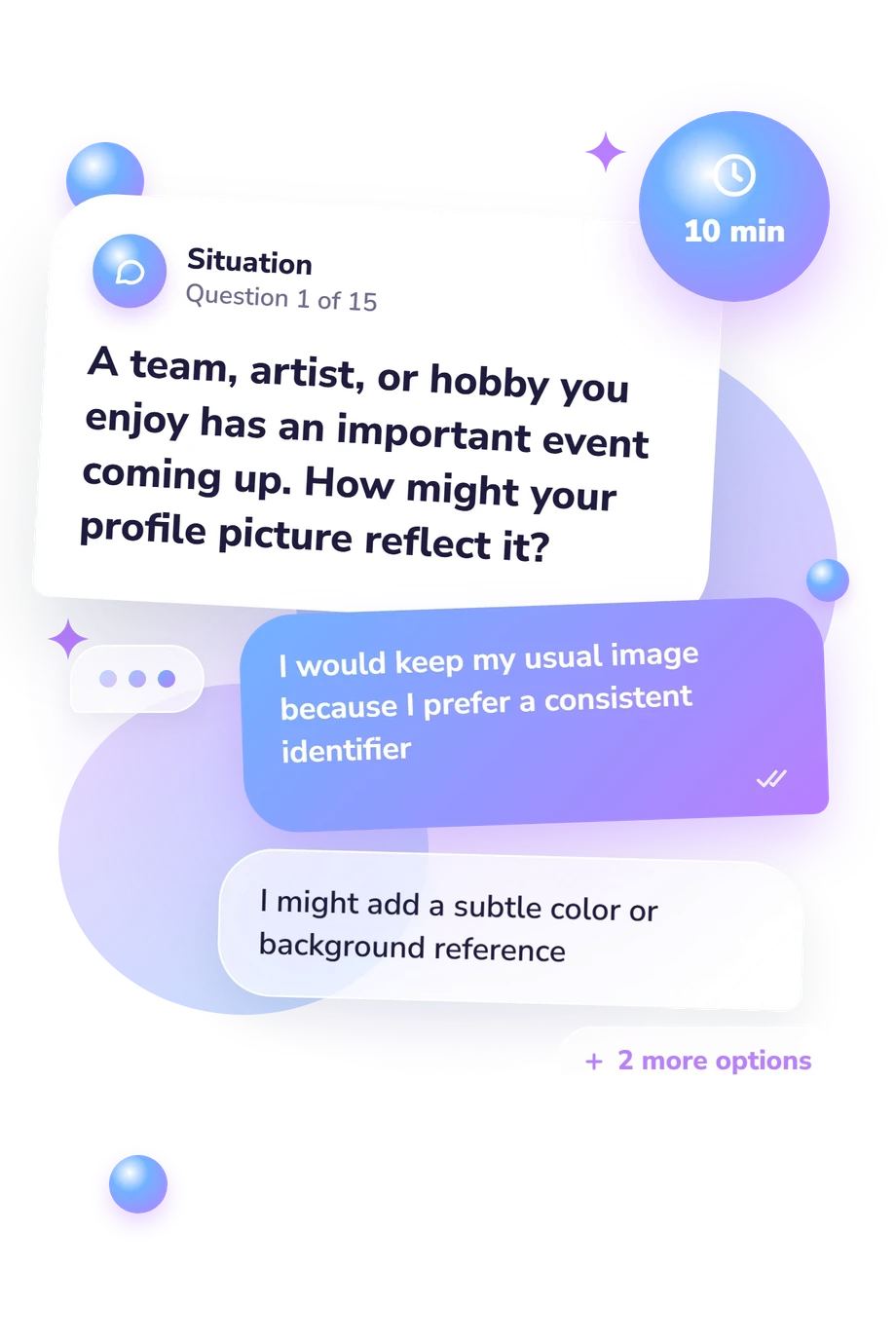
Example Questions From the Test
- Almost never; I usually choose non-personal imagery
- Occasionally, depending on the account's purpose
- Often, although I sometimes use group, distant, or partial views
- Nearly always; easy recognition is usually important to me
- It generally stays the same regardless of the occasion
- I change it only for a personally significant milestone
- I adapt it for selected occasions that matter to me
- I enjoy making timely changes for many events or seasons
- It was spontaneous, and I did not do much to prepare it
- I found a naturally good photo among a small set of options
- I tried several versions and made a few subtle adjustments
- The effortless effect came from careful planning and refinement
Profile Picture Quiz - Description and methodology of the test
People who are reconsidering an online identity can use this assessment to examine choices behind a profile image rather than judge whether one photograph is universally right. The profile picture quiz is intended for anyone curious about how visibility, visual effort, and social meaning shape their presentation. It offers a lens on profile-picture presentation, describing preferences rather than ranking one style above another.
What This Assessment Measures
Your answers examine three connected choices: how much you refine an image, how prominently you show yourself, and how readily you use imagery to signal interests, affiliations, occasions, or values. For someone taking the what should my profile picture be quiz, the result offers a personal pattern rather than a universal recommendation.
The result separates those choices into three dimensions:
- Image Curation (0-15) measures visual planning: Spontaneous Selection (0-5), Light Curation (6-10), and Deliberate Curation (11-15) describe increasing attention to refinement.
- Personal Visibility (0-15) measures recognizability: Selective Presence (0-5), Contextual Visibility (6-10), and Face-Forward Presence (11-15) describe how central your image is.
- Social Signaling (0-15) measures communicated identity: Personal Identifier (0-5), Subtle Signaler (6-10), and Expressive Signaler (11-15) describe how much context your image carries.
Methodology and Evidence Base
Each item presents a situation involving image selection, visibility, updating, cropping, audience, or symbolic meaning, followed by four ordered response options. The choices move from lower to higher emphasis on the relevant tendency, while combined responses produce profile indicators across curation, recognizability, and social signaling.
The themes are conceptually consistent with Strano's 2008 study, which examined self-presentation through Facebook images. Hum and colleagues' 2011 content analysis addressed the personal and social information carried by profile photographs, and Zhao and colleagues' 2008 work situated online presentation within identity construction and audience relationships. These sources support the subject matter, not a claim that this is a validated adaptation of one published instrument.
As an online profile picture assessment, it is useful for comparing your own tendencies and reflecting on context. This self-report questionnaire does not state its point-by-point weighting or standardize scores against reference norms; current context, self-report, and impression management can shape the resulting snapshot of presentation style.
- Strano, Michele M. (2008). User Descriptions and Interpretations of Self-Presentation through Facebook Profile Images. Cyberpsychology: Journal of Psychosocial Research on Cyberspace, 2(2), Article 5.
- Hum, Noelle J., Perrin E. Chamberlin, Brittany L. Hambright, Anne C. Portwood, Amanda C. Schat, and Jennifer L. Bevan. (2011). A picture is worth a thousand words: A content analysis of Facebook profile photographs. Computers in Human Behavior, 27(5), 1828-1833. 10.1016/j.chb.2011.04.003
- Zhao, Shanyang, Sherri Grasmuck, and Jason Martin. (2008). Identity construction on Facebook: Digital empowerment in anchored relationships. Computers in Human Behavior, 24(5), 1816-1836. 10.1016/j.chb.2008.02.012
Updated: