
Plot Elements Quiz
How the Scales are Structured
Who Usually Takes This Test?
See How You Compare
Below is a preview of how scores are typically distributed across each scale.
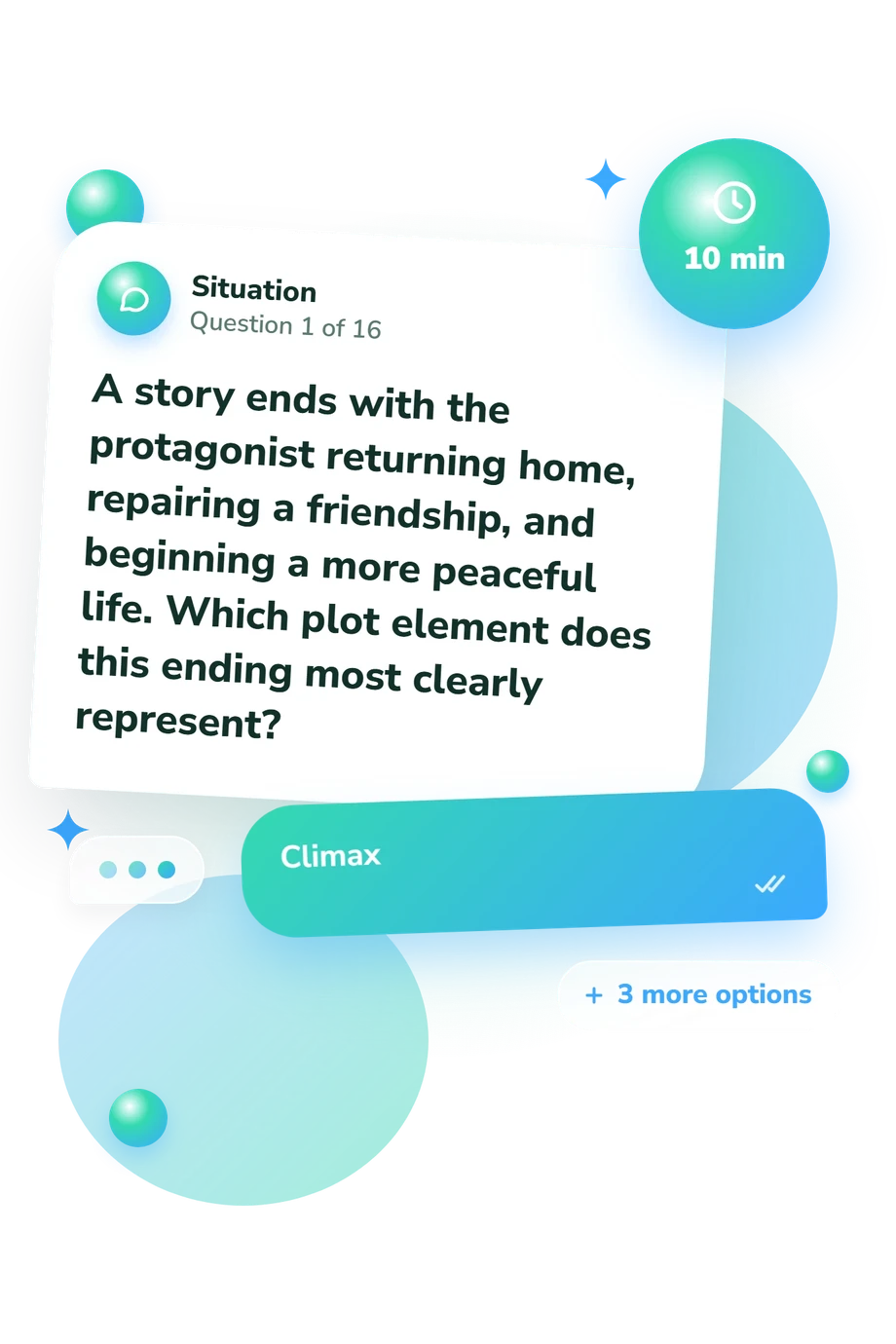
Example Questions From the Test
- Character versus nature
- Character versus society
- Internal conflict
- External conflict with another character
- Exposition
- Rising action
- Resolution
- Falling action
- Resolution
- Climax
- Falling action
- Exposition
Plot Elements Quiz - Description and methodology of the test
Readers who want to strengthen their understanding of narrative form can use this assessment to distinguish major plot functions in familiar story situations. The plot elements quiz is intended for learners, readers, and anyone seeking a focused review of core terminology. It emphasizes recognition and application rather than personal taste. This focus on plot structure can guide further review before discussion or analysis.
What This Assessment Explores
Questions use definitions and brief story situations to test whether terms can be recognized and applied. As a quiz about the elements of plot, it covers these connected areas:
- Exposition and the inciting incident show how a narrative establishes its starting conditions and launches its central conflict.
- Rising action and climax distinguish escalating complications from the decisive turning point.
- Falling action and resolution separate immediate consequences from the later, more settled outcome.
- Conflict, subplot, and foreshadowing test recognition of supporting structures and techniques that shape the main storyline.
The result is Plot Elements Knowledge (0-16): Foundation to Build (0-6) means you recognize some story concepts and may benefit from reviewing the main plot sequence and each element's function; Developing Knowledge (7-12) reflects substantial but incomplete understanding; Strong Knowledge (13-16) indicates accurate recognition across definitions and scenarios. It describes quiz performance, not overall writing ability.
Methodology and Scientific Basis
Each item presents a short definition or scenario with four answer choices, asking the respondent to identify the best plot term or sequence. Together, the four-choice items form an assessment of plot elements that produces one overall educational score, summarizing performance on these keyed concepts.
The plot sequence is conceptually consistent with Freytag's Pyramid, which organizes dramatic movement through exposition, rising action, climax, falling action, and a final catastrophe; this quiz uses resolution as its term for the settled outcome. The turning-point emphasis is also conceptually consistent with work by Papalampidi, Keller, and Lapata, while López offers a broader account of story architecture. This questionnaire is consistent with those works, not an adaptation or validated administration of any one of them.
The questionnaire is presented as an educational tool, and its bands are descriptive categories for this quiz. The single band summarizes quiz performance and can be affected by prior instruction, familiarity with literary vocabulary, guessing, and interpretation of a brief scenario; it reflects performance across these items rather than separate mastery ratings.
- Freytag, Gustav. Freytag's Technique of the Drama: An Exposition of Dramatic Composition and Art. An Authorized Translation from the 6th German Edition by Elias J. MacEwan. Chicago: S. C. Griggs, 1894.
- Papalampidi, Pinelopi, Frank Keller, and Mirella Lapata. “Movie Plot Analysis via Turning Point Identification.” Proceedings of the 2019 Conference on Empirical Methods in Natural Language Processing and the 9th International Joint Conference on Natural Language Processing, Association for Computational Linguistics, 2019, pp. 1707-1717. 10.18653/v1/D19-1180.
- López, Lorraine M. “The Architecture of Story.” In A Companion to Creative Writing, edited by Graeme Harper, Wiley-Blackwell, 2013. 10.1002/9781118325759.ch1.
Updated: