
Freudly+971 508685814hello@freudly.ai
Freudly
pedagogy

Professional and Teaching Motivation Self-Assessment Questionnaire Test
Take the online Professional and Teaching Motivation Self-Assessment Questionnaire Test - AI psychologist FreudlyYou can take Professional and Teaching Motivation Self-Assessment Questionnaire Testhere. Online version of a simple and accurate psychological test with interpretation.en
Understand an educator’s professional motivation level in 4 minutes. With 18 items, it pinpoints growth opportunities and flags disengagement risk for smarter coaching and support.
Start Online Test
Questions: 184 minutes
08:30
October 2, 2025
October 2, 2025
Material has been updated
October 2, 2025
Material has been published
33,503 views
3,237 completions
2,727 likes
Verified by Daniel Hall
Psychologist with 25 years of experience
Share
Scale Explorer

How the Scales are Structured

example score
13/15
Indifferent Attitude (IA)
Measures the degree of indifference and low engagement toward professional-pedagogical activities.
Low indifference
Moderate indifference
High indifference
36: Low indifference | 710: Moderate indifference | 1115: High indifference
A score of 13 falls in the High indifference range, suggesting notably low engagement and limited interest in professional-pedagogical tasks at this time.
example score
9/15
Episodic Curiosity (EC)
Measures situational, short-lived interest in specific aspects of professional pedagogical activity that may not remain stable over time.
Low curiosity
Moderate curiosity
High curiosity
36: Low curiosity | 710: Moderate curiosity | 1115: High curiosity
A score of 9 indicates moderate episodic curiosity, suggesting periodic interest in specific pedagogical topics that may vary with context and may not always persist.
example score
8/15
Demonstrative Interest (DI)
Measures the degree to which a person outwardly demonstrates enthusiasm for pedagogical work that may not reflect their internal motivation.
Low showiness
Moderate showiness
High showiness
36: Low showiness | 710: Moderate showiness | 1115: High showiness
A score of 8 indicates a moderate tendency to display enthusiasm for professional-pedagogical work, which may sometimes be more visible than deeply felt.
example score
12/15
Developing Curiosity (DC)
Measures the extent to which a person actively seeks new professional-pedagogical knowledge and enjoys learning to improve their practice.
Low curiosity
Developing curiosity
High curiosity
36: Low curiosity | 711: Developing curiosity | 1215: High curiosity
A score of 12 indicates high developing curiosity, reflecting a strong, consistent drive to explore new pedagogical knowledge and refine skills.
example score
8/15
Functional Interest (FI)
Functional Interest measures how consistently a person is engaged with and applies the content of their professional pedagogical work rather than relating to it formally.
Low
Moderate
High
36: Low | 710: Moderate | 1115: High
A score of 8 indicates a moderate functional interest, suggesting generally steady engagement with professional duties with some room to strengthen regular application of pedagogical skills.
example score
6/15
Professional Need (PN)
Measures the strength of internal motivation to develop professionally and self-realize in pedagogical work.
Low professional need
Moderate professional need
High professional need
36: Low professional need | 710: Moderate professional need | 1115: High professional need
A score of 6 indicates a low professional need, suggesting internal drive for ongoing professional growth is currently limited and may rely more on external prompts.
Start Online Test
just completed the test
DATA-BASED USER COHORTS

Who Usually Takes This Test?

Teachers Checking Their Drive
44%OF USERS
Practicing educators take it to see whether their motivation is fading, stable, or growing and what to work on next.
Early-Career Educators
33%OF USERS
New teachers and student teachers use it to understand how strong their interest in pedagogy is and where they are in professional development.
School Leaders and HR
23%OF USERS
Principals, department heads, and HR specialists use it to spot motivation risks in staff and plan targeted support or training.
BASED ON AGGREGATED, ANONYMIZED DATA FROM TENS OF THOUSANDS OF FREUDLY USERS.
Benchmarking

See How You Compare

Once you complete the test, your results are compared with real-world data from people in your country.
Below is a preview of how scores are typically distributed across each scale.
Indifferent attitude (Ia)
Average
6
Normal range
4.18
min.
3
max.
15
This curve shows how scores are typically distributed.
Once you complete the test, your result will appear on the scale so you can see how you compare.
Episodic Curiosity (EC)
Average
7.9
Normal range
6.49.5
min.
3
max.
15
This curve shows how scores are typically distributed.
Once you complete the test, your result will appear on the scale so you can see how you compare.
Showy interest (Si)
Showy interest (Si)
Average
7.7
Normal range
6.39.2
min.
3
max.
15
This curve shows how scores are typically distributed.
Once you complete the test, your result will appear on the scale so you can see how you compare.
Developing curiosity (Dc)
Average
8
Normal range
610.1
min.
3
max.
15
This curve shows how scores are typically distributed.
Once you complete the test, your result will appear on the scale so you can see how you compare.
Functional Interest (FI)
Average
10.7
Normal range
9.112.2
min.
3
max.
15
This curve shows how scores are typically distributed.
Once you complete the test, your result will appear on the scale so you can see how you compare.
Professional need (Pn)
Average
9.7
Normal range
7.711.6
min.
3
max.
15
This curve shows how scores are typically distributed.
Once you complete the test, your result will appear on the scale so you can see how you compare.
Featured On
SAMPLE QUESTIONS

Example Questions From the Test

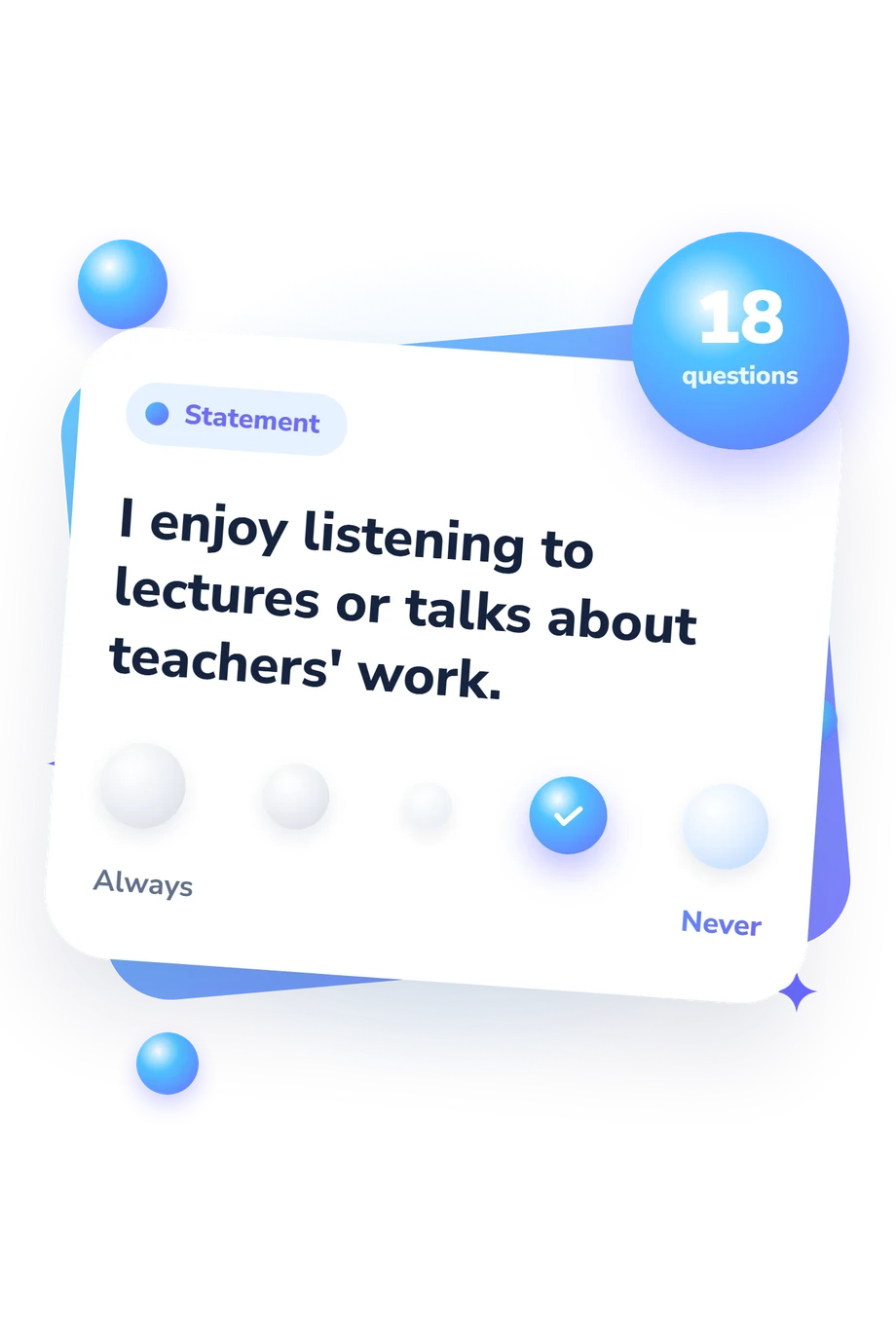
Please rate the statements below. It is recommended that you reflect on yourself, as the first step toward wisdom is self-knowledge. This has been recognized since ancient times.
    • Always
    • Not always, but often
    • Not very often
    • Rarely
    • Never
    • Always
    • Not always, but often
    • Not very often
    • Rarely
    • Never
    • Always
    • Not always, but often
    • Not very often
    • Rarely
    • Never
WHAT THE TEST MEASURES
About This Assessment
Self-Esteem of Professional and Pedagogical Motivation Test

Professional and Teaching Motivation Self-Assessment Questionnaire Test - Symptoms and Signs

pedagogy

This self-report instrument is designed to assess an individual’s motivation toward professional practice and teaching-related activities. The Professional and Teaching Motivation Self-Assessment Questionnaire uses brief, structured items to characterize motivation along a continuum from low engagement to more internalized, self-determined reasons for professional development. It is commonly used to support reflective discussion and to inform developmental planning in educational or training contexts.

The measure includes 18 items and typically takes about 4 minutes to complete. Respondents rate statements describing attitudes, interest, and perceived value related to teaching and professional growth; results are generally interpreted as indicative of relative motivational orientation rather than as a standalone diagnostic finding. The Professional and Teaching Motivation Self-Assessment Questionnaire is attributed to Edward L. Deci and Richard M. Ryan.

Author: Edward L. Deci, Richard M. Ryan
Literature: Deci, E. L., & Ryan, R. M. Intrinsic motivation and self-determination in human behavior. Plenum Press. 1985.
Popular tests
Comments
Leave a Comment