
Libertarian Quiz
How the Scales are Structured
Who Usually Takes This Test?
See How You Compare
Below is a preview of how scores are typically distributed across each scale.
Example Questions From the Test
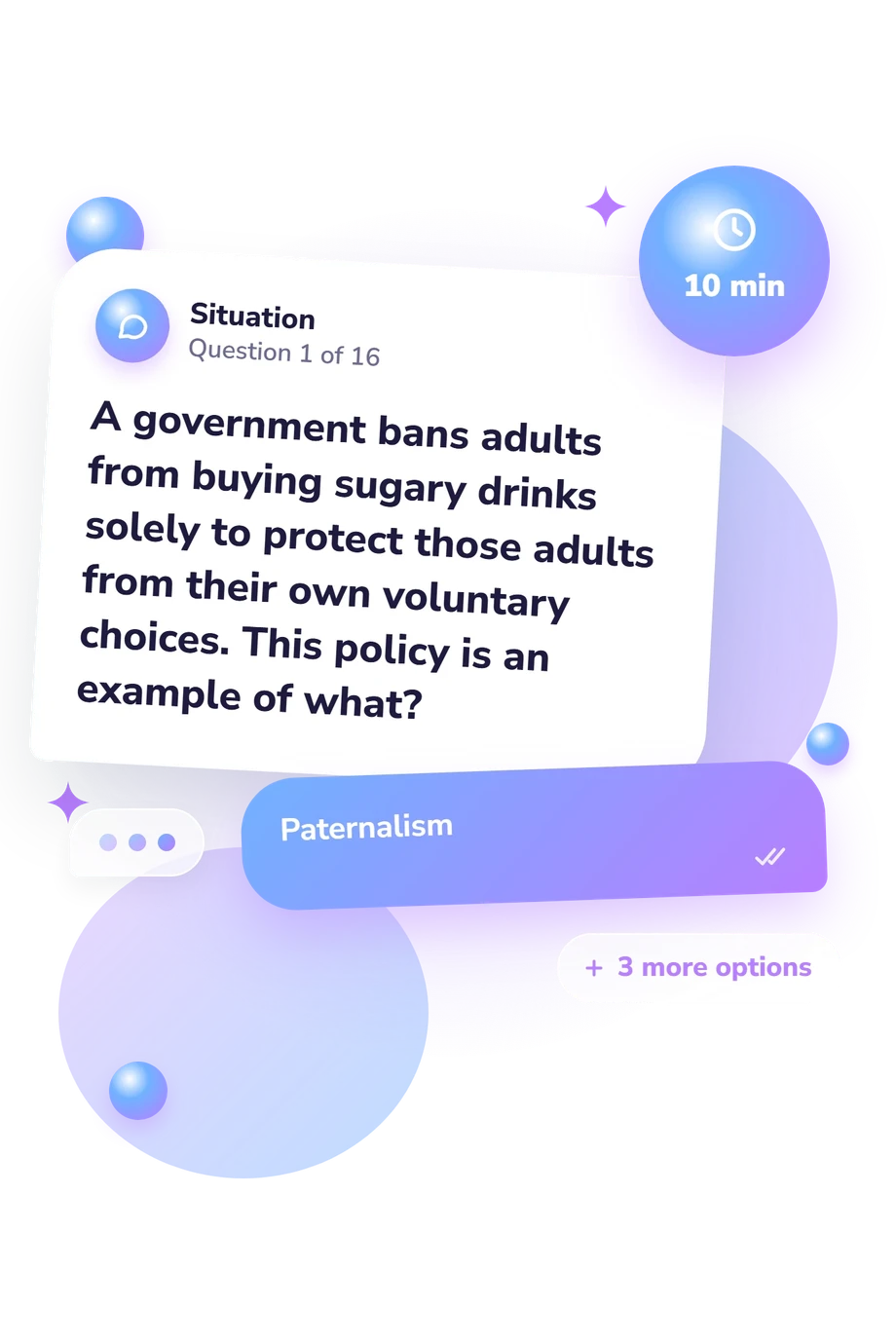
- Paternalism
- Restorative justice
- Spontaneous order
- Freedom of association
- The person makes an unconventional choice that affects only their own life.
- The person expresses an idea that most neighbors find offensive.
- The person’s conduct directly threatens serious harm to another person.
- The person refuses advice intended to improve their wellbeing.
- Only private actors respond to incentives.
- Government decisions are unaffected by institutional rules.
- Elections eliminate conflicts of interest among officials.
- Political actors also respond to incentives and may pursue personal or organizational interests.
Libertarian Quiz - Description and methodology of the test
Readers who want to examine libertarian ideas without reducing them to a party label can use the Libertarian Quiz as a structured introduction to political concepts. It suits curious learners, students, and anyone checking their understanding of libertarian political philosophy. Rather than asking you to identify with a political label, it checks familiarity with libertarian concepts and distinctions.
What This Assessment Explores
Libertarian thought is a family of views valuing individual liberty and questioning concentrated coercive power. It suits readers comparing libertarian political theory, institutions, and economic arguments.
Its scenarios connect principles with civic situations, covering harm, non-aggression, self-ownership, expression, paternalism, property, markets, and government. The items test recognition and application rather than assigning an ideological type.
The main areas are:
- Liberty and coercion test recognition of how harm, non-aggression, self-ownership, expression, and interference are distinguished.
- Institutions and markets assess whether you can identify paternalism, public choice, minimal or stateless government, spontaneous order, and the knowledge problem.
- Justice and traditions test distinctions among entitlement, property, left- and right-libertarian positions, and legal protection versus moral approval.
- Libertarianism Knowledge (0-16) measures overall conceptual understanding: Foundation (0-6), Developing (7-12), Strong (13-16). This educational score does not determine political identity or party affiliation.
Methodology and Evidence Base
Each item presents a conceptual or applied prompt with four answer choices. Scenarios ask the reader to identify a principle in action, while direct questions test distinctions among traditions, institutions, rights, and economic coordination. The result is a single knowledge score on the stated scale; the item-level scoring rule is not provided, so the displayed range alone does not show how individual answers contribute.
The conceptual reference point is van der Vossen and Christmas (2025), whose overview situates shared libertarian commitments and disagreements. Mill supplies the harm principle; Nozick supports entitlement and minimal-state arguments; Hayek supports the knowledge problem and decentralized coordination. The questionnaire is conceptually consistent with these works, not an adaptation, reproduction, or validation of any one of them.
In practice, the format tests knowledge of libertarianism: answers are checks on concepts and distinctions. The displayed result is an educational score, and its bands should not be read as a measure of political identity. Performance can reflect prior reading, wording, and current understanding; it describes achievement on selected concepts and does not cover every debate within libertarian thought.
- van der Vossen, Bas, and Billy Christmas. "Libertarianism." The Stanford Encyclopedia of Philosophy, Fall 2025 Edition, edited by Edward N. Zalta and Uri Nodelman, Metaphysics Research Lab, Stanford University, 2025.
- Nozick, Robert. Anarchy, State, and Utopia. New York: Basic Books, 1974.
- Mill, John Stuart. On Liberty. London: John W. Parker and Son, 1859.
- Hayek, F. A. "The Use of Knowledge in Society." The American Economic Review, vol. 35, no. 4, 1945, pp. 519-530. 10.2307/1809376.
Updated: