
Is It Love or Lust Quiz
How the Scales are Structured
Who Usually Takes This Test?
See How You Compare
Below is a preview of how scores are typically distributed across each scale.
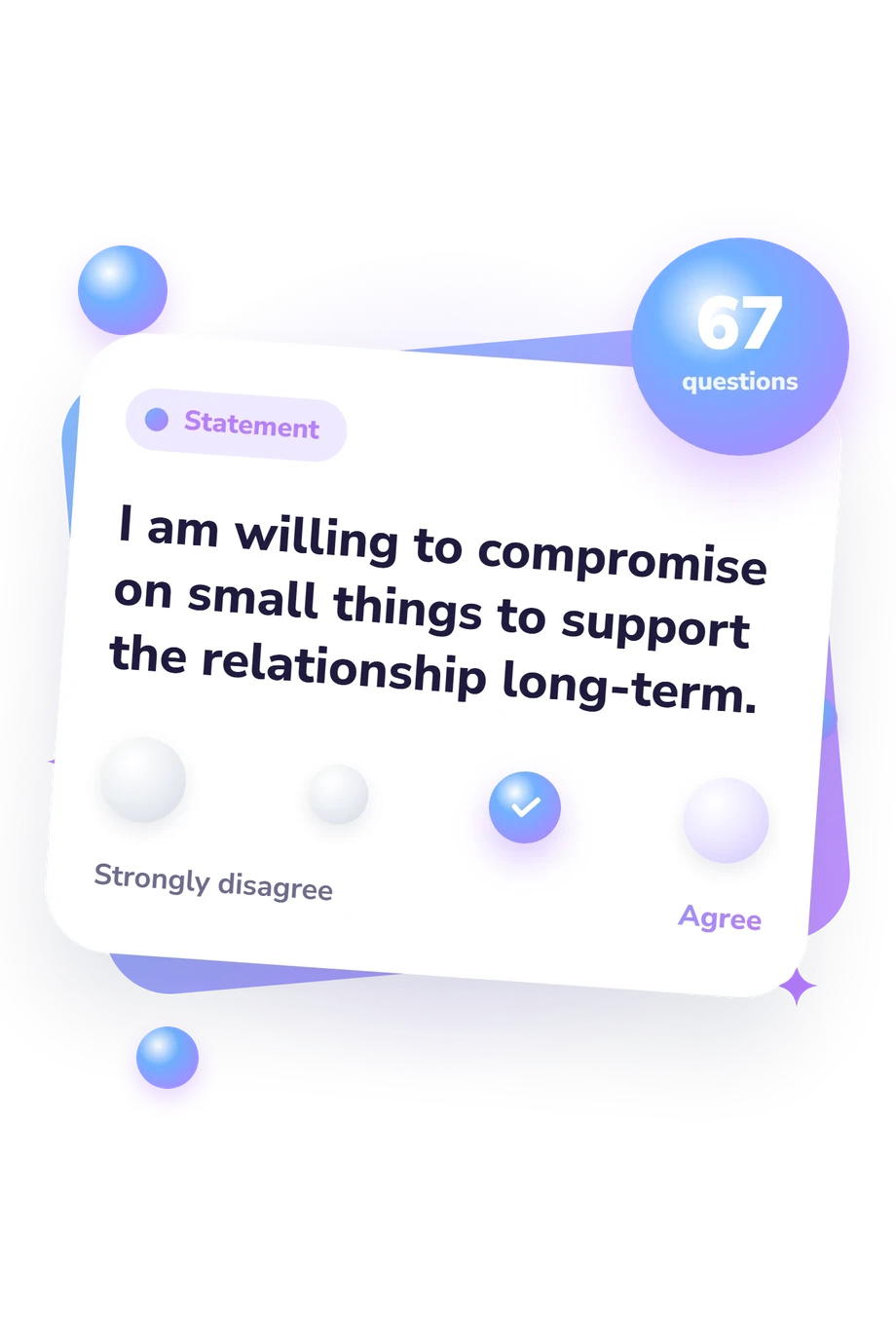
Example Questions From the Test
- Strongly disagree
- Disagree
- Not sure
- Agree
- Strongly disagree
- Disagree
- Not sure
- Agree
- Strongly disagree
- Disagree
- Not sure
- Agree
Is It Love or Lust Quiz - Description and methodology of the test
People who feel both strong chemistry and growing attachment can use this assessment to sort those experiences into a clearer profile. The Is It Love or Lust Quiz is intended for someone reflecting on a current attraction or relationship, especially when excitement, emotional closeness, and commitment do not point in exactly the same direction. As a quiz about love or lust, it highlights patterns worth discussing with yourself or a partner.
What This Assessment Explores
Attraction may combine chemistry, closeness, and commitment, so the assessment separates these strands. This love versus lust test helps you consider whether your connection leans toward intimacy, physical intensity, future-building, or a combination. It suits reflection on a new or established relationship, while the profile helps compare what you feel now with the kind of connection you may be prepared to build.
The result profile covers three dimensions:
- Love Orientation (0-40) measures emotional intimacy, trust, shared values, commitment, and long-term compatibility. Bands: Low love indicators (0-13), Moderate love indicators (14-26), High love indicators (27-40).
- Lust Orientation (0-40) measures chemistry, novelty, intensity, and sexual focus. Bands: Lower lust focus (0-13), Mixed lust focus (14-26), Higher lust focus (27-40).
- Relationship Readiness (0-20) measures clarity, communication, consistency, and investment beyond excitement. Bands: Low readiness (0-6), Mixed readiness (7-13), High readiness (14-20).
Methodology and Scientific Basis
Questions are self-statements rated on four displayed choices: Strongly disagree, Disagree, Not sure, and Agree. Themes include compromise, conflict, trust, future planning, physical fantasy, boundaries, consistency, and making room for a partner. For someone weighing follow-through as well as attraction, it can function as a relationship readiness quiz without reducing the result to yes or no.
The result reports separate scores across the three displayed dimensions.
The constructs in this questionnaire are conceptually consistent with Hendrick and Hendrick (2002), whose work distinguishes love-oriented and sex-oriented perceptions. Acker and Davis’s 1992 work connects intimacy, passion, and commitment, while Diamond’s 2004 review explains why romantic love and sexual desire can overlap without being identical. This questionnaire is not presented as an adaptation or validation of those instruments.
As an online self-report profile, it can be affected by mood, idealization, conflict, self-awareness, and relationship stage. Its bands are interpretive labels for the displayed ranges, so the profile is best read as a pattern across dimensions rather than a single verdict.
- Hendrick, Susan S., & Hendrick, Clyde. (2002). Linking Romantic Love with Sex: Development of the Perceptions of Love and Sex Scale. Journal of Social and Personal Relationships, 19(3), 361-378. 10.1177/0265407502193004
- Acker, Michele, & Davis, Mark H. (1992). Intimacy, Passion and Commitment in Adult Romantic Relationships: A Test of the Triangular Theory of Love. Journal of Social and Personal Relationships, 9(1), 21-50. 10.1177/0265407592091002
- Diamond, Lisa M. (2004). Emerging Perspectives on Distinctions Between Romantic Love and Sexual Desire. Current Directions in Psychological Science, 13(3), 116-119. 10.1111/j.0963-7214.2004.00287.x
Updated: