
Is He Cheating on Me Quiz
How the Scales are Structured
Who Usually Takes This Test?
See How You Compare
Below is a preview of how scores are typically distributed across each scale.
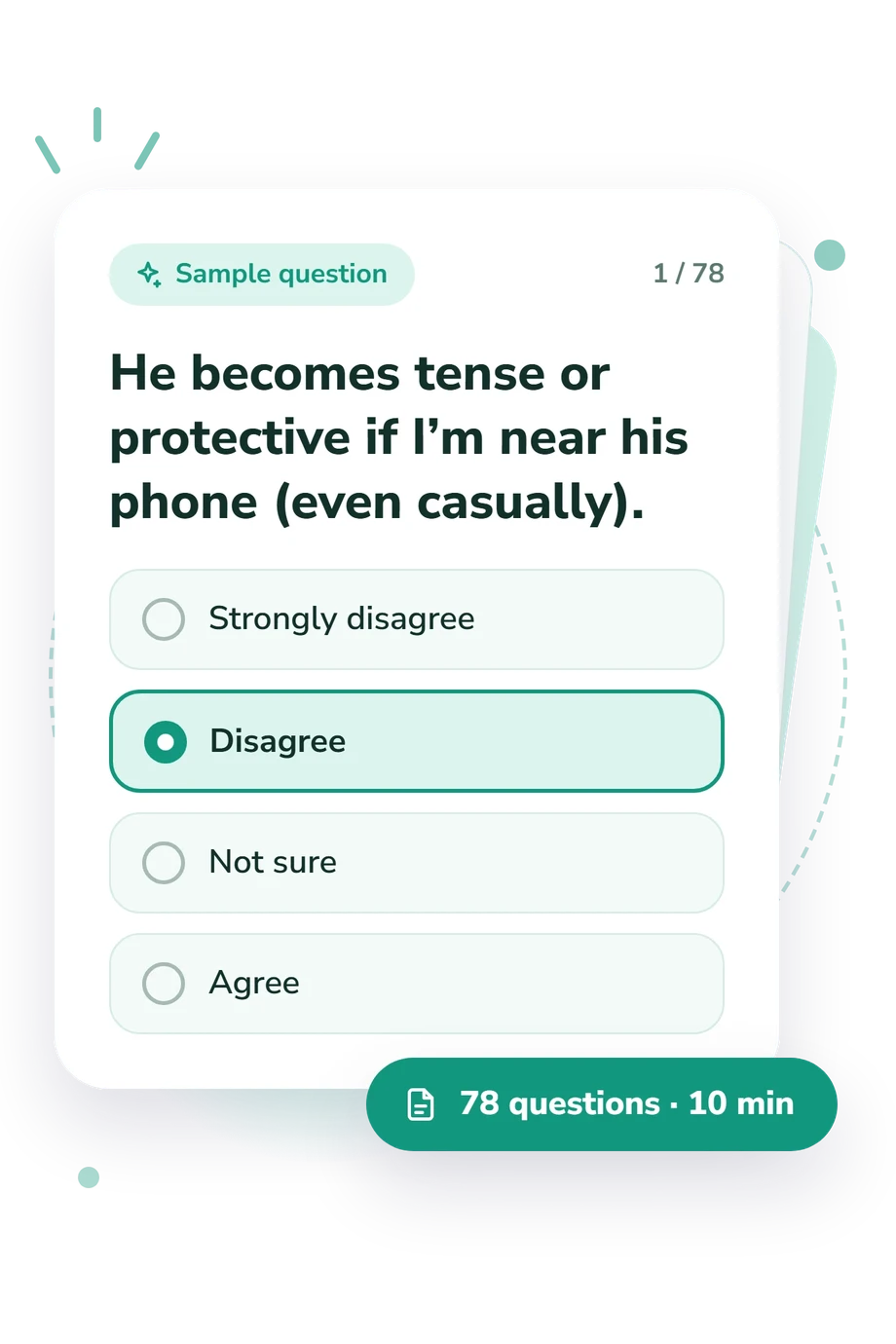
Example Questions From the Test
- Strongly disagree
- Disagree
- Not sure
- Agree
- Strongly disagree
- Disagree
- Not sure
- Agree
- Strongly disagree
- Disagree
- Not sure
- Agree
Is He Cheating on Me Quiz - Description and methodology of the test
People unsettled by secrecy, changing routines, or defensive conversations can use this questionnaire to organize what they notice. The Is He Cheating on Me Quiz turns those observations into a structured reflection on relationship patterns, helping a reader see whether concern centers on privacy, explanations, or trust. Someone considering an Is My Boyfriend Cheating on Me Quiz can use the result to prepare a calmer conversation rather than treat one incident as proof.
What This Assessment Explores
The questionnaire examines device privacy, hidden social activity, changing routines, inconsistent accounts, defensiveness, and difficulty obtaining reassurance. It also captures emotional distance, escalating arguments, and uncertainty about trust. As a test for signs of cheating in a spouse, it organizes observable behaviors without treating one incident as proof of infidelity.
The displayed dimensions show what each result contributes:
- Infidelity Concern (0-30) measures overall red-flag concern; Low concern is 0-10, Moderate concern is 11-20, and High concern is 21-30.
- Secrecy & Avoidance (0-20) measures privacy extremes and avoidance; Low is 0-6, Moderate is 7-13, and High is 14-20.
- Trust & Communication Strain (0-20) measures relational tension and reduced trust clarity; Low strain is 0-6, Moderate strain is 7-13, and High strain is 14-20.
A reader framing the issue as a quiz about signs of a cheating husband can see whether concern is broad or concentrated in secrecy and communication.
Methodology and Evidence
Items use self-report statements with ordered choices. The sample mixes agreement scales, frequency options, and occurrence or intensity responses. Themes cluster around privacy and avoidance, changing routines or explanations, and interpersonal tension. Responses feed the displayed dimensions, but the questionnaire does not publish the point value assigned to each option, so the bands should be read as reported categories rather than reverse-engineered scoring.
Methodologically, the questionnaire is conceptually consistent with Suspicion confirmation and avoidance strategies (Weigel & Shrout, 2025), the closest source for suspicion, avoidance, and communication around infidelity. It also relates to Pfeiffer and Wong’s (1989) multidimensional account of jealousy, particularly cognitive, emotional, and behavioral reactions to uncertainty. It is not presented as an adaptation, and those sources do not validate its specific items.
Interpretation works best at the pattern level. Someone using an Is My Boyfriend Cheating Quiz should consider whether concerns recur across contexts and how strongly trust and communication are affected. Self-report can be shaped by conflict, memory, expectations, and self-awareness; without stated normative standardization, scores cannot establish infidelity or determine a partner’s intentions.
- Weigel, Daniel J., and M. Rosie Shrout. "Are You Cheating on Me? Identifying Factors Contributing to the Use of Suspicion Confirmation and Avoidance Strategies." Western Journal of Communication, vol. 89, no. 1, 2025, pp. 108-131. 10.1080/10570314.2024.2324382
- Pfeiffer, Susan M., and Paul T. Wong. "Multidimensional Jealousy." Journal of Social and Personal Relationships, vol. 6, no. 2, 1989, pp. 181-196. 10.1177/026540758900600203
Updated: