
Internal Medicine Quiz
How the Scales are Structured
Who Usually Takes This Test?
See How You Compare
Below is a preview of how scores are typically distributed across each scale.
Example Questions From the Test
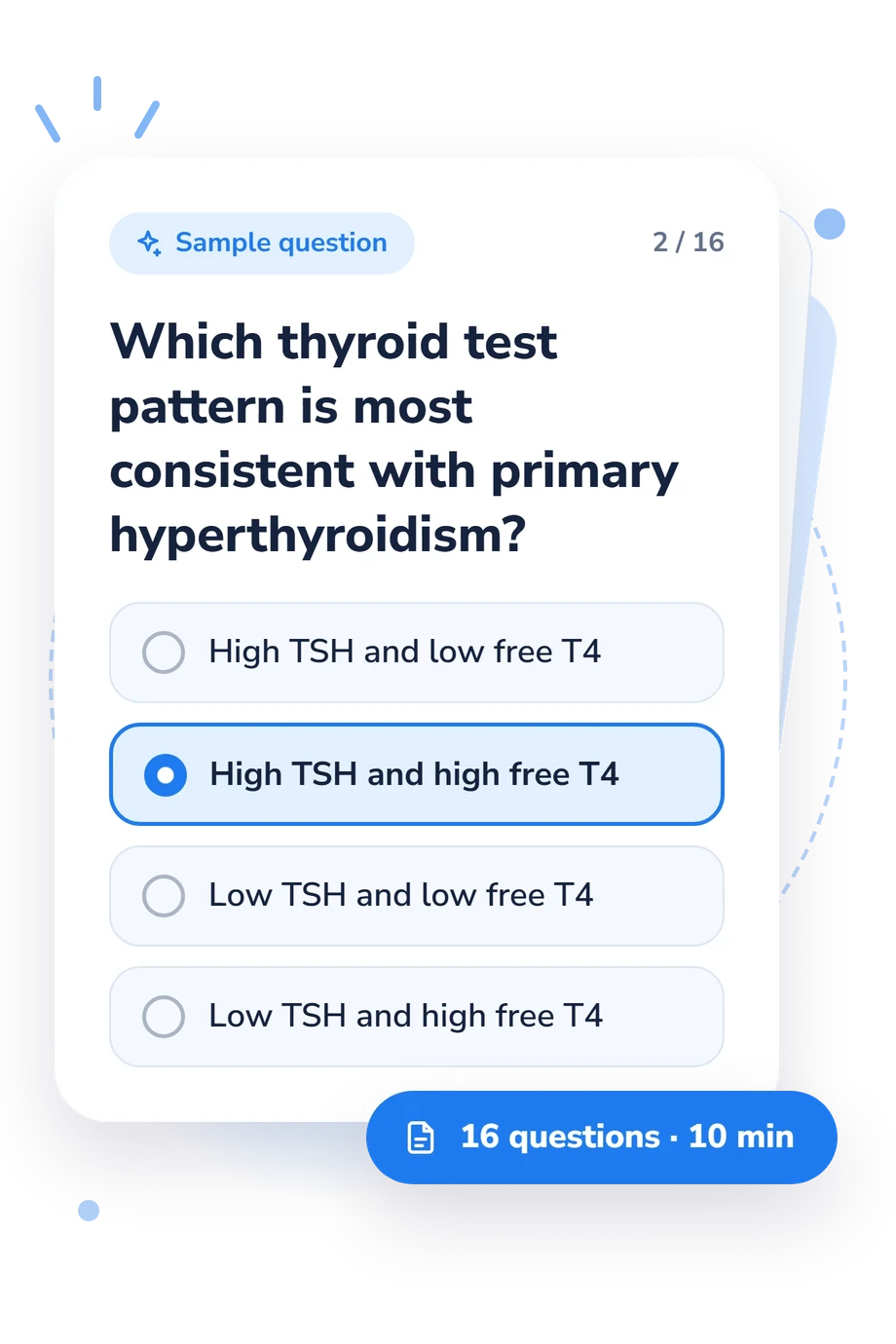
- High TSH and low free T4
- High TSH and high free T4
- Low TSH and low free T4
- Low TSH and high free T4
- Low ferritin
- Elevated haptoglobin
- Elevated ferritin
- Elevated mean corpuscular volume
- Prominent U waves
- A shortened PR interval with a delta wave
- Tall, peaked T waves
- Diffuse ST elevation with PR depression
Internal Medicine Quiz - Description and methodology of the test
For learners revising diagnosis and management across common organ systems, this assessment offers a focused way to check whether clinical clues lead to an appropriate interpretation or next step. The internal medicine quiz can help students and other learners identify topics for targeted review. An internal medicine knowledge test of this kind also supports reflection after teaching, coursework, or independent study.
What This Assessment Measures
Across the scenarios, quiz questions in internal medicine ask learners to connect symptoms, examination clues, laboratory data, and test results with a likely diagnosis, syndrome, investigation, or initial treatment. The focus is practical pattern recognition across common systems, making it suitable for students and other learners reviewing core concepts.
The main thematic groups are:
- Allergy and immunology items interpret hypersensitivity, anaphylaxis, and antibody-deficiency patterns.
- Endocrine and metabolic items distinguish thyroid disease, SIADH, and potassium shifts in diabetic ketoacidosis.
- Hematology, renal, and rheumatologic items connect anemia, nephrotic syndrome, and crystal arthritis with characteristic findings.
- Cardiopulmonary, infectious, and vascular items cover asthma, hyperkalemia, endocarditis, and suspected DVT.
Internal Medicine Knowledge runs from 0-16: Foundation to Build (0-6), Developing Knowledge (7-12), and Strong Knowledge (13-16). The bands guide revision from this sample rather than measure clinical competence.
Methodology and Evidence Base
Each scenario presents a vignette with four answer choices. The respondent selects the option that best fits a diagnosis, investigation, finding, or initial management decision, combining recall with application of symptoms, laboratory values, physiology, and test results.
The score is reported as an educational summary within the displayed scale, with feedback bands tied to this question set. No separate standard-setting process, norm group, reliability estimate, or validated proficiency threshold is stated for this online internal medicine assessment, so the result helps set study priorities rather than rank clinical ability.
Conceptually, the format is consistent with the Internal Medicine In-Training Examination (Garibaldi et al., 1994), a structured knowledge examination used in internal medicine training. Garibaldi et al. (2002) examined performance over time, while Babbott et al. (2007) studied predictive validity. These studies provide context for organized knowledge measurement, but this questionnaire is not an adaptation of that examination and does not inherit its evidence.
Performance may vary with recent revision, familiarity with similar questions, guessing, and current context. Reviewing missed concepts alongside supervised clinical learning gives the result more useful meaning.
- Richard A. Garibaldi, M. C. Trontell, Herbert Waxman, J. H. Holbrook, D. Theresa Kanya, S. Khoshbin, J. Thompson, M. Casey, Raja G. Subhiyah, and Frank Davidoff. The in-training examination in internal medicine. Annals of Internal Medicine. 1994;121(2):117-123. 10.7326/0003-4819-121-2-199407150-00008
- Richard A. Garibaldi, Raja Subhiyah, Mary E. Moore, and Herbert Waxman. The In-Training Examination in Internal Medicine: An Analysis of Resident Performance Over Time. Annals of Internal Medicine. 2002;137(6):505-510. 10.7326/0003-4819-137-6-200209170-00011
- Stewart F. Babbott, B. W. Beasley, K. T. Hinchey, J. W. Blotzer, and Eric S. Holmboe. The Predictive Validity of the Internal Medicine In-Training Examination. The American Journal of Medicine. 2007;120(8):735-740. 10.1016/j.amjmed.2007.05.003
Updated: