
Human Emotion TikTok Quiz
How the Scales are Structured
Who Usually Takes This Test?
See How You Compare
Below is a preview of how scores are typically distributed across each scale.
Example Questions From the Test
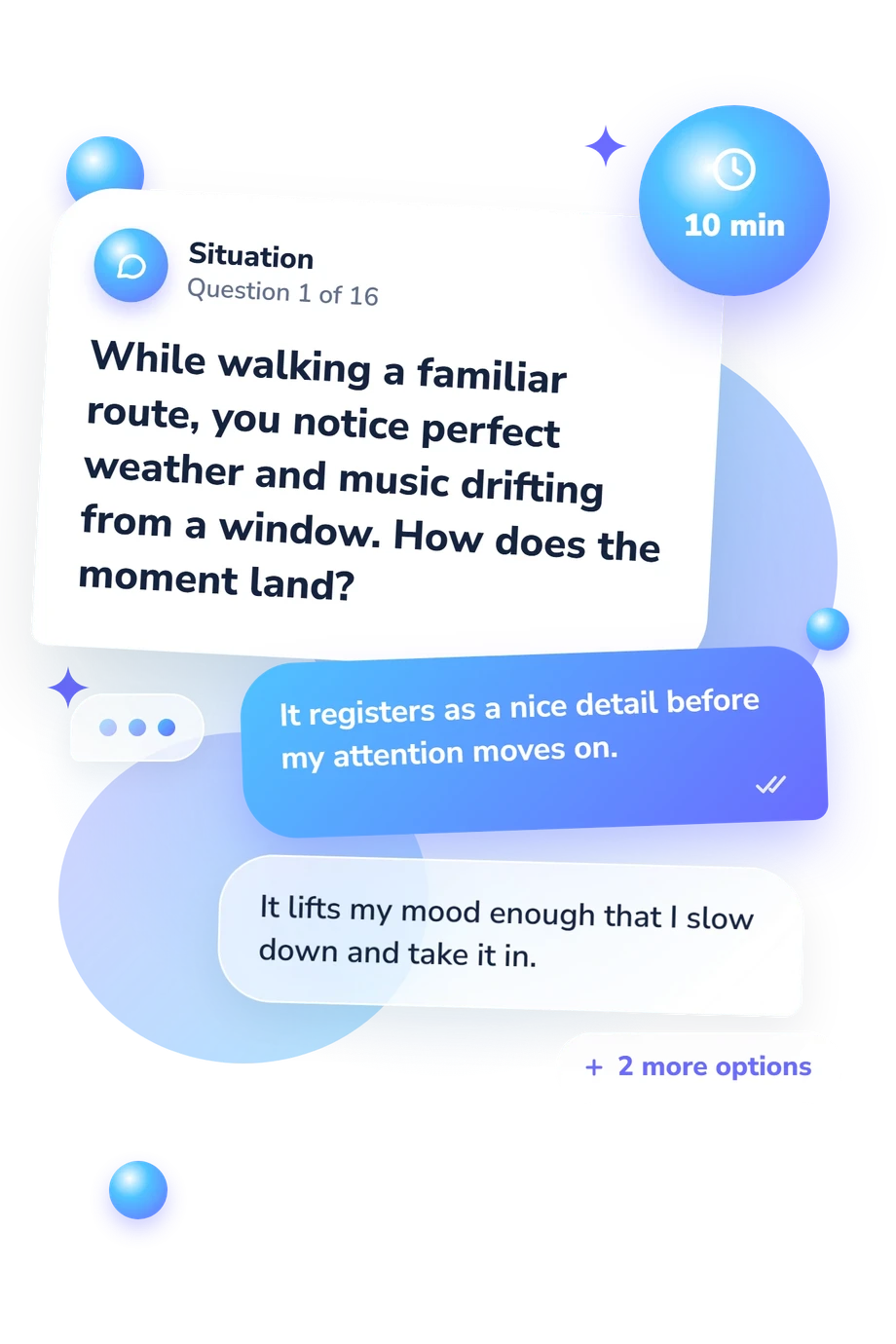
- It registers as a nice detail before my attention moves on.
- It lifts my mood enough that I slow down and take it in.
- It makes the ordinary day feel briefly extraordinary.
- It prompts thoughts about another place or time.
- Work within it unless the impact becomes more significant.
- Find a legitimate workaround that preserves my independence.
- Understand why it exists before deciding whether to object.
- Push against it because needless limits deserve resistance.
- A sharp determination to pursue it on my own terms.
- Curiosity about whether their objections reveal a real weakness.
- A desire to refine the idea and quietly prove its potential.
- Willingness to reconsider where my effort would be better spent.
Human Emotion TikTok Quiz - Description and methodology of the test
Readers who want to understand which emotional themes shape their reactions can use the Human Emotion Quiz TikTok Trend as a compact profile rather than a fixed label. Framed as a what human emotion am I TikTok quiz, it turns everyday choices, memories, pleasure, possibility, and personal boundaries into a readable pattern. The result identifies your strongest affinity or a blend, giving you language for tendencies you may already notice.
What This Assessment Explores
The questions explore everyday moments involving limits, pleasure, possibility, and memory. They suit anyone curious about emotional style.
Rather than forcing one answer, the format can address the what emotion am I TikTok quiz question by comparing directions of feeling. The four dimensions are:
- Defiance (0-12) shows how resisting pressure and questioning limits energize autonomy: Selective Challenger (0-4), Independent Current (5-8), Defiant Affinity (9-12).
- Joy (0-12) shows how readily you notice, create, and share delight: Quiet Spark (0-4), Open to Delight (5-8), Radiant Affinity (9-12).
- Longing (0-12) shows attraction to distant possibilities and imagined futures: Grounded Focus (0-4), Horizon Seeker (5-8), Deep Longing Affinity (9-12).
- Nostalgia (0-12) shows the pull of memories and familiar objects: Present-Oriented (0-4), Memory Keeper (5-8), Deep Nostalgic Affinity (9-12).
The highest score marks the strongest affinity; scores within one point indicate a blend.
Methodology and Scientific Basis
Each item describes a familiar situation and offers four responses. Choices emphasize practical attention, present experience, reflection, imagined possibility, or resistance, so you select the reaction that feels most characteristic. This self-report format records endorsed tendencies rather than observed behavior.
As a TikTok human emotion quiz, the questionnaire translates those themes into a compact profile. Its structure is conceptually consistent with the Discrete Emotions Questionnaire (Harmon-Jones et al., 2016), which distinguishes discrete emotional experiences instead of reducing feeling to one positive-negative score. It is not an adaptation of that instrument.
Three related research lines clarify the construct: Scheibe, Freund, and Baltes (2007) describe life longings and imagined alternatives; Batcho (1995) examines nostalgia as a response to the past; Hong and Faedda (1996) examine reactance, or resistance when freedom feels threatened.
Responses are combined into four displayed scales, but the questionnaire does not state a per-option weighting rule or population norms. Read the bands as an organized reflection of your answers. Current mood, context, and self-awareness can influence self-report, so the pattern is not a fixed account of personality.
- Cindy Harmon-Jones, Brock Bastian, and Eddie Harmon-Jones. The Discrete Emotions Questionnaire: A New Tool for Measuring State Self-Reported Emotions. PLOS ONE, 11(8), e0159915, 2016. 10.1371/journal.pone.0159915
- Susanne Scheibe, Alexandra M. Freund, and Paul B. Baltes. Toward a developmental psychology of Sehnsucht (life longings): The optimal (utopian) life. Developmental Psychology, 43(3), 778-795, 2007. 10.1037/0012-1649.43.3.778
- K. I. Batcho. Nostalgia: A psychological perspective. Perceptual and Motor Skills, 80(1), 131-143, 1995. 10.2466/pms.1995.80.1.131
- Sung-Mook Hong and Salvatora Faedda. Refinement of the Hong Psychological Reactance Scale. Educational and Psychological Measurement, 56(1), 173-182, 1996. 10.1177/0013164496056001014
Updated: