
How Well Do You Know Me Quiz
How the Scales are Structured
Who Usually Takes This Test?
See How You Compare
Below is a preview of how scores are typically distributed across each scale.
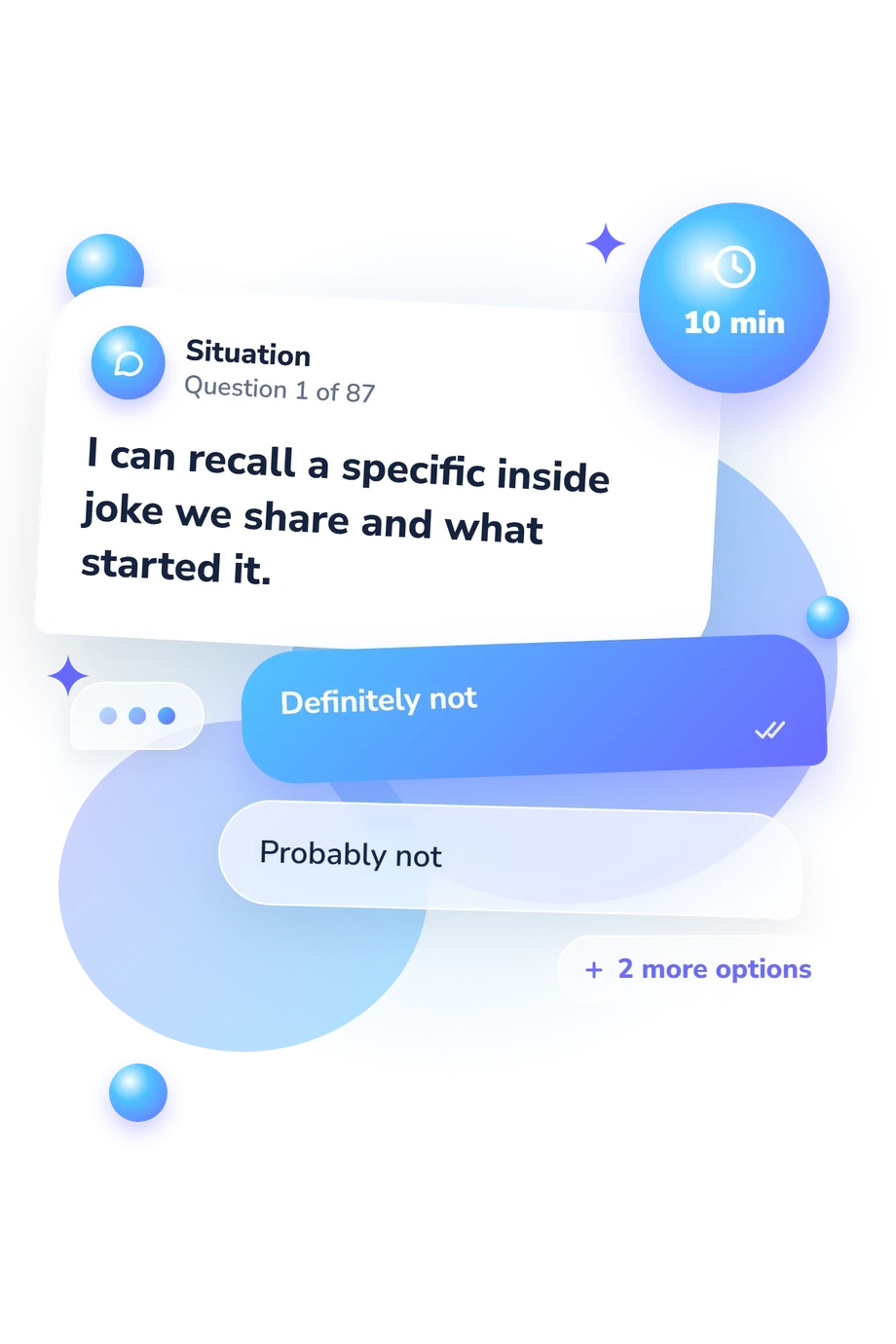
Example Questions From the Test
- Definitely not
- Probably not
- Not sure
- Yes, definitely
- Definitely not
- Probably not
- Not sure
- Yes, definitely
- Definitely not
- Probably not
- Not sure
- Definitely yes
How Well Do You Know Me Quiz - Description and methodology of the test
For a friend, relative, or another close person, this assessment turns shared knowledge into a focused conversation about familiarity. The How Well Do You Know Me Quiz compares a respondent’s answers with the creator’s intended answers across preferences, routines, opinions, and memories. It suits anyone who wants a playful do you know me quiz that highlights what is known, remembered, or still worth discussing.
What This Assessment Explores
The questions test whether a close person knows the creator’s choices and remembers shared moments. They suit friends, relatives, or partners with enough contact for specific answers to matter. A who knows me best quiz framing keeps the result about one person’s familiarity, not relationship quality.
The displayed result separates that familiarity into three areas:
- Everyday Preferences (0-10) measures accuracy about habits and favorites: Just a Guess (0-3), Some Familiarity (4-7), or Very In Sync (8-10).
- Knowledge Score (0-20) totals correct answers about preferences, habits, opinions, and shared memories: Just Getting Started (0-6), Pretty Familiar (7-13), or Super In-The-Know (14-20).
- Personal Memories (0-10) measures accuracy about shared experiences and past events: Fuzzy Recall (0-3), Mixed Recall (4-7), or Spot-On Recall (8-10).
The mix supports a funny quiz built from how well do you know me questions while retaining items about meaningful memories.
Methodology and Evidence Base
Each item describes a preference, habit, opinion, or shared memory. Four response choices move from definite disagreement or wrongness through uncertainty to definite agreement or correctness. The creator’s answer key determines whether the response matches.
Correct responses feed the three displayed results. Because the questionnaire does not state a universal point value for each response, its ranges are reporting bands rather than a formula to reconstruct. In a how well do you know me family quiz setting, relatives can compare mismatches without treating them as proof of closeness.
Conceptually, the format is consistent with Diaz and Berndt (1982), who examined best-friend knowledge, and Gershoff and Venkataramani Johar (2006), who studied friends’ knowledge calibration. Kenny and Acitelli (2001) adds work on accuracy and bias in close relationships. These sources support the construct, but this questionnaire is not a standardized adaptation of them, and their norms do not establish its bands.
As an online self-report tool, it can vary with memory gaps, current context, selective responding, and interpretations of the creator’s intended answer. The result is a snapshot of shared familiarity, not a clinical or diagnostic judgment.
- Diaz, Rafael M., and Thomas J. Berndt. (1982). Children's knowledge of a best friend: Fact or fancy? Developmental Psychology, 18(6), 787-794. 10.1037/0012-1649.18.6.787
- Gershoff, Andrew D., and Gita Venkataramani Johar. (2006). Do You Know Me? Consumer Calibration of Friends' Knowledge. Journal of Consumer Research, 32(4), 496-503. 10.1086/500479
- Kenny, David A., and Linda K. Acitelli. (2001). Accuracy and bias in the perception of the partner in a close relationship. Journal of Personality and Social Psychology, 80(3), 439-448. 10.1037/0022-3514.80.3.439
Updated: