
How Big Is My Brain Quiz
How the Scales are Structured
Who Usually Takes This Test?
See How You Compare
Below is a preview of how scores are typically distributed across each scale.
Example Questions From the Test
- Faster mineral absorption by roots
- Reduced pollination for species that rely on bees
- More energy captured from each unit of sunlight
- Greater protection from herbivores
- A recent textbook chapter summarizing the war
- A diary written by a civilian during the war
- A documentary produced decades afterward
- A modern novel set during the war
- Condensation
- Evaporation
- Freezing
- Sublimation
How Big Is My Brain Quiz - Description and methodology of the test
For readers who want a quick, structured snapshot, the How Big Is My Brain Quiz offers a cross-subject self-check rather than a measure of anatomy or innate ability. It is useful for students, lifelong learners, and anyone deciding which topics to revisit. The result summarizes performance across broad knowledge areas and indicates how widely you handled the subject mix.
What This Assessment Explores
The questionnaire samples factual understanding and brief applied reasoning in familiar academic situations. Its result is intended to show how broadly the respondent handled the material, rather than to estimate intelligence as a whole.
The main knowledge areas are:
- Science items show how accurately the respondent handles principles from biology, chemistry, physics, and Earth science.
- History, civics, and culture items reflect recognition of sources, institutions, periods, literary devices, and musical conventions.
- Quantitative and logical items show whether numerical relationships, calculations, and formal conclusions are handled correctly.
The quiz asks how big your brain is but actually tests general knowledge and offers a reflective result. General Knowledge: 0-16; Building Foundations 0-6, Developing Range 7-12, Strong Range 13-16. These bands describe performance on the included questions only, not brain size or intelligence.
Methodology and Scientific Basis
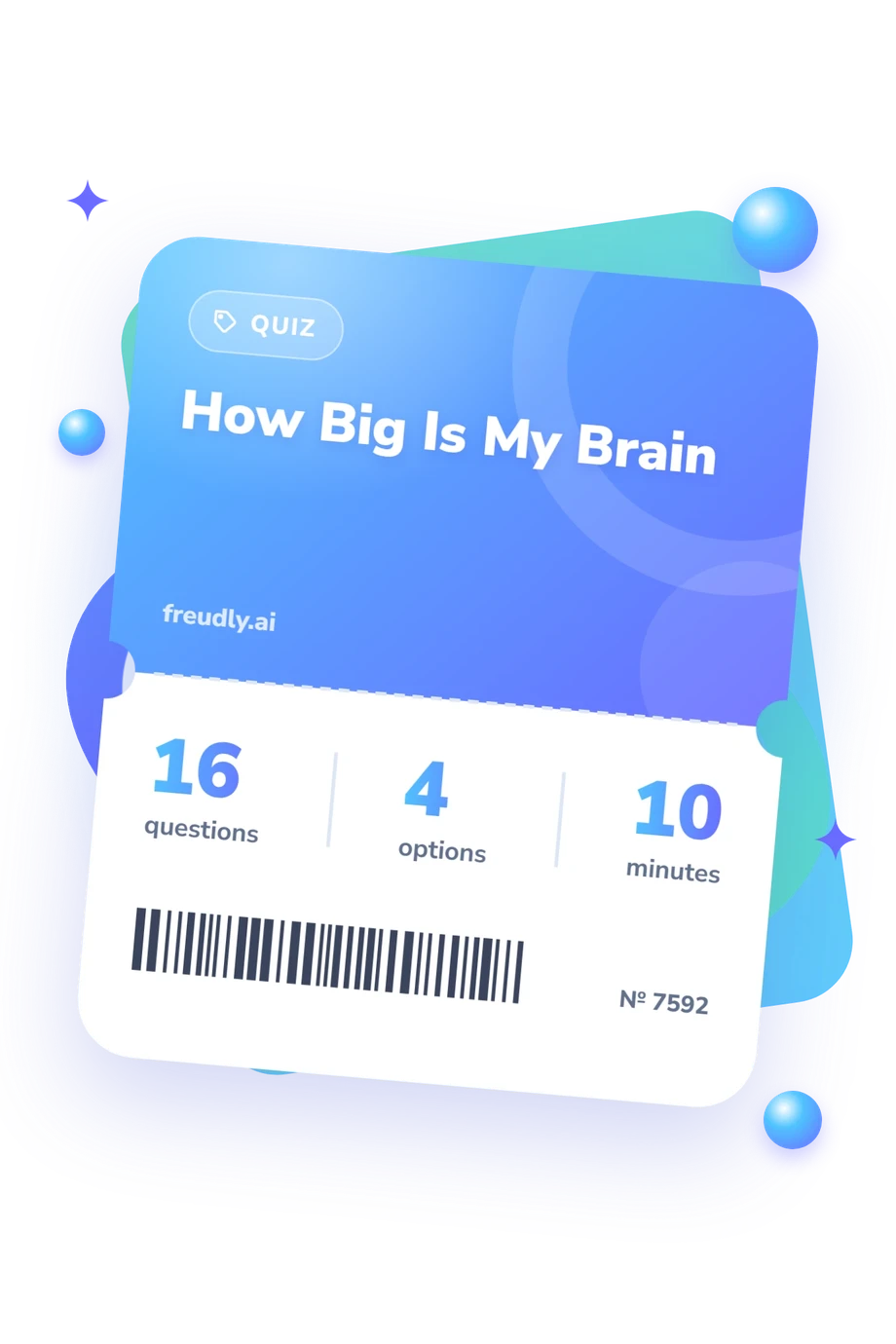
Each item uses a short prompt followed by four answer choices, with one response intended to best fit the question. The set moves across factual recall, concept recognition, comparison, inference, and calculation. The displayed result is one aggregate score grouped into three bands for these sixteen questions, and the score is explicitly unstandardized.
The questionnaire is conceptually consistent with the General Knowledge Test described by Irwing, Cammock, and Lynn (2001), but it is not a reproduction or validated adaptation of it. Cattell’s fluid-and-crystallized intelligence framework helps explain the mixture of learned information and brief reasoning demands. Buades-Sitjar and Duñabeitia (2022) provide additional context for relationships between intelligence subcomponents and general knowledge.
For a general knowledge quiz, results are best read as a snapshot of responses under current conditions. Familiarity with the subjects, language, concentration, guessing, and uneven educational exposure can affect performance. As an unstandardized online self-reflection tool, the score can guide topic review and personal learning goals, but it cannot establish overall intelligence or replace a broader assessment.
- Irwing, Paul, Tommy Cammock, and Richard Lynn. (2001). Some evidence for the existence of a general factor of semantic memory and its components. Personality and Individual Differences, 30(5), 857-871. 10.1016/S0191-8869(00)00078-7
- Buades-Sitjar, Francisco, and Jon Andoni Duñabeitia. (2022). Intelligence subcomponents and their relationship to general knowledge. Journal of Cultural Cognitive Science, 6, 343-355. 10.1007/s41809-022-00113-z
- Cattell, Raymond B. (1963). Theory of fluid and crystallized intelligence: A critical experiment. Journal of Educational Psychology, 54(1), 1-22. 10.1037/h0046743
Updated: