
High School Stereotypes Quiz
How the Scales are Structured
Who Usually Takes This Test?
See How You Compare
Below is a preview of how scores are typically distributed across each scale.
Example Questions From the Test
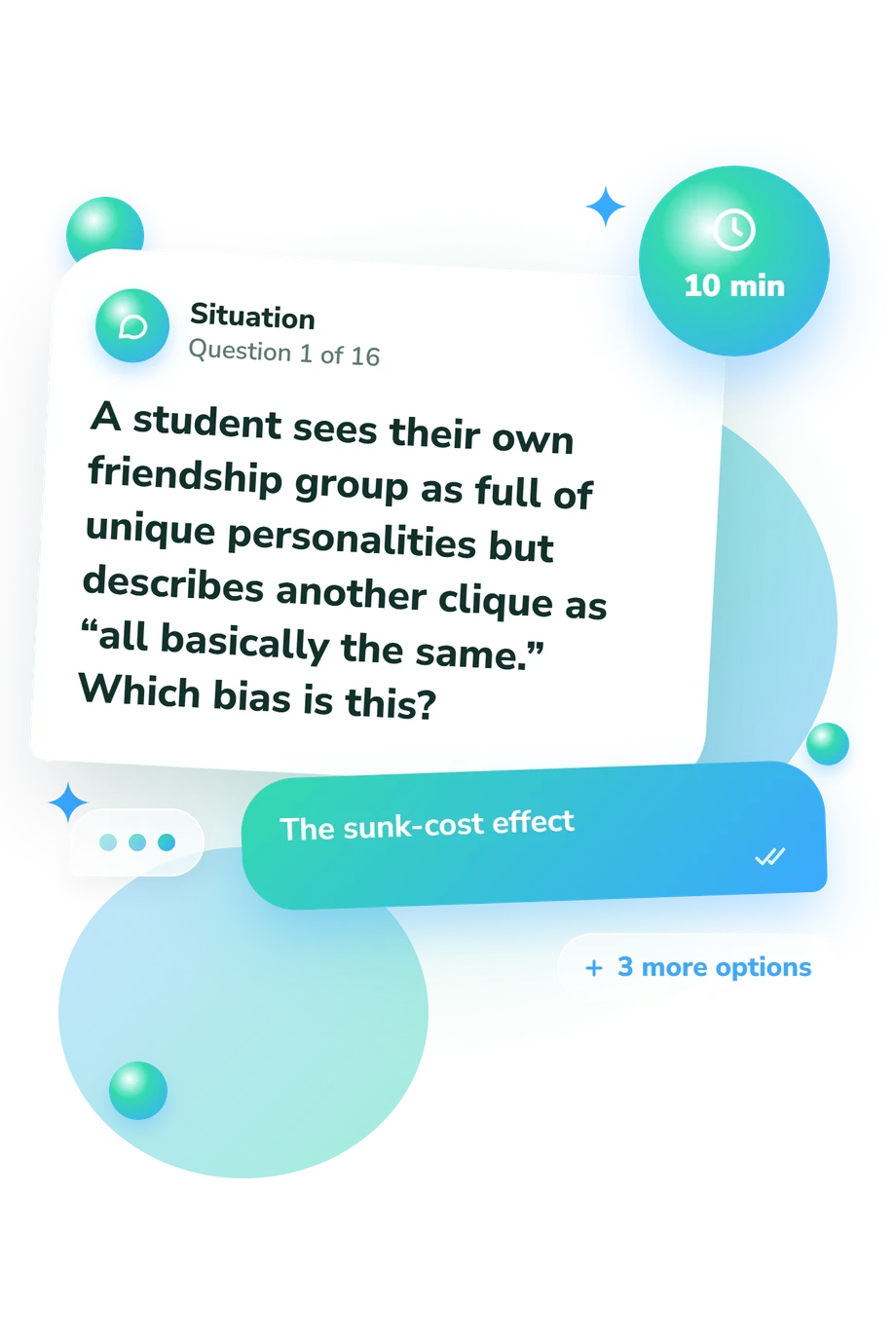
- The sunk-cost effect
- Hindsight bias
- Out-group homogeneity bias
- The framing effect
- A personal preference shared by several friends
- A verified description that applies to every group member
- A generalized belief that assigns traits to members of a group
- A formal rule governing how a group must behave
- “Students in that group should act confident and competitive.”
- “Three students from that group joined the debate team.”
- “The group meets in the library on Thursdays.”
- “Membership in the group increased this semester.”
High School Stereotypes Quiz - Description and methodology of the test
Students, educators, and anyone reflecting on school-group labels can use this high school stereotypes quiz to examine how they distinguish generalizations from evidence about individual people. It focuses on the reasoning behind common stereotype processes rather than asking respondents to declare whether they are biased. The personal-sounding subject may invite a quiz about what your high school stereotype is, but its result measures conceptual understanding rather than a fixed identity.
What This Assessment Explores
The questions examine how labels compress variation, how expectations influence opportunity, and how evidence can correct assumptions. They address out-group homogeneity, implicit bias, stereotype threat, self-fulfilling prophecies, illusory correlation, confirmation bias, individuation, and intersectionality. As a quiz about school stereotypes, it tests group reasoning rather than assigning identity.
The main themes are:
- Group variation shows whether you distinguish labels from individuals.
- Bias and expectations reveal how associations, memory, and predictions shape judgment.
- Evidence and identity test whether you update assumptions and consider overlapping identities.
High School Stereotypes Knowledge (0-16) is educational: Foundations to Build (0-6) means review is useful; Developing Insight (7-12) means many mechanisms are recognized; Strong Understanding (13-16) means labels are distinguished from individual evidence. Because the personal subject matter may suggest an identity type, the result measures understanding, not identity, beliefs, or character.
Methodology and Evidence Base
Methodology combines scenario-based knowledge questions with concepts drawn from established psychological research. Bardach et al. (2023) is the closest school-focused evidence: this questionnaire is conceptually consistent with its treatment of stereotype awareness and educational inequality, not an adaptation of that study. Devine (1989) supports the distinction between automatic and controlled components of stereotyping. Steele and Aronson (1995) provide the stereotype-threat framework, while Hamilton and Gifford (1976) explain how memorable group-linked events can create illusory correlations.
Each item in this high school stereotype test presents a school situation or definition with four answer choices and asks for the most accurate concept or response. It displays one educational score and result bands but does not state item-level weights or population norms, so the bands should be read as descriptive learning levels rather than population cutoffs.
Performance can reflect attention, prior exposure, and current context as well as understanding. The result is therefore best read as a focused learning profile: useful for identifying concepts to revisit, but not evidence of a person's character, conduct, or clinical status.
- Bardach, Lisa, Claudia Neuendorf, Kou Murayama, Thorsten Fahrbach, Michel Knigge, Benjamin Nagengast, and Ulrich Trautwein. “Does students’ awareness of school-track-related stereotypes exacerbate inequalities in education?” npj Science of Learning 8, 59 (2023). 10.1038/s41539-023-00203-9
- Devine, Patricia G. “Stereotypes and prejudice: Their automatic and controlled components.” Journal of Personality and Social Psychology 56(1) (1989): 5-18. 10.1037/0022-3514.56.1.5
- Steele, Claude M., and Joshua Aronson. “Stereotype threat and the intellectual test performance of African Americans.” Journal of Personality and Social Psychology 69(5) (1995): 797-811. 10.1037/0022-3514.69.5.797
- Hamilton, David L., and Robert K. Gifford. “Illusory correlation in interpersonal perception: A cognitive basis of stereotypic judgments.” Journal of Experimental Social Psychology 12(4) (1976): 392-407. 10.1016/S0022-1031(76)80006-6
Updated: