
HHA Quiz
How the Scales are Structured
Who Usually Takes This Test?
See How You Compare
Below is a preview of how scores are typically distributed across each scale.
Example Questions From the Test
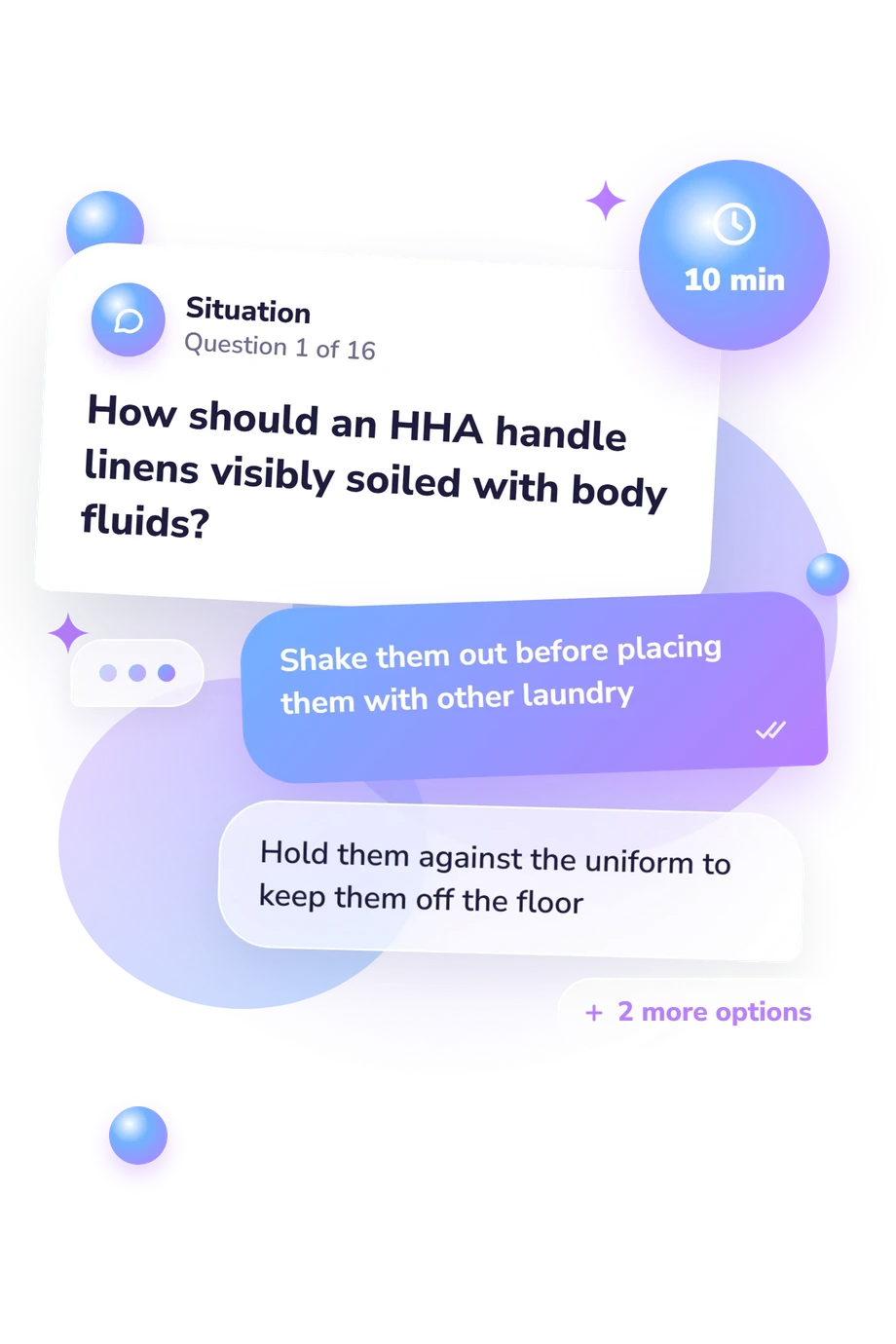
- Shake them out before placing them with other laundry
- Hold them against the uniform to keep them off the floor
- Rinse them in a food-preparation sink before washing
- Use appropriate barriers, avoid shaking them, and follow the designated laundry procedure
- Clean the gloves for reuse if they appear undamaged
- Put on a new pair without cleaning the hands
- Discard them appropriately and perform hand hygiene
- Wait until all household tasks are complete to clean the hands
- Put on two pairs of gloves for the entire visit
- Clean your hands using the approved hand-hygiene method
- Disinfect every object in the room before approaching the client
- Ask the client to wash their hands instead of cleaning yours
HHA Quiz - Description and methodology of the test
People preparing for home-based care, reviewing workplace expectations, or checking their practical foundations can use the HHA Quiz to examine how they would respond to common situations. This home health aide quiz focuses on decisions that protect clients, respect their choices, and keep care within the aide’s role. The result offers an overall indication of HHA knowledge.
What This Assessment Explores
The questions examine practical judgment in infection control, privacy, emergencies, personal care, mobility, nutrition, dementia support, and documentation. Learners and aides can use the questions to review home health aide practice, comparing their choices with safe assistance, client dignity, care-plan instructions, and timely reporting.
Results use one scale, HHA Knowledge (0-16), with Foundations to strengthen (0-6), Developing knowledge (7-12), and Strong knowledge (13-16).
The scenarios cover these question themes:
- Safety and infection control show how the respondent manages hazards, barriers, hygiene, equipment, and prevention.
- Role boundaries and privacy indicate whether choices respect authorization, confidentiality, care-plan instructions, and client refusal.
- Emergency recognition and reporting reflect noticing sudden change, seeking appropriate help, and recording observations clearly.
- Person-centered support captures promotion of independence, dignity, comfort, and safe assistance.
Methodology and Scientific Basis
Each item presents a home-care scenario with four response options. The respondent chooses the action that best fits safe, authorized practice across hygiene, equipment, emergencies, privacy, mobility, nutrition, medication support, and documentation.
The questionnaire reports one overall score but does not specify the weighting or calculation method for individual responses. The score helps organize home health aide study by suggesting review priorities. The educational score indicates overall HHA knowledge, not certification, proof of competence, or a diagnostic conclusion.
Its content is conceptually consistent with Sengupta et al. (2012) on aide training needs. CMS guidance (2024) and 42 CFR § 484.80 address supervision, care plans, reporting, and safety; Naber and Perlow (2008) address pressure-injury prevention. These sources support the topics; this questionnaire is not adapted from them and has no score norms.
Interpretation depends on HHA familiarity, current training, and how accurately selected options reflect the respondent’s knowledge. Duties vary by jurisdiction and employer; an urgent change or hazard requires the agency’s emergency procedure and contacting the appropriate supervisor or emergency service rather than relying on the quiz result.
- Sengupta, M., Ejaz, F. K., & Harris-Kojetin, L. D. (2012). Training of home health aides and nurse aides: Findings from national data. Gerontology & Geriatrics Education, 33(4), 383-401. 10.1080/02701960.2012.702167
- Centers for Medicare & Medicaid Services. (2024). State Operations Manual, Appendix B: Guidance to Surveyors-Home Health Agencies, Revision 219.
- Electronic Code of Federal Regulations. 42 CFR § 484.80, Condition of participation: Home health aide services.
- Naber, J. L., & Perlow, M. (2008). Pressure ulcers and the home health aide: Evaluation of an educational program. Home Healthcare Nurse, 26(5), 269-272. 10.1097/01.NHH.0000318940.77785.95
Updated: