
Healthy Food Quiz
How the Scales are Structured
Who Usually Takes This Test?
See How You Compare
Below is a preview of how scores are typically distributed across each scale.
Example Questions From the Test
- Replacing butter with coconut oil
- Replacing butter with olive oil
- Replacing canola oil with butter
- Replacing olive oil with shortening
- White toast with jam and juice
- Eggs with bacon and coffee
- Oatmeal with berries and plain yogurt
- A banana with a plain granola bar
- Made with wheat
- 100% whole-wheat bread
- Seven-grain bread
- Brown-colored bread
Healthy Food Quiz - Description and methodology of the test
People who want to make more confident everyday food choices can use this assessment to check practical nutrition knowledge rather than personal eating habits alone. The healthy food quiz questions and answers focus on labels, portions, food groups, cooking methods, hydration, iron absorption, and food safety. Working through the healthy eating quiz questions and answers helps readers identify concepts they understand and topics that deserve a closer look.
What This Assessment Explores
The assessment focuses on knowledge for everyday decisions, rather than tracking diets or prescribing meals. Its scenarios ask readers to apply basic principles to common choices, making these healthy food quiz questions useful for anyone seeking a nutrition refresher or self-check.
Across the assessment, the questions cover three connected areas:
- Label literacy and portion awareness show understanding of serving sizes, ingredient order, sodium, and product claims.
- Meal balance and food-group variety indicate recognition of varied, nutritious combinations.
- Nutrient sources, preparation, and food safety reveal knowledge of protein, fiber, iron absorption, added sugar, hydration, cooking, and safe handling.
The result appears as Healthy Food Knowledge (0-16): Building Foundations 0-6, Developing Knowledge 7-12, or Strong Knowledge 13-16. These bands describe educational nutrition knowledge rather than personal dietary advice.
Methodology and Evidence Base
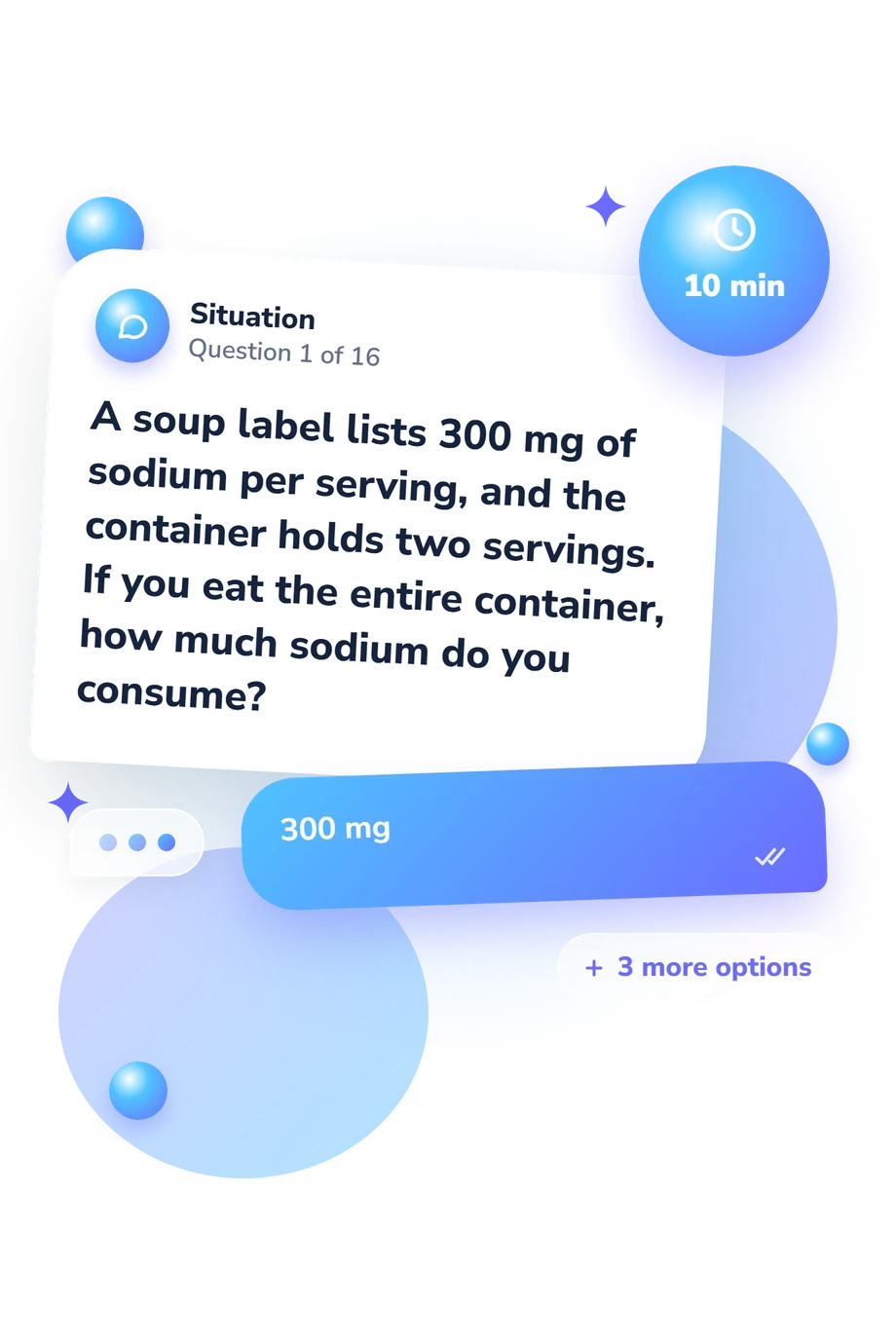
Each item uses a single-best-answer multiple-choice format. Scenarios require practical application: calculating sodium, interpreting labels, choosing balanced combinations, and identifying safer preparation or storage. The questionnaire displays a total score, but item weighting is not documented, so point contributions should not be inferred beyond the stated bands.
The method is conceptually consistent with the Consumer Nutrition Knowledge Scale (Dickson-Spillmann et al., 2011), a concise consumer-focused approach to nutrition knowledge, but this questionnaire is not presented as an adaptation of that instrument. Parmenter and Wardle (1999) provide a relevant comparison for broad nutrition domains, while Reynolds et al. (2012) address food-label literacy. These sources support the content areas, but they do not validate or standardize this online questionnaire.
As a healthy food knowledge test, the result is a snapshot of answers in the respondent’s context. Knowledge may differ from eating behavior because choices also reflect habits, preferences, access, and circumstances; performance depends on careful reading, attention, guessing, and familiarity with nutrition guidance. No norms, reliability estimates, or clinical cutoffs are stated, so use the score to identify review topics.
- Dickson-Spillmann M, Siegrist M, Keller C. Development and validation of a short, consumer-oriented nutrition knowledge questionnaire. Appetite. 2011;56(3):617-620. 10.1016/j.appet.2011.01.034
- Parmenter K, Wardle J. Development of a general nutrition knowledge questionnaire for adults. European Journal of Clinical Nutrition. 1999;53(4):298-308. 10.1038/sj.ejcn.1600726
- Reynolds JS, Treu JA, Njike V, Walker J, Smith E, Katz CS, Katz DL. The validation of a food label literacy questionnaire for elementary school children. Journal of Nutrition Education and Behavior. 2012;44(3):262-266. 10.1016/j.jneb.2011.09.006
Updated: