
Hand and Power Tool Safety Quiz
How the Scales are Structured
Who Usually Takes This Test?
See How You Compare
Below is a preview of how scores are typically distributed across each scale.
Example Questions From the Test
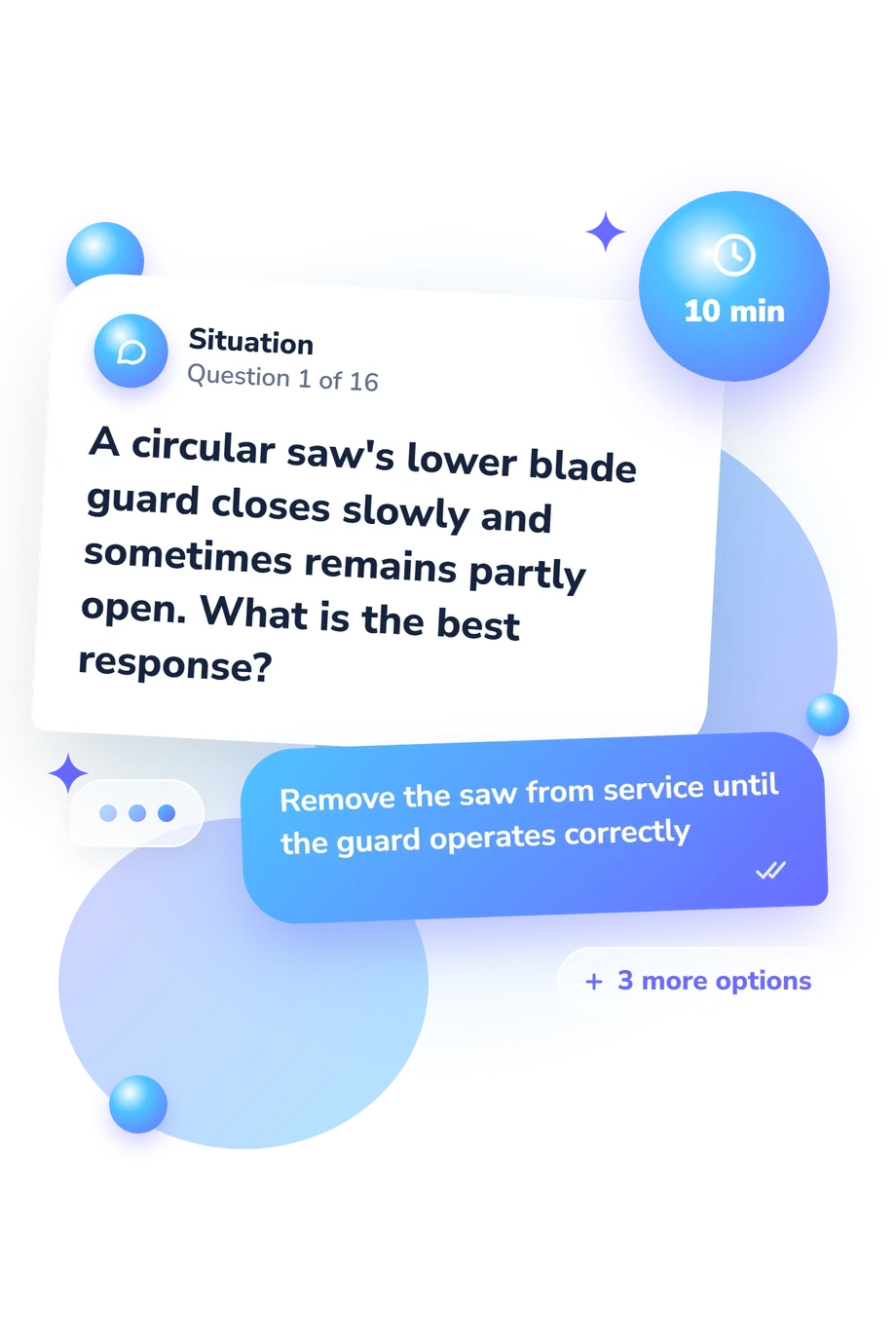
- Remove the saw from service until the guard operates correctly
- Hold the guard open manually during each cut
- Add lubricant without disconnecting the saw, then continue
- Make a short test cut to see whether vibration releases it
- Hold the tang through a thick work glove
- Wrap the tang with several layers of tape
- Grip the tang with locking pliers
- Install a properly fitted file handle
- Safety glasses with suitable side protection
- A face shield worn without safety glasses or goggles
- Ordinary prescription glasses with standard frames
- A welding helmet with the dark lens raised
Hand and Power Tool Safety Quiz - Description and methodology of the test
People who use, supervise, or prepare to use hand and power equipment can use this assessment to examine how ready they are to recognize hazards and choose safe actions. The hand and power tool safety quiz helps identify gaps in preparedness through workplace scenarios. The tool safety quiz presents decisions about equipment, materials, and surroundings rather than abstract rules.
What This Assessment Explores
These questions examine hand and power equipment decisions, not dexterity. They ask whether you notice defects, preserve safeguards, control the workpiece, and respond to electrical, cutting, grinding, and fire hazards. The assessment organizes these situations into a hand and power tool quiz with three themes:
- Equipment condition and guarding: this dimension shows whether you identify damaged tools, defective guards, and unsafe accessories before use.
- Electrical and personal protection: this dimension shows whether you control shock and flying-particle risks through suitable equipment, connections, and eye protection.
- Task and environment control: this dimension shows whether you select the right tool, secure material, manage motion, and isolate nearby hazards.
The displayed scale is Hand and Power Tool Safety Knowledge (0-16), with Foundations to strengthen (0-6), Developing knowledge (7-12), and Strong knowledge (13-16). The result reflects knowledge shown in scenarios, not observed work.
Methodology and Evidence Base
Each item presents a workplace scenario followed by response options. Choices test recognition of safe action, including stopping work, unplugging equipment, removing a defective tool from service, or securing a board before cutting. The format emphasizes applied judgment rather than recall of isolated terms.
The power tool safety quiz uses the displayed descriptive bands; the questionnaire does not specify how individual responses are converted into the scale. No occupational norms or standardization are stated, so interpretation remains limited to knowledge shown in these scenarios.
Its content is conceptually consistent with OSHA Hand and Power Tools, which addresses inspection, guards, electrical protection, tool selection, and safe handling. OSHA’s portable-tool guidance supports these principles. Kim and colleagues (2019) add evidence context by documenting hand and upper-extremity injuries associated with power-tool use; that study does not validate this online questionnaire.
When reviewing answers, focus on the hazard-control principle behind each choice. Because the questionnaire is completed online without observation of actual work, current familiarity can affect performance, and the result cannot demonstrate behavior with equipment; tool-specific instructions and site rules also matter.
- Occupational Safety and Health Administration. Hand and Power Tools. OSHA 3080. Washington, DC: U.S. Department of Labor, Occupational Safety and Health Administration; 2002 (revised).
- Occupational Safety and Health Administration. Safe Use of Portable and Hand-Held Power Tools. OSHA FS 3950. Washington, DC: U.S. Department of Labor, Occupational Safety and Health Administration; 2018.
- Kim, Yong Hun, Jin-Hee Choi, Yoon Kyu Chung, Sug Won Kim, and Jiye Kim. Epidemiologic study of hand and upper extremity injuries by power tools. Archives of Plastic Surgery. 2019;46(1):63-68. 10.5999/aps.2018.00815
Updated: