
Favorite Animal Quiz
How the Scales are Structured
Who Usually Takes This Test?
See How You Compare
Below is a preview of how scores are typically distributed across each scale.
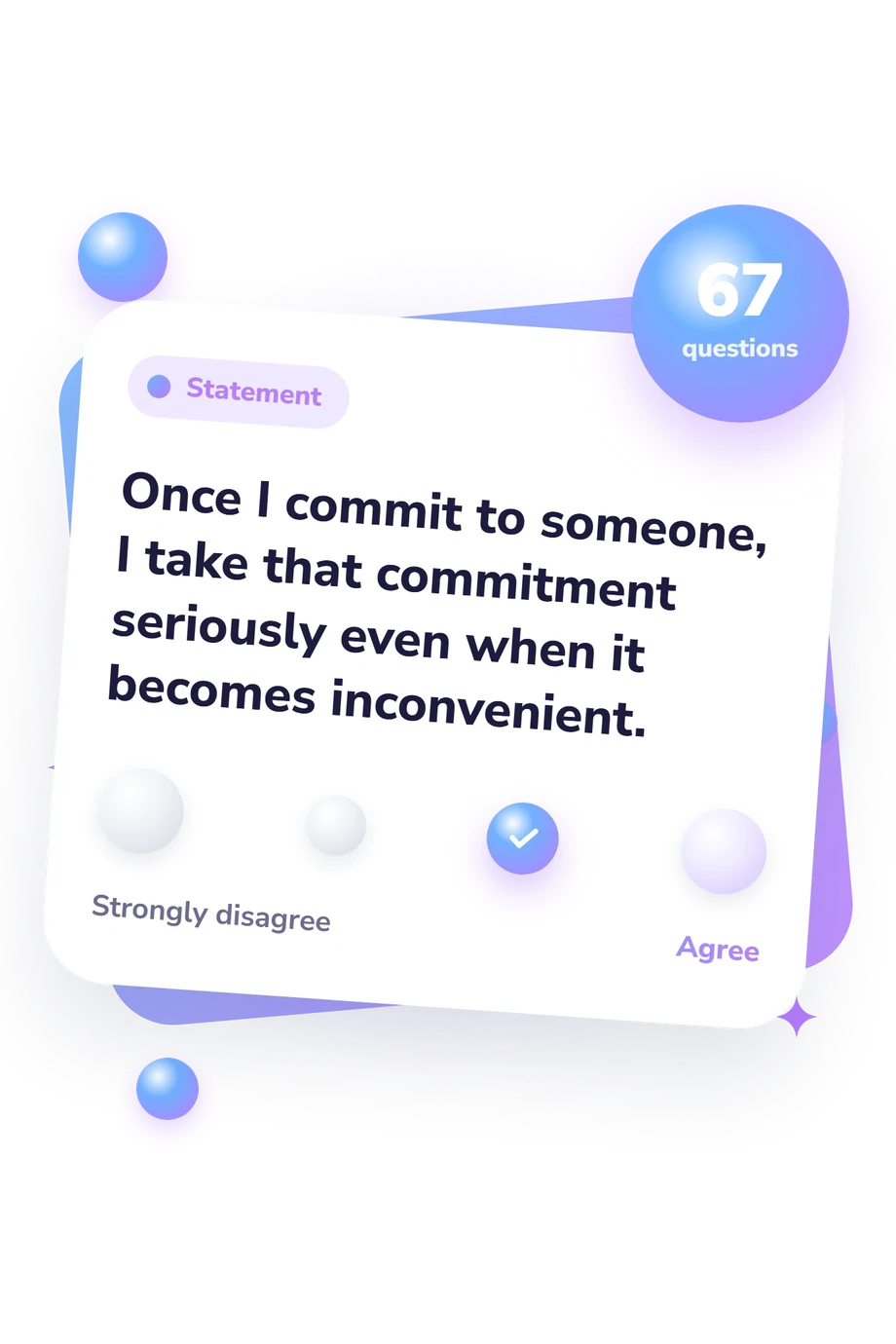
Example Questions From the Test
- Strongly disagree
- Disagree
- Not sure
- Agree
- Strongly disagree
- Disagree
- Not sure
- Agree
- Strongly disagree
- Disagree
- Not sure
- Agree
Favorite Animal Quiz - Description and methodology of the test
People who enjoy personality quizzes can use the favorite animal quiz to turn everyday preferences into a structured reflection on novelty, close relationships, and social contact. It suits curious visitors who want a light but organized profile rather than a fixed label. As an animal personality test, this quiz offers a playful way to notice patterns in how you explore, connect, and recharge.
What This Assessment Explores
Three broad tendencies organize the questionnaire around novelty, close relationships, and social stimulation. In this favorite animal personality test, statements about unfamiliar activities, learning, dependability, protecting loved ones, group participation, and solitude become a descriptive profile. The result shows preferences across these situations rather than assigning one animal a fixed personality.
These descriptions explain each dimension and its displayed result bands:
- Novelty & Curiosity (0-20) measures interest in exploration and learning: Routine-Oriented (0-6) favors familiarity, Balanced Explorer (7-13) combines both, and Adventure-Seeking (14-20) reflects openness to change.
- Security & Loyalty (0-20) measures stability and close bonds: Independent & Flexible (0-6) favors autonomy, Balanced (7-13) mixes autonomy with commitment, and Security-Seeking & Loyal (14-20) values dependable ties.
- Social Energy (0-20) measures solitude versus interaction: Solitude-leaning (0-7) favors quiet settings, Balanced (8-13) combines both, and Highly social (14-20) favors shared activity.
Methodology and Scientific Basis
The statements shown use a four-option agreement format: Strongly disagree, Disagree, Not sure, or Agree. Responses are combined into the displayed dimension scores and placed in the named bands. No population norm sample is documented for this online questionnaire, so the displayed bands are descriptive guides rather than validated population or clinical thresholds; answers may shift with current mood, recent experiences, wording, or self-presentation.
The closest subject-specific comparison is Hagan et al. (2017), whose study examined personality profiles among users sharing animal-related content. That study offers thematic context, but this questionnaire is not an adaptation of its measures or scoring procedure. Its curiosity and exploration themes can be compared conceptually with the Curiosity and Exploration Inventory-II, although this does not establish validity for these custom dimensions. These sources do not validate this questionnaire or provide its scoring model.
Read the result as a pattern across dimensions rather than a verdict about identity. For a useful animal personality profile, answer according to your usual pattern instead of an idealized self-image. The profile is most useful as a starting point for self-reflection.
- Hagan, Courtney, Jordan Carpenter, Lyle Ungar, and Daniel Preotiuc-Pietro. "Personality Profiles of Users Sharing Animal-related Content on Social Media." Anthrozoös, 30(4), 671-680, 2017. 10.1080/08927936.2017.1370235
- Kashdan, Todd B., Matthew W. Gallagher, Paul J. Silvia, Beate P. Winterstein, William E. Breen, Daniel Terhar, and Michael F. Steger. "The Curiosity and Exploration Inventory-II: Development, Factor Structure, and Psychometrics." Journal of Research in Personality, 43(6), 987-998, 2009. 10.1016/j.jrp.2009.04.011
- Goldberg, Lewis R. "The Development of Markers for the Big-Five Factor Structure." Psychological Assessment, 4(1), 26-42, 1992. 10.1037/1040-3590.4.1.26
Updated: