
English Literature Quiz
How the Scales are Structured
Who Usually Takes This Test?
See How You Compare
Below is a preview of how scores are typically distributed across each scale.
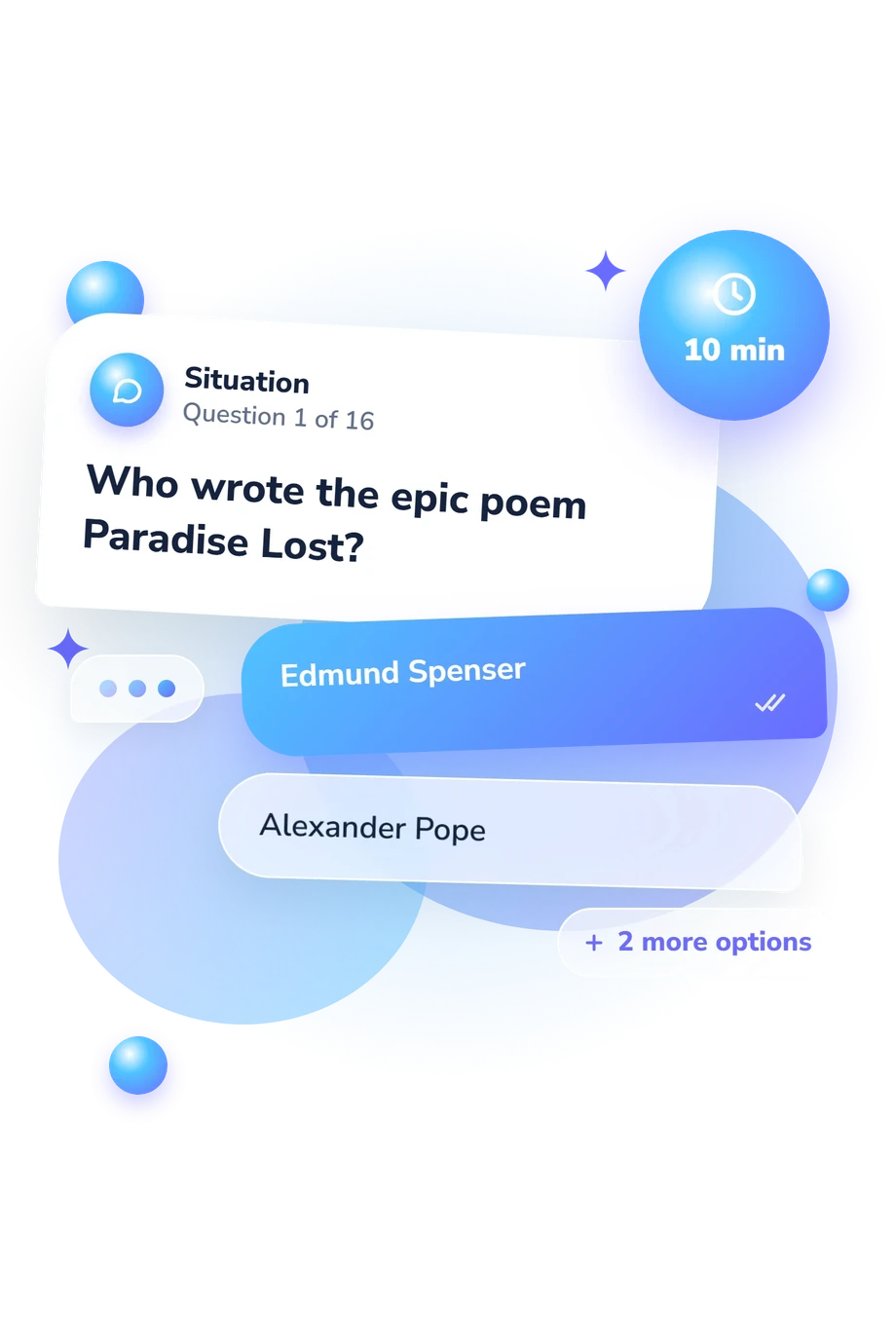
Example Questions From the Test
- Edmund Spenser
- Alexander Pope
- John Milton
- William Blake
- The refrain
- The caesura
- The volta
- The envoi
- Modern English
- Middle English
- Early Modern English
- Old English
English Literature Quiz - Description and methodology of the test
Readers who want to connect familiar books with the ideas and techniques that shape them can use the English Literature Quiz as a focused way to review literary knowledge. As a quiz about English literature, it suits students, independent readers, and anyone returning to study. The result identifies confidence across authors, works, periods, forms, narrative methods, and terminology, offering a practical starting point for further reading.
What This Assessment Explores
Questions connect authors with works, place texts in periods and traditions, and ask you to identify forms, techniques, narrative perspectives, and defining features. It suits students, independent readers, and anyone returning to literary study. The result of this English literature knowledge test offers a snapshot of these selected abilities.
The four areas represented by the questions are:
- Author-and-work recognition shows how securely you connect texts with writers and characters.
- Periods and literary history show how well you place works within traditions.
- Forms and techniques reveal whether you identify verse patterns, structures, and narrative devices.
- Interpretation and context show how you connect situations with broader meaning.
The English Literature Knowledge scale runs from 0-16: Foundation Building (0-6) signals room to explore; Developing Knowledge (7-12) reflects useful command of the canon; Strong Knowledge (13-16) indicates broad, accurate knowledge of literary history, texts, and techniques.
Methodology and Evidence Base
Each item presents four answer choices and asks you to select the author, work, term, form, technique, or interpretation that best fits the prompt. Some questions test direct recognition; others require matching a described feature with a text, period, or literary concept. The format combines recall with basic application.
Scoring is straightforward in an online quiz on English literature: each correct response contributes one point, and the total equals the number of correct answers. This is a snapshot of performance on the selected questions, not a weighted essay evaluation or standardized psychometric score.
Terminology can be traced to Abrams and Harpham (2015), historical coverage is consistent with Sanders (2004), and the canonical selection with Greenblatt (2018). These works provide a literary reference framework; the questionnaire is conceptually consistent with them, not a direct adaptation of any one source.
Interpret the result alongside prior reading, guessing, and topic mix. Because the questionnaire samples a limited canon and relies on fixed-choice recognition, it cannot capture every period, tradition, interpretive skill, or depth of reading.
- Abrams, M. H., and Geoffrey Galt Harpham. A Glossary of Literary Terms. 11th ed., Cengage Learning, 2015.
- Sanders, Andrew. The Short Oxford History of English Literature. 3rd ed., Oxford University Press, 2004. 10.1093/oso/9780198711575.001.0001
- Greenblatt, Stephen, general editor. The Norton Anthology of English Literature. 10th ed., W. W. Norton & Company, 2018.
Updated: