
Empirically Derived Test
How the Scales are Structured
Who Usually Takes This Test?
See How You Compare
Below is a preview of how scores are typically distributed across each scale.
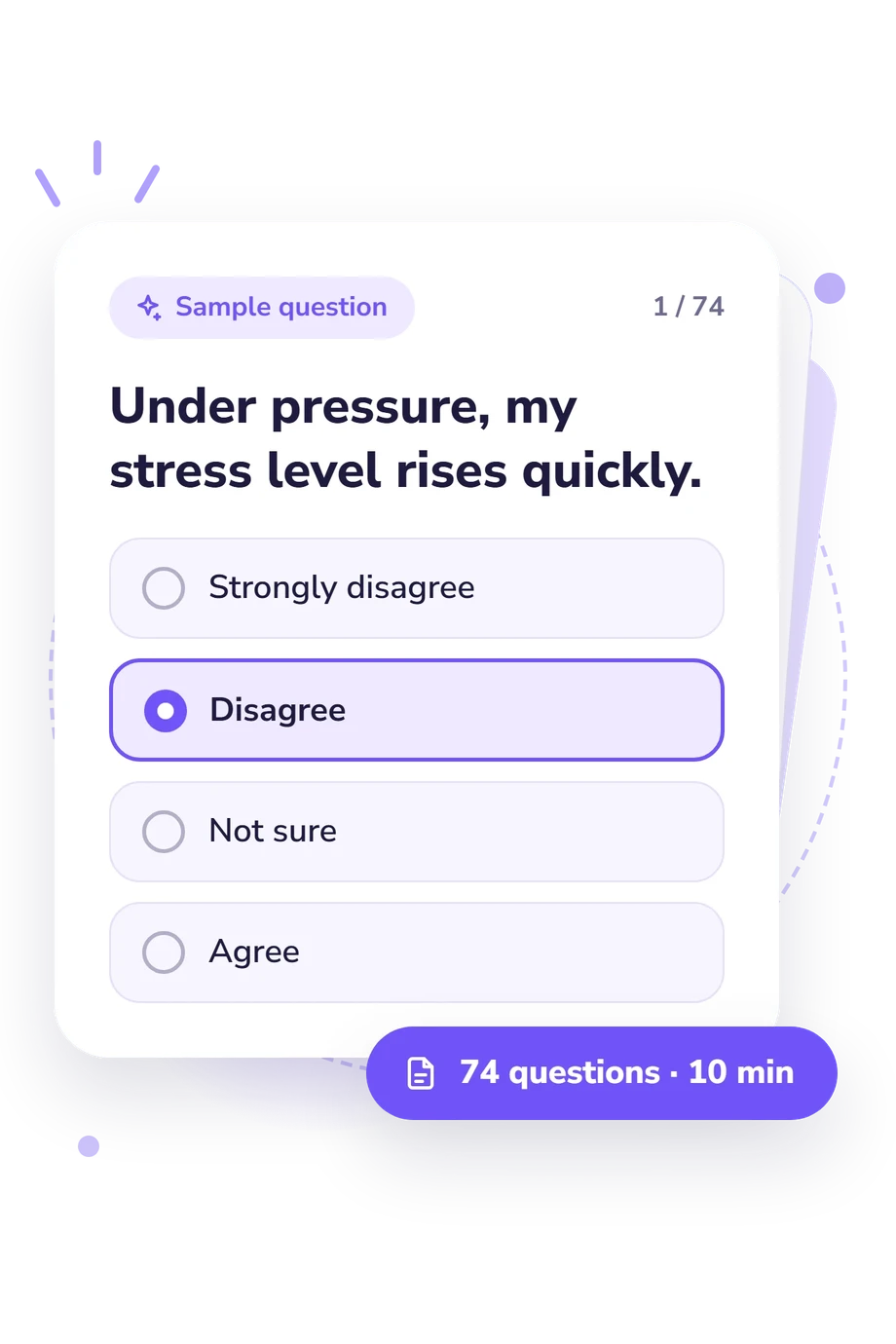
Example Questions From the Test
- Strongly disagree
- Disagree
- Not sure
- Agree
- Strongly disagree
- Disagree
- Not sure
- Agree
- Strongly disagree
- Disagree
- Not sure
- Agree
Empirically Derived Test - Description and methodology of the test
Readers deciding whether a structured personality questionnaire fits their needs can use it to reflect on familiar situations before making changes in communication, coping, or daily routines. The empirically derived test may suit people who want language for discussing personal tendencies without treating one result as a fixed identity. Instead, the questionnaire summarizes patterns in responses to personality items, giving the respondent material to consider alongside real-life examples.
What This Assessment Explores
Questions place personality in ordinary situations: speaking up, asking for help, handling disagreement, initiating contact, meeting obligations, responding to criticism, and recovering after setbacks. They also sample planning, self-control, persistence, and respectful boundary-setting. This makes the questionnaire useful for anyone wanting a personality snapshot assessment based on recognizable behavior.
The result has three displayed dimensions:
- Interaction Style (0-40) shows how actively and directly you tend to engage with others; Reserved 0-13, Balanced 14-26, Direct & Engaging 27-40.
- Stress Reactivity (0-40) indicates how strongly pressure, uncertainty, and setbacks may trigger worry, irritability, rumination, or rapid escalation; Low reactivity 0-13, Moderate reactivity 14-26, High reactivity 27-40.
- Trait Strengths (0-40) reflects the level and consistency of constructive, well-established personality traits; Developing 0-13, Mixed 14-27, Consistent 28-40.
Together, these dimensions organize interpersonal approach, stress response, and constructive traits; no band defines the whole person.
Methodology and Scientific Basis
The representative items use four agreement options: Strongly disagree, Disagree, Not sure, or Agree. First-person wording asks respondents to compare each item with usual behavior or reaction in an online self-report format. As an everyday personality test, it emphasizes concrete self-observation.
The result presents three dimension scores with displayed bands. Answer contributions and any reverse-scoring rule are undisclosed, and no standardized scoring is stated, so the ranges do not show how responses become scores.
The method is conceptually consistent with the IPIP and with Goldberg’s Big Five marker work. It is not presented as a direct adaptation, validation, or reproduction of either instrument. Its stress dimension is also conceptually consistent with the personality-stress meta-analysis by Luo and colleagues, which offers research context for links between traits and stress, not norms for this profile.
The cited instruments and meta-analysis supply conceptual context, not norms or validation for this exact profile. Current stress, recent conflict, response style, and self-awareness can influence answers; compare surprising results with examples from several situations and time periods.
- Goldberg, L. R., Johnson, J. A., Eber, H. W., Hogan, R., Ashton, M. C., Cloninger, C. R., & Gough, H. G. (2006). The International Personality Item Pool and the Future of Public-Domain Personality Measures. Journal of Research in Personality, 40(1), 84-96. 10.1016/j.jrp.2005.08.007
- Goldberg, L. R. (1992). The Development of Markers for the Big-Five Factor Structure. Psychological Assessment, 4(1), 26-42. 10.1037/1040-3590.4.1.26
- Luo, J., Zhang, B., Cao, M., & Roberts, B. W. (2023). The Stressful Personality: A Meta-Analytical Review of the Relation Between Personality and Stress. Personality and Social Psychology Review, 27(2), 128-194. 10.1177/10888683221104002
Updated: