
ECG Anatomy and Physiology Quiz
How the Scales are Structured
Who Usually Takes This Test?
See How You Compare
Below is a preview of how scores are typically distributed across each scale.
Example Questions From the Test
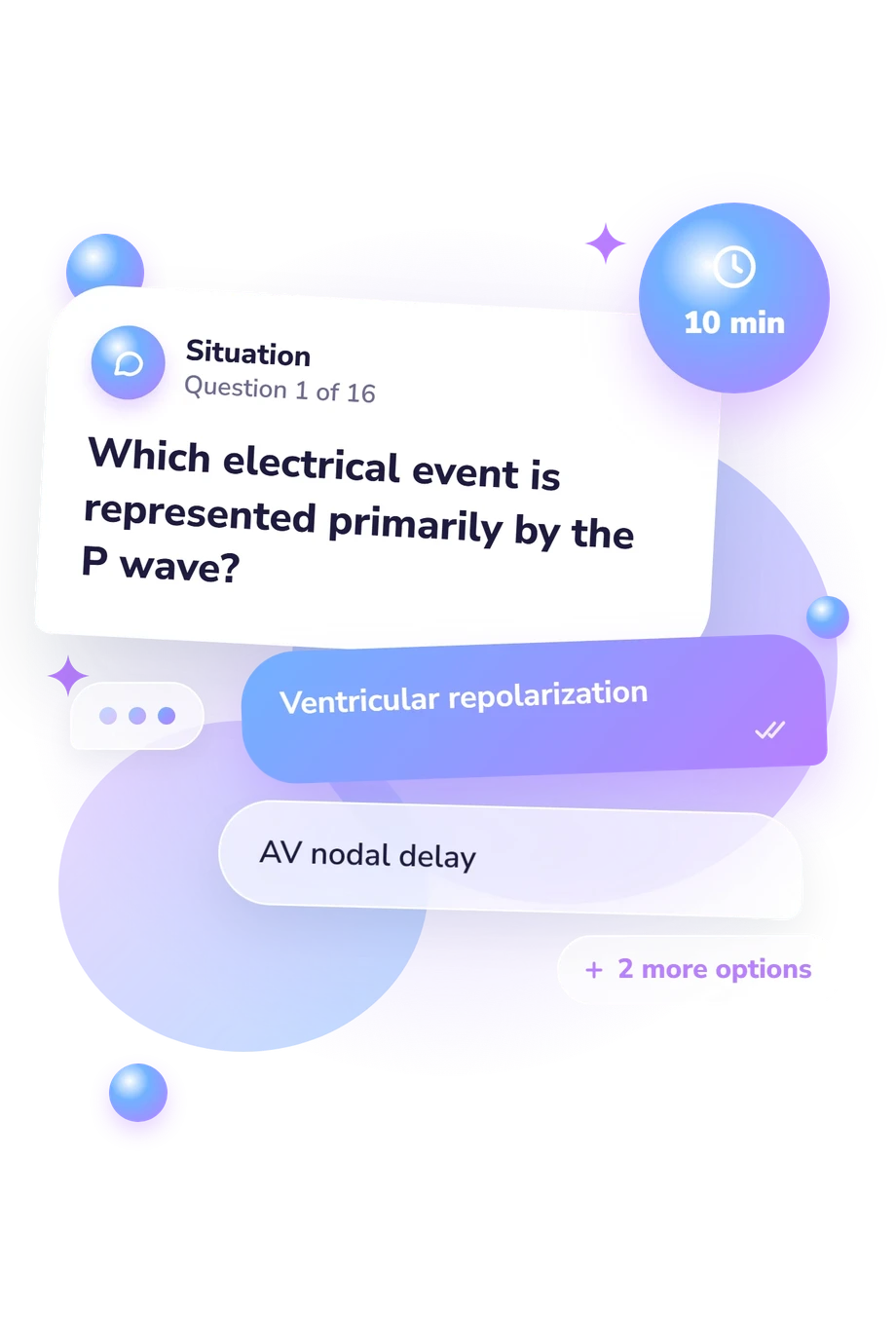
- Ventricular repolarization
- AV nodal delay
- Atrial depolarization
- Ventricular depolarization
- Atrial depolarization
- Ventricular repolarization
- Conduction through the AV node only
- Ventricular depolarization
- Slower SA node firing and slower AV nodal conduction
- Faster SA node firing and faster AV nodal conduction
- Faster SA node firing but complete interruption of AV conduction
- No effect on pacemaker activity, but slower Purkinje conduction
ECG Anatomy and Physiology Quiz - Description and methodology of the test
Students, trainees, and curious readers who want to connect ECG tracings with cardiac physiology can use the ecg anatomy and physiology quiz as a focused knowledge check. This quiz supports ECG interpretation practice beyond memorising labels by asking what each waveform represents and how electrical activity coordinates contraction. The result indicates overall performance and highlights areas suggested for review before practical study or coursework.
What This Assessment Explores
Normal cardiac electrophysiology is the focus: atrial and ventricular depolarization, ventricular repolarization, pacemaker tissue, the AV node and His-Purkinje pathway, conduction delays, and refractory periods. Several items apply these concepts to altered conduction or autonomic stimulation, linking ECG anatomy with electrical and mechanical events.
Questions connect electrocardiography anatomy and the ecg quiz with recorded electrical signals, bringing cardiac structures and physiology into one practical framework. It suits people reviewing basic ECG interpretation, cardiac anatomy, or physiology. A stronger result suggests integrated understanding, while a lower band identifies concepts to revisit. The knowledge groups are:
- Waveform recognition shows what P, QRS, and T waves represent electrically.
- Conduction reasoning shows whether impulses can be traced through the cardiac pathway.
- Interval interpretation connects PR and ST features with timing.
- Physiology links electrical activity with contraction, refractoriness, autonomic effects, and lead direction.
Methodology and Scientific Basis
Each item presents a concept question or brief physiology scenario with four answer choices. The respondent selects the option fitting normal cardiac activation, conduction, waveform generation, or timing. The result reflects total correct answers and the displayed bands, giving learners a starting point for targeted revision.
The ECG Anatomy and Physiology Knowledge scale runs from 0-16 correct. Foundations to review covers 0-6, Developing knowledge 7-12, and Strong knowledge 13-16. The bands are descriptive levels showing whether to revisit fundamentals, connect patterns with physiology, or extend integrated understanding.
Stroobandt and colleagues (2016) describe ECG waves, intervals, leads, and interpretation. The questionnaire is conceptually consistent with those concepts, but is not adapted from the book. Boyett (2009) supports the conduction-system sequence; Hurst (1998) relates wave names to electrical origins; and Einthoven (1903) represents the historical basis of galvanometric recording.
Because guessing, current preparation, and uneven familiarity with terminology can affect results, the score reflects performance on the tested items. A lower band can guide review of ECG physiology questions on conduction, waveforms, and timing.
- Roland X. Stroobandt, S. Serge Barold, and Alfons F. Sinnaeve. ECG from Basics to Essentials: Step by Step. 1st ed. John Wiley & Sons, 2016. 10.1002/9781119066446
- Mark R. Boyett. 'And the beat goes on' The cardiac conduction system: the wiring system of the heart. Experimental Physiology 94, no. 10 (2009): 1035-1049. 10.1113/expphysiol.2009.046920
- J. Willis Hurst. Naming of the waves in the ECG, with a brief account of their genesis. Circulation 98, no. 18 (1998): 1937-1942. 10.1161/01.cir.98.18.1937
- Willem Einthoven. The galvanometric registration of the human electrocardiogram, together with an assessment of the use of the capillary electrometer in physiology. Pflügers Archiv für die gesamte Physiologie des Menschen und der Tiere 99, nos. 9-10 (1903): 472-480. 10.1007/BF01811855
Updated: