
Does She Like Me Quiz for Guys
How the Scales are Structured
Who Usually Takes This Test?
See How You Compare
Below is a preview of how scores are typically distributed across each scale.
Example Questions From the Test
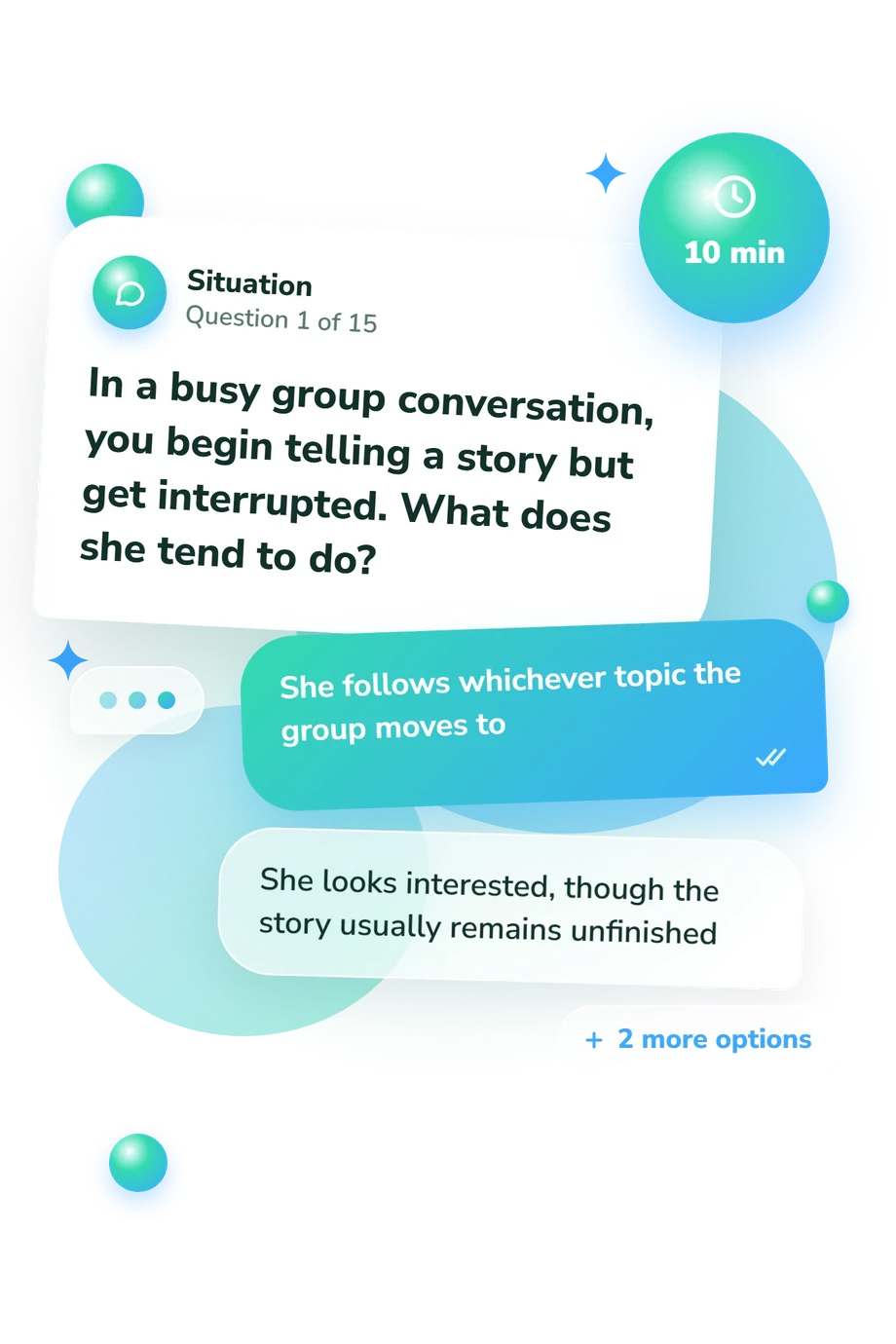
- She follows whichever topic the group moves to
- She looks interested, though the story usually remains unfinished
- She occasionally asks me to finish when there is an opening
- She reliably returns attention to me and asks how the story ended
- I usually begin the next conversation too
- She occasionally sends a brief reaction or follow-up
- She sometimes returns later with a new question or topic
- She often revives the conversation or starts another one herself
- She stays mainly with her existing group unless I approach
- She greets me warmly, then returns to mingling
- She joins conversations I am in or checks in more than once
- She actively seeks me out and creates time for a longer exchange
Does She Like Me Quiz for Guys - Description and methodology of the test
People who are unsure how to read a developing connection can use the Does She Like Me Quiz for Guys to compare recurring interactions instead of relying on one memorable moment. It is especially useful when you want to compare patterns of attention, initiative, and romantic signals across recent encounters while keeping context, consistency, and her own stated boundaries in view.
What This Assessment Explores
The questions focus on interaction patterns rather than inferring a hidden feeling. They ask whether she remembers details, follows up on personal news, creates opportunities for contact, responds to flirtation, frames the relationship, and behaves differently from ordinary friendliness. Together, these themes distinguish warmth from observable patterns that may relate to romantic interest, while no score can establish what she actually feels. The three result dimensions describe different parts of that pattern:
- Personal Engagement (0-15) reflects focused curiosity and sustained attention; Limited engagement (0-5), Growing engagement (6-10), and Sustained engagement (11-15) mark increasing personal investment.
- Reciprocal Initiative (0-15) reflects who helps create contact or shared time; Limited reciprocity (0-5), Some reciprocity (6-10), and Strong reciprocity (11-15) show increasing mutual effort.
- Romantic Signaling and Clarity (0-15) reflects recurring romantic cues beyond warmth; Friendship/Unclear (0-5), Ambiguous Possible (6-10), and Clearer Romantic (11-15) mark increasing clarity.
Methodology and Scientific Basis
Each item presents a situation with four ordered choices, moving from unclear evidence toward more consistent personal, mutual, or romantic behavior. The questionnaire does not specify how responses become points or how dimension totals are calculated, so the ranges describe its reporting framework rather than a weighting system; no single response should dominate interpretation.
Conceptually, the structure is consistent with Muehlenhard and colleagues’ research on verbal and nonverbal dating-interest cues. Place and colleagues’ work is relevant because judging another person’s attraction is a distinct interpersonal task, while Jolink and Algoe link early social behavior with later relationship development. These studies provide context; this questionnaire is not their adaptation or validated replication. No standardization, validation data, or normative sample are stated for this questionnaire.
In practice, this assessment organizes uncertainty around consistency, reciprocity, personal attention, and romantic framing. It helps compare details, follow-up, contact initiation, one-to-one time, and explicit framing across interactions. Self-report can be influenced by selective memory, wishful thinking, anxiety, and current context, so direct, pressure-free communication remains more informative than any score.
- Muehlenhard, Charlene L., Mary A. Koralewski, Sandra L. Andrews, and Cynthia A. Burdick. "Verbal and nonverbal cues that convey interest in dating: Two studies." Behavior Therapy, 17(4), 404-419, 1986. 10.1016/S0005-7894(86)80071-5
- Place, Skyler S., Peter M. Todd, Lars Penke, and Jens B. Asendorpf. "The Ability to Judge the Romantic Interest of Others." Psychological Science, 20(1), 22-26, 2009. 10.1111/j.1467-9280.2008.02248.x
- Jolink, Tatum A., and Sara B. Algoe. "What Happens in Initial Interactions Forecasts Relationship Development: Showcasing the Role of Social Behavior." Social Psychological and Personality Science, 15(2), 142-156, 2024. 10.1177/19485506231153438
Updated: