
Does He Like Me or Just Want Sex Quiz
How the Scales are Structured
Who Usually Takes This Test?
See How You Compare
Below is a preview of how scores are typically distributed across each scale.
Example Questions From the Test
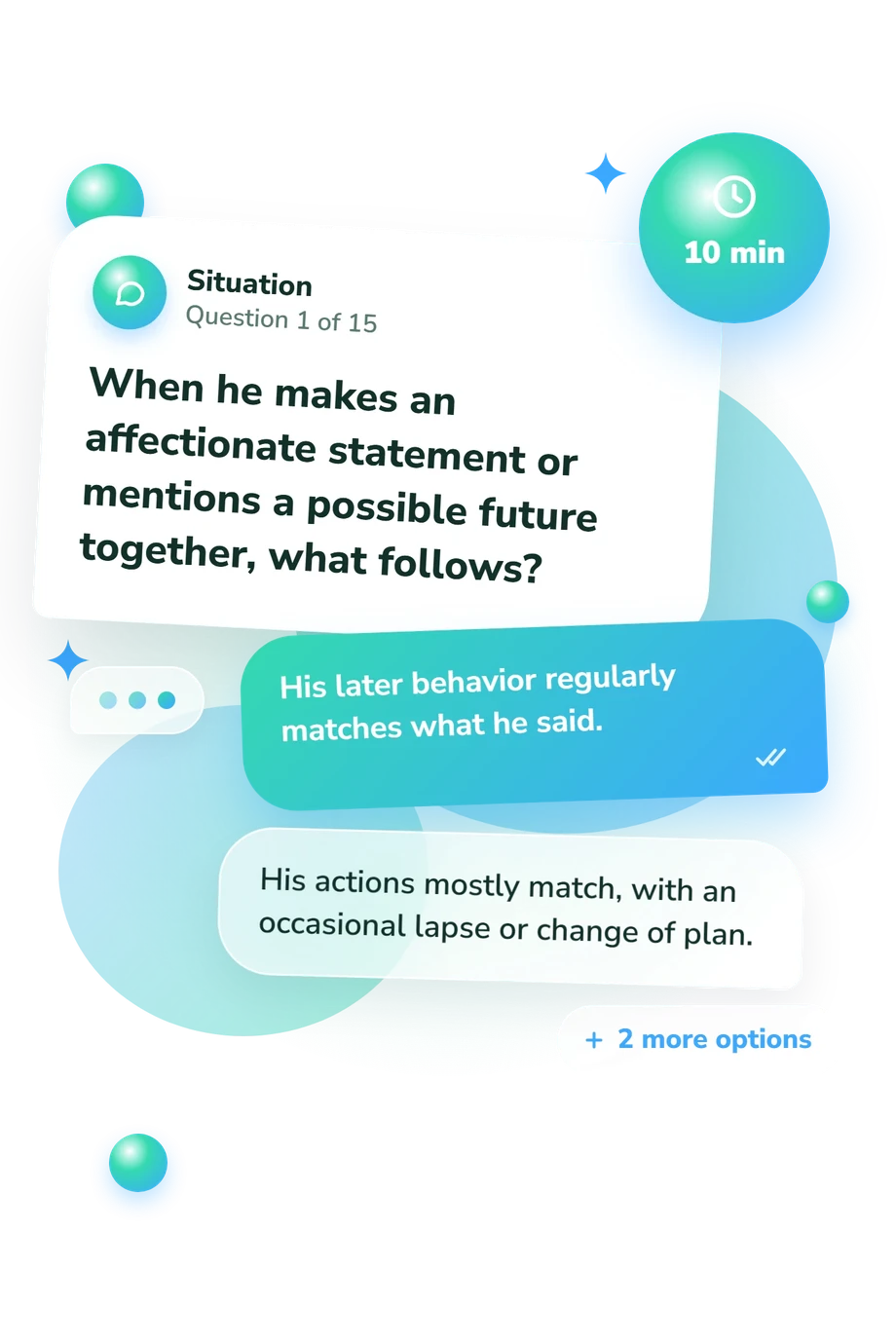
- His later behavior regularly matches what he said.
- His actions mostly match, with an occasional lapse or change of plan.
- He often delays, minimizes, or behaves differently from what he suggested.
- He cycles between intense promises and noticeable withdrawal.
- It is fairly steady, even when he is busy.
- It varies for understandable reasons that he usually communicates.
- He shifts unpredictably between highly responsive and difficult to reach.
- He repeatedly disappears and reappears with little explanation, often acting as though nothing changed.
- It stays steady or becomes more emotionally connected.
- It dips briefly but returns to its usual rhythm without me chasing it.
- It noticeably drops until he wants another meetup.
- He repeatedly disappears and returns with a sexual message or invitation.
Does He Like Me or Just Want Sex Quiz - Description and methodology of the test
People who feel unsure about a partner’s intentions can use this assessment to compare attention, follow-through, everyday involvement, and the role of sexual availability across repeated interactions. The Does He Like Me or Just Want Sex Quiz is intended for readers who want a clearer profile of observable behavior. It helps readers use the does he want sex or a relationship quiz question to weigh behavior without treating one pattern as proof of his inner motives.
What This Assessment Explores
The questions focus on observable situations that make intentions difficult to read: follow-through after affectionate claims, communication after intimacy, inclusion in ordinary life, his responses to your sexual boundaries, and effort when sex is unavailable. For readers using the does he only want me sexually quiz, the relevant question is whether sexual access disproportionately shapes his attention and effort, rather than whether attraction is present.
The displayed result dimensions are:
- Genuine Relationship Interest (0-15) reflects curiosity, reliability, and everyday investment: Limited evidence 0-5, Emerging evidence 6-10, and Consistent evidence 11-15.
- Mixed or Unclear Intentions (0-15) shows how coherent the connection appears: Mostly Coherent Signals 0-5, Meaningful Ambiguity 6-10, and Strong Ambiguity 11-15.
- Primarily Sexual Interest (0-15) indicates whether attention and effort center on sexual opportunities: Limited sexual priority 0-5, Noticeable sexual priority 6-10, and Strong sexual priority 11-15.
Methodology and Scientific Basis
Each item describes a situation and offers four ordered response choices, from steady investment and respect to inconsistency, withdrawal, or pressure. Prompts cover future talk, availability, post-intimacy contact, everyday plans, boundaries, public acknowledgment, memory, and contact timing. The respondent selects the option that best fits the connection.
The three result dimensions are reported separately. The profile also answers the does he want me sexually quiz question by showing patterns elsewhere. Higher results indicate more of the named tendency, not certainty about feelings or motives; the bands organize recurring behavior. The questionnaire has no standardized scoring or norms.
The structure is conceptually consistent with the Relational Ambiguity Scale (James-Kangal, 2020), Camilleri, Quinsey, and Tapscott’s 2009 research on sexual coaxing and coercion, and the Investment Model Scale (Rusbult, Martz, and Agnew, 1998). This questionnaire is not a direct adaptation of those instruments.
Self-report may reflect current emotions, selective memory, or limited knowledge of the other person. Sexual desire is not wrongdoing, but an ignored refusal, threat, or coercive pressure matters independently of the score and warrants support, with emergency help if danger is immediate.
- James-Kangal, Neslihan. "Development and Initial Validation of the Relational Ambiguity Scale." Doctoral dissertation, University of Cincinnati, 2020.
- Camilleri, Joseph A., Vernon L. Quinsey, and Jennifer L. Tapscott. "Assessing the Propensity for Sexual Coaxing and Coercion in Relationships: Factor Structure, Reliability, and Validity of the Tactics to Obtain Sex Scale." Archives of Sexual Behavior 38, no. 6 (2009): 959-973. 10.1007/s10508-008-9377-2
- Rusbult, Caryl E., John M. Martz, and Christopher R. Agnew. "The Investment Model Scale: Measuring Commitment Level, Satisfaction Level, Quality of Alternatives, and Investment Size." Personal Relationships 5, no. 4 (1998): 357-387. 10.1111/j.1475-6811.1998.tb00177.x
Updated: