
David and Goliath Quiz
How the Scales are Structured
Who Usually Takes This Test?
See How You Compare
Below is a preview of how scores are typically distributed across each scale.
Example Questions From the Test
- David was a shepherd, while Goliath was a king
- David fought on foot, while Goliath always fought from a chariot
- David was young, while Goliath had been a warrior from his youth
- David came from Judah, while Goliath commanded several nations
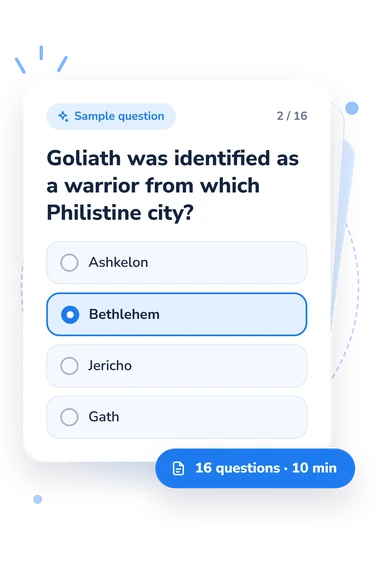
- Ashkelon
- Bethlehem
- Jericho
- Gath
- A bow
- A sling
- A spear
- A javelin
David and Goliath Quiz - Description and methodology of the test
Readers who want to revisit 1 Samuel 17 can use this assessment to check recall of its people, setting, turning points, and central contrast. The David and Goliath Quiz suits independent learners, families, and educators who want a focused knowledge snapshot rather than a personality profile. Families and educators can use this questionnaire with children as a quiz for kids about David and Goliath, prompting discussion after reading the passage.
What This Assessment Measures
The questions examine recall of the encounter between David and Goliath and ask the reader to connect individual details with the story’s larger meaning. This David and Goliath Bible quiz turns recalled details and the story’s meaning into one overall indication of knowledge for readers revisiting the passage alone or with a group.
The result brings these areas together:
- David and Goliath Knowledge (0-16) reports overall command of the account: Foundational (0-6) indicates recognition of parts of the story; Developing (7-12) indicates knowledge of the main narrative and several details; Strong (13-16) indicates detailed understanding of sequence, contrasts, and central message.
- Character and setting recall shows whether people, places, and opposing armies are identified accurately.
- Event sequence recall shows whether major actions are remembered in narrative order.
- Thematic understanding shows whether the story’s emphasis on trust in God rather than conventional military power is recognized.
Methodology and Evidence Base
Each item uses a direct question with four answer choices. Some prompts test who, where, what, or sequence; others ask the reader to recognize the meaning of a speech, action, or repeated contrast. The questionnaire combines literal recall with limited interpretation and produces one overall result, not separate subscores. The questionnaire does not state how individual answers contribute to the total, so no item-by-item formula should be inferred.
Auld and Ho (1992) is conceptually consistent with the questionnaire’s attention to narrative structure and character contrasts. The biblical reference point is 1 Samuel 17 in the 2021 updated NRSV text, while Johnson (2013) discusses David’s victory and the weapons motif. This online questionnaire is not an adaptation of those publications; its items focus on recall and limited interpretation of the passage.
The questionnaire has no stated normative sample, reliability estimate, or standardization procedure, so the result works best as a structured knowledge check. This David and Goliath trivia quiz may support review or discussion, but performance can reflect recent reading, translation familiarity, attention, guessing, and self-confidence. The score is an educational self-check, not a diagnostic measure.
- A. Graeme Auld and Craig Y. S. Ho, “The Making of David and Goliath,” Journal for the Study of the Old Testament, vol. 17, no. 56, 1992, pp. 19-39. 10.1177/030908929201705602
- New Revised Standard Version Updated Edition, 1 Samuel 17. National Council of the Churches of Christ in the United States of America, 2021.
- Benjamin J. M. Johnson, “Did David Bring a Gun to a Knife Fight? Literary and Historical Considerations in Interpreting David’s Victory over Goliath,” The Expository Times, vol. 124, no. 11, 2013, pp. 530-537. 10.1177/0014524613485519
Updated: